
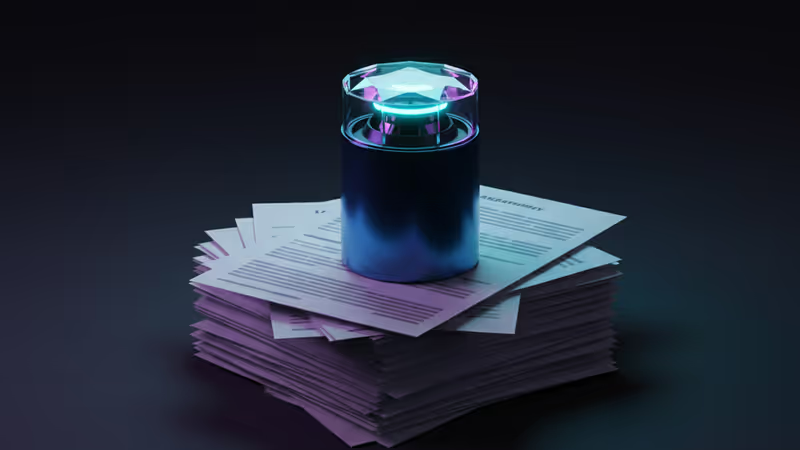
From $11B to $22M: The Tragic Fall and Luminar Lidar Business Sale
Luminar is selling its lidar business to Quantum Computing Inc for $22 million amid bankruptcy. Learn why the former $11B company collapsed and the details of the stalking horse bid.
It's a staggering fall for a tech darling. Luminar, the lidar pioneer once valued at $11 billion, has reached a deal to sell its core lidar business for a mere $22 million. The buyer, Quantum Computing Inc (QCI), steps in as the company struggles through Chapter 11 bankruptcy.
The Details of the Luminar Lidar Business Sale
Under the terms of the agreement, Quantum Computing Inc serves as a "stalking horse bidder," setting the floor price at $22 million. Competitive offers are still possible until 5:00 p.m. CT today. This follows a separate $110 million deal for Luminar's semiconductor subsidiary, also with QCI.
The situation is further complicated by Austin Russell, Luminar's founder and former CEO. While Russell has expressed interest in bidding for the assets, the company is currently seeking to subpoena his personal data as part of an ongoing ethics inquiry. The outcome of this legal friction could determine if a rival bid emerges before the deadline.

Why the Lidar Dream Collapsed
Luminar's downfall wasn't overnight. The company's massive $11 billion valuation in 2021 was built on the promise of mass adoption by giants like Volvo. However, Volvo walked away from a 1 million unit order in 2025, dealing a fatal blow to Luminar's revenue projections. Similar deals with Mercedes-Benz and Polestar also disintegrated.
| Entity | Deal Value | Status |
|---|---|---|
| Lidar Business | $22 Million | Stalking Horse Bid |
| Semiconductor Sub | $110 Million | Announced |
| Peak Market Cap (2021) | $11 Billion | Historical |
Authors
Related Articles
Waymo's new Ojai robotaxi isn't just a vehicle upgrade. It's the company's most serious attempt yet at cracking the cost problem that has kept autonomous vehicles from scaling. Here's what's really at stake.
Tesla expanded its driverless robotaxi to Dallas and Houston, even after reporting 14 crashes in Austin. What does this tell us about how autonomous vehicles actually get built?
A U.S. Senate investigation found that seven autonomous vehicle companies — including Waymo and Tesla — refused to disclose how often remote operators intervene in their vehicles. Here's why that silence matters.
Uber and WeRide have launched fully driverless robotaxi service in Dubai — no safety operator, real fares. Here's what it means for the global AV race and your next ride.
Waymo's new Ojai robotaxi isn't just a vehicle upgrade. It's the company's most serious attempt yet at cracking the cost problem that has kept autonomous vehicles from scaling. Here's what's really at stake.
Tesla expanded its driverless robotaxi to Dallas and Houston, even after reporting 14 crashes in Austin. What does this tell us about how autonomous vehicles actually get built?
A U.S. Senate investigation found that seven autonomous vehicle companies — including Waymo and Tesla — refused to disclose how often remote operators intervene in their vehicles. Here's why that silence matters.
Uber and WeRide have launched fully driverless robotaxi service in Dubai — no safety operator, real fares. Here's what it means for the global AV race and your next ride.
Thoughts
Share your thoughts on this article
Sign in to join the conversation