
CES 2026 Physical AI Trends: The $123 Billion Shift in Automotive Intelligence
Explore how Physical AI is transforming the automotive industry at CES 2026. Discover why Nvidia and ARM are targeting a $123 billion market with new autonomous chips.
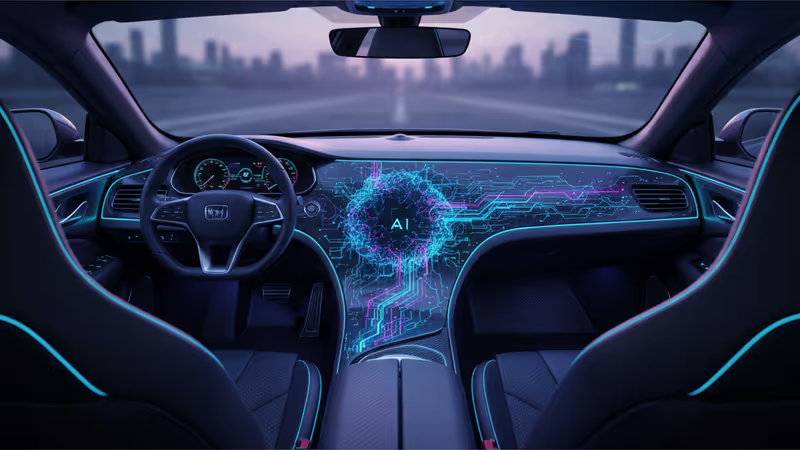
AI is finally getting a body. At CES 2026, the term Physical AI emerged as more than just a buzzword—it's the blueprint for a $123 billion opportunity. As tech developers push for autonomous systems that can reason and act in the real world, the automotive industry is transforming into a high-stakes arena for chipmakers and software pioneers.
How Physical AI is Redefining the Automotive Industry at CES 2026
Physical AI allows autonomous systems—like cameras, robots, and self-driving cars—to perceive and perform complex actions in the real world. This isn't just about code anymore; it's about hardware interacting with the physical environment. Whether it's humanoid robots on a Hyundai factory floor or a car navigating through chaotic traffic, the integration of Google DeepMind and Boston Dynamics tech shows the gap between robotics and mobility is closing fast.
The $123 Billion Chip War: Why Nvidia and ARM are Betting Big

Chipmakers are the ones making the loudest noise. Nvidia recently announced a new line of open-source AI models, while ARM debuted its dedicated Physical AI division. The stakes are massive: the automotive chip market is expected to grow 85% from its 2023 levels, reaching $123 billion by 2032. Jensen Huang, Nvidia's CEO, stated that self-driving tech is already a giant business for them.
| Company | Target Year | Key Feature |
|---|---|---|
| Ford | 2028 | Eyes-off driving system |
| Mercedes-Benz | 2026 | Hands-off system debut in US |
| Geely | TBD | High-level autonomous driving via Nvidia |
Consultancy AlixPartners notes that the vehicle's "central brain" will soon be hundreds of times larger than current systems. This leap in computing power is what's driving the massive investments we're seeing from traditional automakers like Ford and the Sony-Honda collaboration, Afeela.
Authors
Related Articles

Nvidia shipped roughly a billion RISC-V cores in 2024, then announced it would run CUDA on the open standard. We break down how royalty-free instruction sets and open software stacks are trying to route around CUDA's lock-in. Part 2 of the Semiconductor Sovereignty series.

US AI-chip export controls split into three layers in the first half of 2026 — January easing, a May crackdown on circumvention, and a pending bill. Nvidia erased China from its guidance and still posted a record $81.6 billion quarter. A look at the export policy that both shields and cages it.

AMD's MI325X matches or beats Nvidia on memory and bandwidth — yet Nvidia's 86-92% share holds. The real moat is CUDA, 20 years in the making. Part 1 of 4.
Waymo's new Ojai robotaxi isn't just a vehicle upgrade. It's the company's most serious attempt yet at cracking the cost problem that has kept autonomous vehicles from scaling. Here's what's really at stake.
Nvidia shipped roughly a billion RISC-V cores in 2024, then announced it would run CUDA on the open standard. We break down how royalty-free instruction sets and open software stacks are trying to route around CUDA's lock-in. Part 2 of the Semiconductor Sovereignty series.
US AI-chip export controls split into three layers in the first half of 2026 — January easing, a May crackdown on circumvention, and a pending bill. Nvidia erased China from its guidance and still posted a record $81.6 billion quarter. A look at the export policy that both shields and cages it.
AMD's MI325X matches or beats Nvidia on memory and bandwidth — yet Nvidia's 86-92% share holds. The real moat is CUDA, 20 years in the making. Part 1 of 4.
Waymo's new Ojai robotaxi isn't just a vehicle upgrade. It's the company's most serious attempt yet at cracking the cost problem that has kept autonomous vehicles from scaling. Here's what's really at stake.
Thoughts
Share your thoughts on this article
Sign in to join the conversation