

The Earth's Hidden Symphony We Never Heard
Artist Brian House transforms 24 hours of Earth's inaudible infrasound into a 24-minute ambient album, revealing the planet's constant acoustic chatter from volcanoes to storms.
The Planet Never Stops Talking
Right now, as you read this, the Earth is screaming. Glaciers boom as they calve into the ocean. Wildfires crackle across continents. Storm fronts roar with invisible fury. But the loudest sounds of all? We can't hear them.
These are infrasounds—acoustic waves below 20 hertz that travel around the globe like whispered secrets. A volcanic eruption in Hawaii sends its low-frequency signature to Alaska. Ocean currents shifting in the Pacific register on sensors in the Atlantic. Yet human ears remain deaf to this planetary chatter.
Until musician and artist Brian House decided to eavesdrop.
Listening to What We've Been Missing
From the quiet woods of western Massachusetts, House built an acoustic surveillance system that would make any intelligence agency jealous. Three "macrophones"—essentially oversized tubes—funnel air pressure changes into barometers taking 100 readings per second. The result: 24 hours of Earth's infrasonic conversation compressed into a 24-minute ambient album.
"I'm really interested in the layers of perception that we can't access," House explains. "It's not only low sound, but it's also distant sound. That kind of blew my mind."
The process is elegantly simple: speed up the recording by 60 times and suddenly the planet's bass line becomes audible. What emerges is otherworldly—a chorus alternating between low grumbling vibrations and ghostlike whispers.

When Art Meets Seismic Science
This isn't just artistic experimentation. Scientists have been tracking infrasound since 1883, when barometers in London detected the Krakatoa eruption from thousands of miles away. Today, a global network of infrasound sensors helps enforce nuclear test ban treaties.
Leif Karlstrom, a volcanologist at the University of Oregon who studies Mount Kilauea using infrasound, helped House understand his acoustic harvest. "He's highlighting interesting phenomena," Karlstrom notes, even though pinpointing specific sources remains impossible. That high-pitched whistle? Could be a train. The intense low-octave rattle? Maybe a distant thunderstorm or shifting ocean current.
The Mystery Is the Point
House embraces this ambiguity. "For me, it's about the mystery of it," he says. "I hope that's a little bit unsettling." The album doesn't offer easy answers about what's making each sound—and that's intentional.
In an age of information overload, there's something profound about confronting the limits of human perception. We live surrounded by phenomena we can't directly sense: electromagnetic fields, gravitational waves, and yes, the Earth's constant acoustic chatter.
Beyond the Art Gallery
While House's work is artistic, its implications extend further. Environmental monitoring increasingly relies on acoustic signatures to track climate change, wildlife populations, and natural disasters. Infrasound sensors can detect approaching storms, avalanches, and even meteor impacts hours before they become visible.
The challenge isn't technical—it's perceptual. How do we make invisible environmental changes tangible to human consciousness? House's approach suggests one answer: translate data into experience.
Authors
Related Articles

Samsung Electronics' union branch revealed that 84% of survey respondents oppose the government's roughly $290 billion (₩400 trillion) semiconductor megaproject in Gwangju. Government, management, the union and shareholders are all reading the same national project in sharply different ways.

Nvidia shipped roughly a billion RISC-V cores in 2024, then announced it would run CUDA on the open standard. We break down how royalty-free instruction sets and open software stacks are trying to route around CUDA's lock-in. Part 2 of the Semiconductor Sovereignty series.
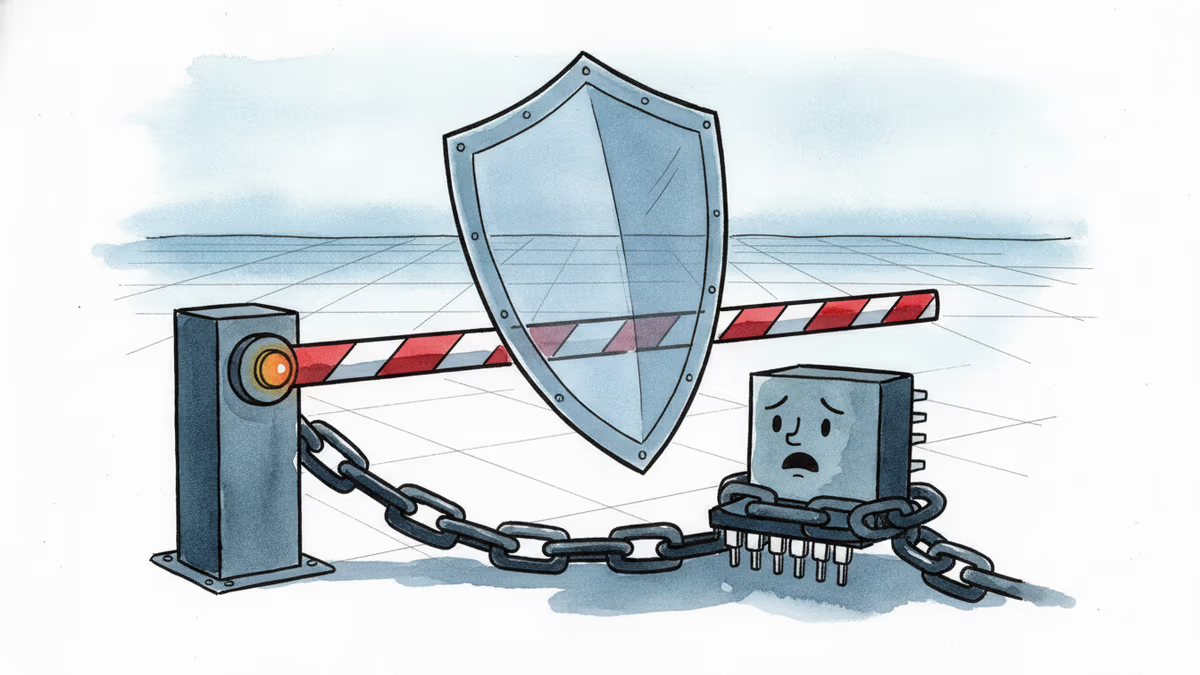
US AI-chip export controls split into three layers in the first half of 2026 — January easing, a May crackdown on circumvention, and a pending bill. Nvidia erased China from its guidance and still posted a record $81.6 billion quarter. A look at the export policy that both shields and cages it.
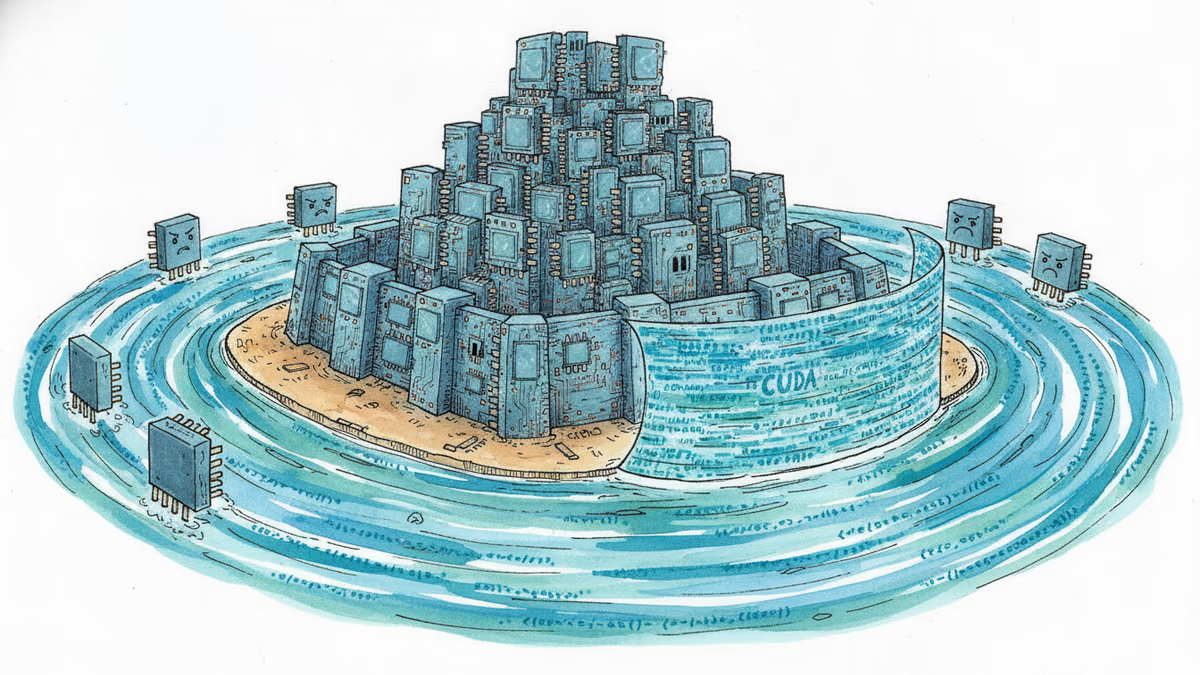
AMD's MI325X matches or beats Nvidia on memory and bandwidth — yet Nvidia's 86-92% share holds. The real moat is CUDA, 20 years in the making. Part 1 of 4.
Samsung Electronics' union branch revealed that 84% of survey respondents oppose the government's roughly $290 billion (₩400 trillion) semiconductor megaproject in Gwangju. Government, management, the union and shareholders are all reading the same national project in sharply different ways.
Nvidia shipped roughly a billion RISC-V cores in 2024, then announced it would run CUDA on the open standard. We break down how royalty-free instruction sets and open software stacks are trying to route around CUDA's lock-in. Part 2 of the Semiconductor Sovereignty series.
US AI-chip export controls split into three layers in the first half of 2026 — January easing, a May crackdown on circumvention, and a pending bill. Nvidia erased China from its guidance and still posted a record $81.6 billion quarter. A look at the export policy that both shields and cages it.
AMD's MI325X matches or beats Nvidia on memory and bandwidth — yet Nvidia's 86-92% share holds. The real moat is CUDA, 20 years in the making. Part 1 of 4.
Thoughts
Share your thoughts on this article
Sign in to join the conversation