
Two Root-Level Linux Exploits in Two Weeks — and the Second One Is Already in the Wild
Dirty Frag gives low-privilege users root access on virtually every Linux distro. The exploit code leaked three days ago. Microsoft says attackers are already experimenting with it.
The Code Dropped Three Days Ago. Attackers Are Already Using It.
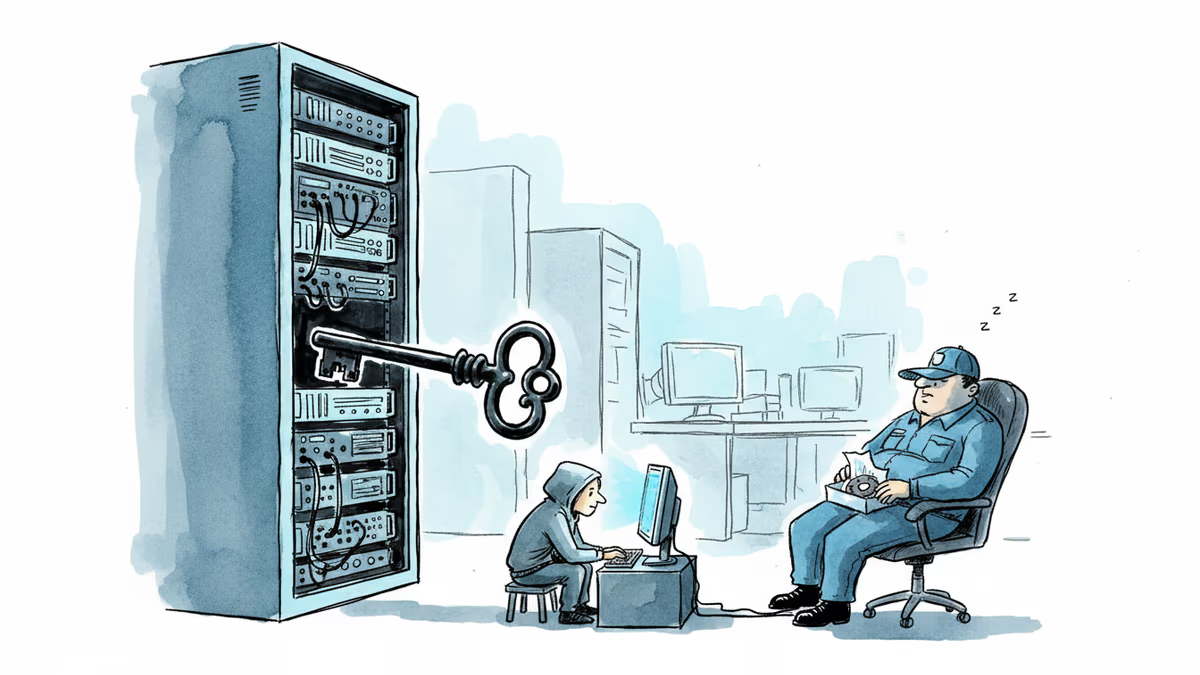
Somewhere on the internet three days ago, someone posted a block of code. It takes a low-privilege user on a Linux server — a container tenant, a shared hosting account, a virtual machine guest — and hands them the keys to the entire machine. It works on virtually every Linux distribution. It runs the same way every single time. It doesn't crash anything. And Microsoft says it has already spotted hackers experimenting with it in the wild.
The vulnerability is called Dirty Frag. It is the second critical Linux root-privilege escalation exploit to emerge in two weeks.
What Makes This One Different
Not all vulnerabilities are created equal. Security teams triage dozens of CVEs a week, most of which require highly specific conditions or leave obvious traces. Dirty Frag clears the bar for genuine alarm in three ways.
First, it's deterministic. The exploit doesn't rely on timing, memory layout guesswork, or environmental quirks. It produces the same result every time it runs, across distributions. That's rare — and it's what separates a theoretical proof-of-concept from a reliable weapon.
Second, it's silent. Most privilege escalation attacks leave fingerprints: crashed processes, anomalous log entries, unusual CPU spikes. Dirty Frag causes no crashes. A sysadmin watching standard monitoring dashboards may see nothing unusual while an attacker quietly acquires root.
Third, it's structurally suited to shared environments. Cloud servers, university computing clusters, managed hosting platforms — anywhere multiple parties share a single machine — are the ideal hunting ground. A malicious container tenant can pivot to root and reach data belonging to every other tenant on that host. In cloud security terms, this is a tenant isolation failure scenario, and it's among the most serious categories of cloud risk.

The Week Before: Copy Fail
Context matters here. Last week, a separate vulnerability called Copy Fail was disclosed. Same profile: Linux, root privilege escalation, deterministic exploit, stealthy execution. Patches for Copy Fail have not yet reached end users.
Two vulnerabilities with near-identical characteristics surfacing in consecutive weeks is the kind of pattern that makes kernel security researchers uncomfortable. It raises a question that goes beyond individual CVEs: is there a structural weakness in a specific region of the Linux kernel's memory management code that researchers — or threat actors — have recently started probing systematically?
No one has confirmed that publicly yet. But the coincidence is notable enough that it's being discussed in security circles.
Who's Exposed
Linux runs the majority of the world's server infrastructure. AWS, Google Cloud, and Azure all run Linux at their core. The vulnerability doesn't discriminate by cloud provider or distribution. Any organization running Linux servers where untrusted or low-privilege users have any foothold — even inside a container — is potentially exposed.
The two attack scenarios that concern defenders most are: a malicious co-tenant in a shared cloud environment using Dirty Frag to access other customers' data; and an attacker who has already achieved limited access via a separate exploit using Dirty Frag to escalate to full system control. The second scenario is a textbook step in advanced persistent threat (APT) playbooks — gain a toehold through phishing or a web application flaw, then use a local privilege escalation vulnerability to own the machine entirely.
What Defenders Can Do Right Now
Official patches are in progress but not yet broadly available. Until they arrive, the realistic mitigation options are limited: tighten container isolation policies, enforce strict least-privilege principles, and increase kernel-level logging verbosity to catch anomalous behavior. Some distribution vendors are pushing interim mitigation patches, but these address symptoms rather than the root cause.
The uncomfortable reality is that for the next window of days or weeks, a significant portion of Linux infrastructure is running exposed.
This content is AI-generated based on source articles. While we strive for accuracy, errors may occur. We recommend verifying with the original source.
Related Articles
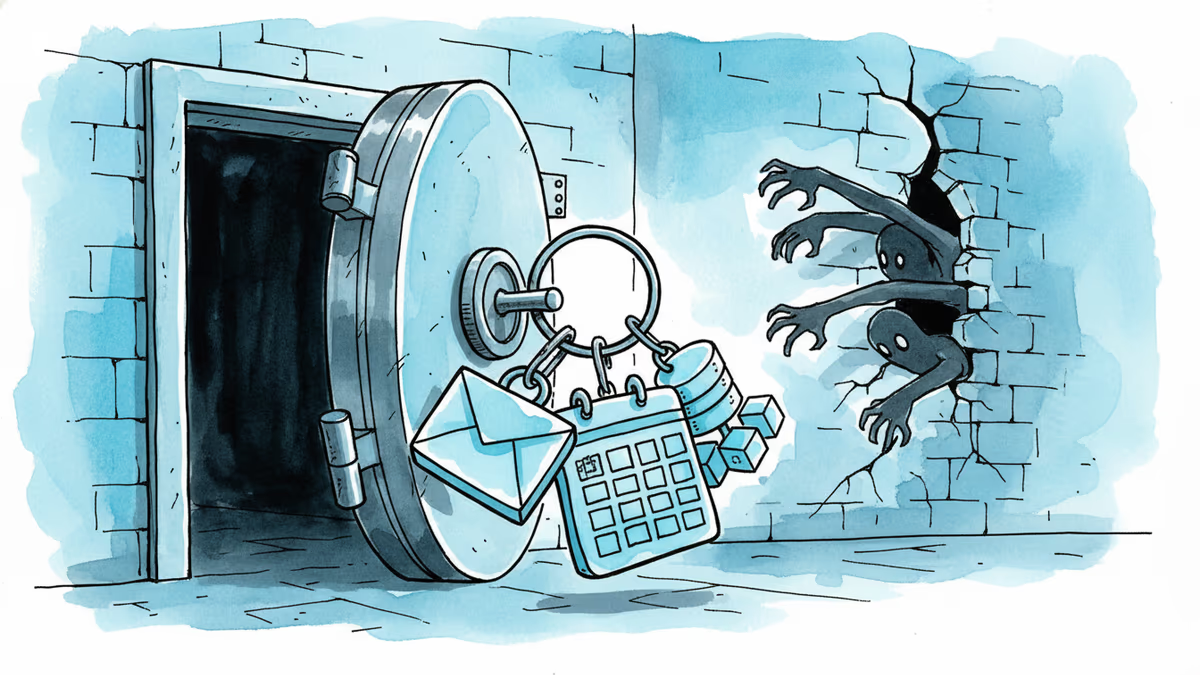
A critical vulnerability in Starlette—downloaded 325 million times per week—puts millions of AI agent servers at risk, exposing stored credentials for email, databases, and third-party services.

GitHub confirmed hackers stole data from 3,800 internal repositories via a poisoned VS Code extension. Here's why developer tools are now the most dangerous attack surface in tech.

A Utah woman was sentenced to life in prison partly because of her Google searches and deleted texts. The Kouri Richins case reveals how digital footprints have become the courtroom's most reliable witness.

OpenAI's new Daybreak initiative uses the Codex AI agent to find and patch security vulnerabilities before attackers do—putting it in direct competition with Anthropic's secretive Claude Mythos.
A critical vulnerability in Starlette—downloaded 325 million times per week—puts millions of AI agent servers at risk, exposing stored credentials for email, databases, and third-party services.
GitHub confirmed hackers stole data from 3,800 internal repositories via a poisoned VS Code extension. Here's why developer tools are now the most dangerous attack surface in tech.
A Utah woman was sentenced to life in prison partly because of her Google searches and deleted texts. The Kouri Richins case reveals how digital footprints have become the courtroom's most reliable witness.
OpenAI's new Daybreak initiative uses the Codex AI agent to find and patch security vulnerabilities before attackers do—putting it in direct competition with Anthropic's secretive Claude Mythos.
Thoughts
Share your thoughts on this article
Sign in to join the conversation