

Linux 6.19 Breathes New Life Into Decade-Old Graphics Cards
Linux 6.19 adds modern GPU driver support for AMD's 2012-era Radeon cards, challenging the throwaway tech culture while raising questions about sustainable computing.
Your 2012 Radeon HD 7850 just got a second wind. While most tech companies push you toward their latest silicon, Linus Torvalds dropped Linux 6.19 on Sunday with something different: modern driver support for graphics cards that are now 12 years old.
The kernel update brings AMD's contemporary AMDGPU driver to ancient GCN 1.0 and 1.1 architectures—cards that AMD itself abandoned years ago. Suddenly, those Radeon HD 7000 series GPUs gathering dust can run Vulkan graphics through the RADV driver, complete with improved power management that wasn't available when they first shipped.
The Throwaway Tech Paradox
This move cuts against Silicon Valley's fundamental business model. While Intel and AMD race to launch Wildcat Lake and Nova Lake processors (also supported in 6.19), Linux developers are extending the useful life of hardware that predates the iPhone 5.
The timing feels deliberate. As semiconductor shortages ease and GPU prices normalize, the open-source community is making a statement: your old hardware isn't obsolete just because the manufacturer says so.

For system administrators running legacy workstations, this changes the calculus entirely. Those HD 7970 cards that seemed destined for e-waste can now handle modern graphics workloads—not flagship gaming, but certainly enough for development work, digital signage, or secondary displays.
Beyond Graphics: The Bigger Picture
Linux 6.19 isn't just about old GPUs. The kernel adds PCIe link encryption and device authentication—security features that matter more in 2026's threat landscape than raw performance numbers. There's expanded HDR support through the new DRM Color Pipeline, plus an updated Asus Armoury driver for gaming hardware enthusiasts.
But the AMD graphics revival tells a different story about sustainable computing. While Apple designs chips that make three-year-old devices feel ancient, Linux developers are proving that software optimization can breathe life into hardware that's older than some college freshmen.
The enterprise implications aren't trivial either. Data centers running visualization workloads could extend their hardware refresh cycles, potentially saving millions on unnecessary upgrades while reducing electronic waste.
Authors
Related Articles

Huawei's CANN is open source under a license barring software for non-Ascend chips. Inside China's second CUDA, and the two links still outside it: pre-training compute and 5nm capacity.
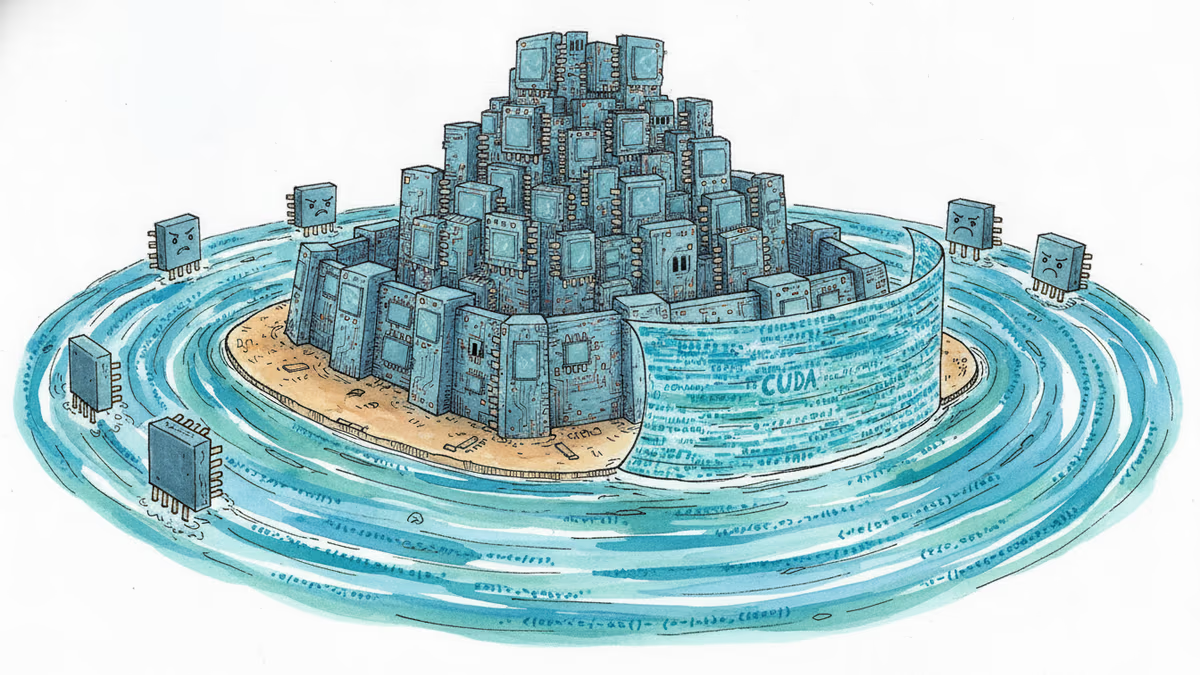
AMD's MI325X matches or beats Nvidia on memory and bandwidth — yet Nvidia's 86-92% share holds. The real moat is CUDA, 20 years in the making. Part 1 of 4.

Dirty Frag gives low-privilege users root access on virtually every Linux distro. The exploit code leaked three days ago. Microsoft says attackers are already experimenting with it.

Moonshot AI raised $2B at a $20B valuation. Its Kimi models rank second on OpenRouter. What China's open-weight AI surge means for the global LLM market.
Huawei's CANN is open source under a license barring software for non-Ascend chips. Inside China's second CUDA, and the two links still outside it: pre-training compute and 5nm capacity.
AMD's MI325X matches or beats Nvidia on memory and bandwidth — yet Nvidia's 86-92% share holds. The real moat is CUDA, 20 years in the making. Part 1 of 4.
Dirty Frag gives low-privilege users root access on virtually every Linux distro. The exploit code leaked three days ago. Microsoft says attackers are already experimenting with it.
Moonshot AI raised $2B at a $20B valuation. Its Kimi models rank second on OpenRouter. What China's open-weight AI surge means for the global LLM market.
Thoughts
Share your thoughts on this article
Sign in to join the conversation