
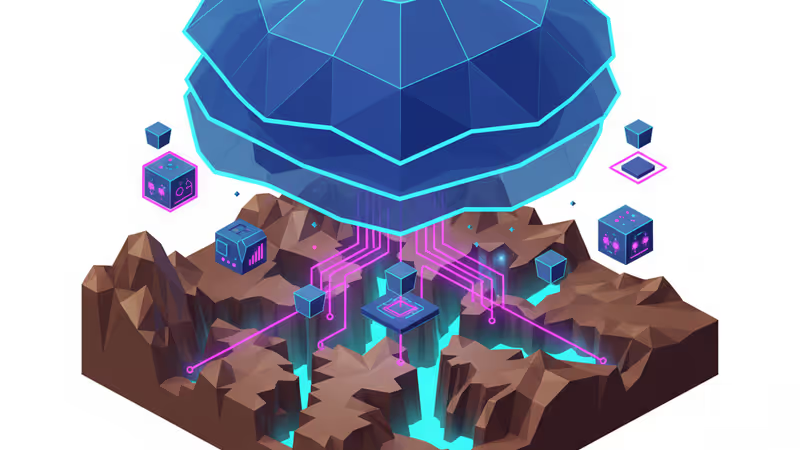
More Detailed Than Mars: The Antarctica Subglacial Map 2026 Breakthrough
The Antarctica subglacial map 2026 reveals unprecedented details of the continent's underbelly, including a 400km canyon, reshaping our climate change predictions.
It's a startling fact: we've had better maps of the surface of Mars than our own Antarctic bedrock. That's finally changing. Researchers from the University of Grenoble-Alpes, led by Dr. Helen Ockenden, have just unveiled the Antarctica subglacial map 2026 edition in the journal Science. It's like upgrading from a grainy pixelated film camera to a high-definition digital sensor.
Piercing Through 3 Miles of Ice with Physics
Traditional surveys relied on radar attached to planes, which left massive gaps of tens of kilometers between data tracks. To fill these voids, the team applied the physics of ice flow. They analyzed how ice—which can be up to 3 miles (4.8km) thick—warps and speeds up as it flows over hidden mountains, much like eddies in a river reveal rocks beneath the surface.
Maud Subglacial Basin: A Massive Hidden Channel

The most intriguing find in this Antarctica subglacial map 2026 is a gargantuan channel incised into the bed of the Maud Subglacial Basin. This subglacial canyon is 50m deep on average, 6km wide, and stretches for nearly 400km (250 miles). To put that in perspective, that's roughly the distance from London to Newcastle.
| Feature | Old Radar Maps | 2026 Mapping Model |
|---|---|---|
| Method | Direct Radar Tracks | Satellite + Physics Modeling |
| Detail | Grainy/Interpolated | High-Resolution Digital |
| Discoveries | Major Mountain Ranges | Tens of Thousands of Hills/Ridges |
This isn't just a win for geography. Understanding the roughness of the bedrock is crucial for climate modeling. Dr. Peter Fretwell from the British Antarctic Survey notes that these landforms shape how fast glaciers move and retreat. As the world warms, these hidden hills might be the only thing slowing down sea-level rise.
Authors
Related Articles
Scientists warn a strong El Niño could push Earth past the 1.5°C warming threshold within 12-18 months. What that means for weather, food, energy—and the politics of climate action.
Republican lawmakers are pushing bills to shield fossil fuel companies from climate lawsuits—while cities, states, and individuals are suing those same companies for billions. A breakdown of the legal battle reshaping corporate accountability.
Google claimed AI could cut global emissions by 5-10%, but the source? A consulting firm's 'client experience.' How solid are tech giants' green AI promises?
The Trump administration's attempt to overturn 17 years of climate science collapsed under the weight of evidence. What this means for policy and business.
Scientists warn a strong El Niño could push Earth past the 1.5°C warming threshold within 12-18 months. What that means for weather, food, energy—and the politics of climate action.
Republican lawmakers are pushing bills to shield fossil fuel companies from climate lawsuits—while cities, states, and individuals are suing those same companies for billions. A breakdown of the legal battle reshaping corporate accountability.
Google claimed AI could cut global emissions by 5-10%, but the source? A consulting firm's 'client experience.' How solid are tech giants' green AI promises?
The Trump administration's attempt to overturn 17 years of climate science collapsed under the weight of evidence. What this means for policy and business.
Thoughts
Share your thoughts on this article
Sign in to join the conversation