
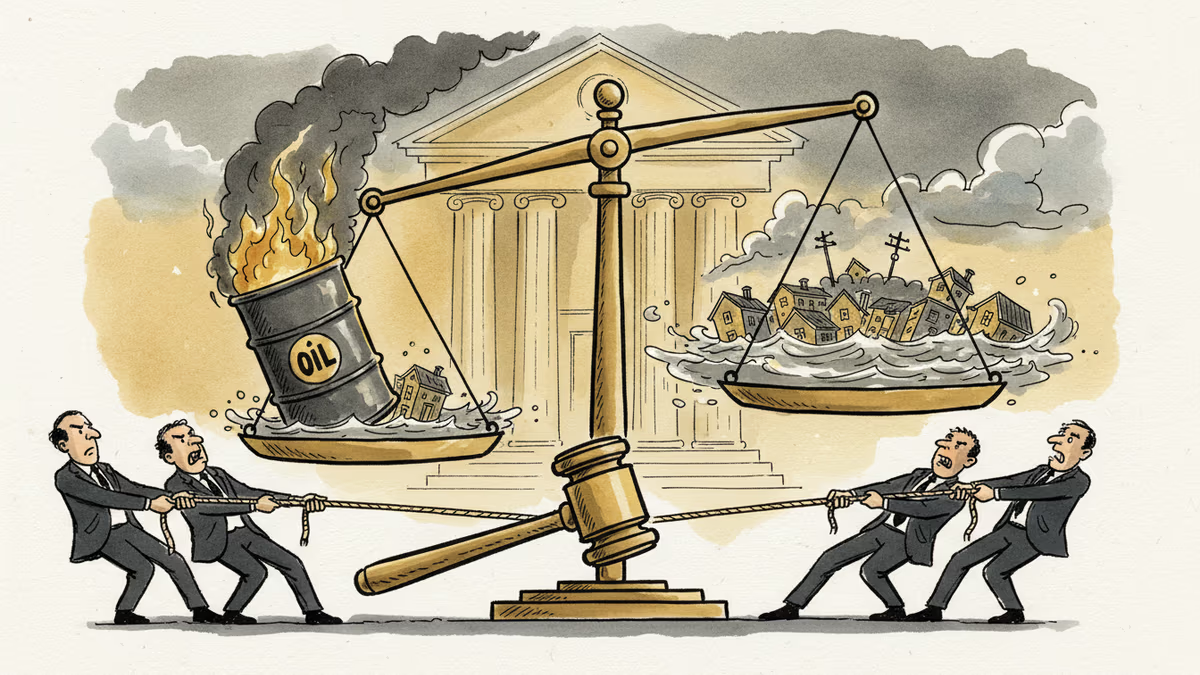
Who Pays for Climate Damage? The Legal War Heating Up
Republican lawmakers are pushing bills to shield fossil fuel companies from climate lawsuits—while cities, states, and individuals are suing those same companies for billions. A breakdown of the legal battle reshaping corporate accountability.
The Bill Is Due. The Fight Is Over Who Signs It.
Someone is already paying for climate change. Flooded basements, heat-buckled highways, drought-stricken reservoirs—the costs are real, and right now, they're landing on local governments and taxpayers. Dozens of cities, counties, states, and individual plaintiffs have decided that arrangement is unacceptable. They're suing ExxonMobil, Chevron, BP, and their industry trade groups—arguing that these companies knew about climate risks for decades, misled the public, and should therefore help foot the bill.
At the same moment, a coordinated counter-push is underway to make sure those lawsuits never reach a verdict.
The Shield: What the New Legislation Would Do
Republican lawmakers in Congress and multiple state legislatures are advancing bills designed to do one of two things: block climate-related lawsuits outright, or explicitly immunize fossil fuel producers from liability for climate harms. The proposals vary in scope, but the direction is consistent.
Proponents frame it as a matter of economic stability and democratic principle. Their argument: energy policy should be set by elected legislatures, not decided through litigation. Courts, they contend, aren't equipped to adjudicate something as complex and diffuse as global climate causation. And if companies face open-ended liability for atmospheric carbon, the chilling effect on energy investment could drive up costs for ordinary consumers at the pump and on their utility bills.
There's a version of this argument worth taking seriously. Climate attribution science, while advancing rapidly, still involves contested chains of causation. Holding a single company legally responsible for a category-5 hurricane is genuinely complicated. But critics of the immunity bills respond that complexity isn't the same as innocence—and that internal documents from several major oil companies suggest executives understood the risks of their products far better than their public communications implied.
The Offense: Superfund Logic, Applied to Carbon
Separate from the courtroom battles, some states are pursuing a more legislative route to the same destination. New York and Vermont have moved toward laws modeled after the federal Superfund program—the mechanism that forces industrial polluters to clean up toxic sites. Applied to climate, the concept works like this: large fossil fuel producers would be assessed a one-time charge proportional to their historical emissions, generating a dedicated fund for climate adaptation and resilience infrastructure.

This approach sidesteps the causation problem that makes individual lawsuits so difficult. It doesn't require proving that Company X caused Storm Y. It simply asserts that companies which profited from carbon-intensive activity bear some responsibility for the costs that activity is now generating. The fossil fuel industry calls it retroactive taxation. Supporters call it the polluter-pays principle.
What's Actually at Stake
This isn't just a legal procedural dispute. The outcome of this battle will shape who absorbs climate costs for the next several decades—and that has implications well beyond the United States.
For businesses, especially those with significant carbon footprints or fossil fuel supply chains, the litigation environment is becoming a material risk factor. Legal exposure is now a line item in ESG assessments. If courts begin allowing climate damage suits to proceed, the liability calculus for energy-intensive industries changes fundamentally.
For consumers and taxpayers, the stakes are equally direct. If immunity legislation passes and litigation is blocked, the default outcome is that climate adaptation costs remain with public budgets—meaning higher taxes or deferred infrastructure. If companies are made to contribute, energy prices may rise, but the burden shifts.
For investors, the uncertainty itself is the problem. Markets dislike open-ended legal risk. A wave of successful climate suits could crater valuations in the fossil fuel sector. Conversely, broad immunity legislation could briefly stabilize those stocks while accelerating capital outflows from the sector in anticipation of stricter future regulation.
Two Sides, Laid Out
| Dimension | Pro-Litigation Side | Pro-Immunity Side |
|---|---|---|
| Core claim | Companies deceived the public; polluter pays | Policy belongs in legislatures, not courts |
| Legal basis | Tort law, consumer protection statutes | Anti-retroactivity principle, separation of powers |
| Funding mechanism | Court-ordered damages → climate recovery | Negotiated funds or legislative appropriations |
| Key backers | Local governments, environmental groups, trial lawyers | Fossil fuel industry, Republican legislators, energy trade groups |
| Main risk | Lengthy litigation, uncertain outcomes | Climate costs permanently offloaded to taxpayers |
The Timing Problem
Why does this matter right now, in early 2026? Two reasons.
First, the legal pipeline is filling up. Cases filed years ago are finally reaching stages where courts must decide whether to hear them at all. Immunity legislation, if passed now, could moot those cases before they ever produce a verdict. The window for legislative intervention is closing.
Second, climate costs are no longer theoretical. The National Oceanic and Atmospheric Administration has documented a sustained rise in billion-dollar weather disasters over the past decade. Insurance companies are exiting high-risk markets. Municipal bond ratings are beginning to factor in climate exposure. The financial reality is arriving faster than the legal framework to address it.
Authors
Related Articles

AI sustainability researcher Sasha Luccioni is launching a new venture to push for energy transparency in AI. Here's why Big Tech keeps the numbers hidden—and what's starting to change.
Scientists warn a strong El Niño could push Earth past the 1.5°C warming threshold within 12-18 months. What that means for weather, food, energy—and the politics of climate action.
Tesla leads 18 global automakers in supply chain sustainability while Toyota ranks near bottom. Is this the canary in the coal mine for traditional auto giants?
Google claimed AI could cut global emissions by 5-10%, but the source? A consulting firm's 'client experience.' How solid are tech giants' green AI promises?
AI sustainability researcher Sasha Luccioni is launching a new venture to push for energy transparency in AI. Here's why Big Tech keeps the numbers hidden—and what's starting to change.
Scientists warn a strong El Niño could push Earth past the 1.5°C warming threshold within 12-18 months. What that means for weather, food, energy—and the politics of climate action.
Tesla leads 18 global automakers in supply chain sustainability while Toyota ranks near bottom. Is this the canary in the coal mine for traditional auto giants?
Google claimed AI could cut global emissions by 5-10%, but the source? A consulting firm's 'client experience.' How solid are tech giants' green AI promises?
Thoughts
Share your thoughts on this article
Sign in to join the conversation