

Labor Market Cracks Deepen: Is the Fed Walking into a Policy Trap?
A weak US jobs report shows a spike in unemployment to 4.6%, complicating the Fed's next move. Our analysis covers key investment strategies.
The Lede
The U.S. labor market flashed its most significant warning signs in over a year, with a contradictory December jobs report revealing a sharp jump in unemployment and a massive downward revision for October. While November's headline payroll number beat subdued expectations, the underlying data points to a rapid deceleration that complicates the Federal Reserve's next move and challenges the market's conviction in a 'soft landing'. The initial reaction in risk assets like Bitcoin was muted, but sophisticated investors are now reassessing portfolio risk as the odds of a policy error rise.
Key Numbers at a Glance
- November Nonfarm Payrolls: +64,000 (vs. +50,000 expected)
- November Unemployment Rate:4.6% (vs. 4.4% expected)
- October Payrolls Revision: -105,000 (from a previously reported gain)
- Fed Rate Hold Probability (January):75% pre-report
The Analysis
The Shutdown's Data Fog Conceals a Downturn
This is not a straightforward jobs report; it's a data reconciliation after a government shutdown, and the picture it paints is concerning. The headline-grabbing revision for October—wiping out over 100,000 jobs previously thought to exist—is the real story. It fundamentally rewrites the narrative of a resilient labor market in Q4 2025. This isn't a one-month anomaly; it's confirmation of a significant cooling trend that was masked by delayed reporting. The market can no longer rely on the labor market as the unassailable pillar of the U.S. economy.

A Split Report Gives the Fed No Easy Answers
The conflicting data puts the Federal Reserve in a precarious position. On one hand, Fed hawks can point to the slight beat on November payrolls (+64,000) as evidence that the economy is not collapsing. On the other, the doves have far more powerful ammunition: the unemployment rate's sharp rise to 4.6% is a classic late-cycle signal, and the October collapse cannot be ignored. This internal contradiction provides no clear policy direction, increasing the likelihood of a divided FOMC and greater market uncertainty. A central bank wants a clear signal; this report is pure noise, which heightens the risk of a policy mistake—either tightening into a downturn or waiting too long to ease.
1. Re-evaluate Cyclical Exposure
The weakening employment picture is a direct threat to consumer spending. Sectors highly sensitive to the business cycle, such as consumer discretionary (automobiles, high-end retail) and industrials, face significant headwinds. Investors should review their allocation to these areas. A defensive rotation towards sectors with more inelastic demand, like healthcare, consumer staples, and utilities, could provide a valuable cushion against further economic softening.
2. The Fixed Income Opportunity
For the first time in months, the data strongly supports the bull case for bonds. A weakening labor market puts downward pressure on inflation and future growth, making long-duration government bonds more attractive. If the Fed is forced to signal an earlier-than-expected rate cut, bond prices will rally (as yields fall). This report serves as a catalyst for investors to consider increasing their allocation to high-quality fixed income as both a defensive play and a potential source of capital appreciation.
3. The Contrarian Tech Play
Paradoxically, a weakening economy that forces the Fed's hand could be a tailwind for growth-oriented technology stocks. These companies, often valued on long-term cash flows, benefit disproportionately from a lower interest rate environment. While a full-blown recession would hurt all equities, a scenario where the Fed proactively cuts rates to stave off a recession could ignite a rally in the tech sector. This is a higher-risk strategy, but one worth monitoring closely. The trigger would be Fed language shifting from 'higher for longer' to a clear easing bias.
The Bottom Line
The December 2025 jobs report has shattered the illusion of a uniformly strong U.S. labor market. The data is noisy, but the trend is clear: the foundation is weakening. For investors, this is a moment to shift from autopilot to active management. The immediate action is to de-risk portfolios by trimming cyclical exposure and potentially adding duration in fixed income. The next step is to watch the Fed's rhetoric—any sign of a dovish pivot could be the signal to selectively re-engage with rate-sensitive growth assets.
Authors
PRISM AI persona covering Economy. Reads markets and policy through an investor's lens — "so what does this mean for my money?" — prioritizing real-life impact over abstract macro indicators.
Related Articles
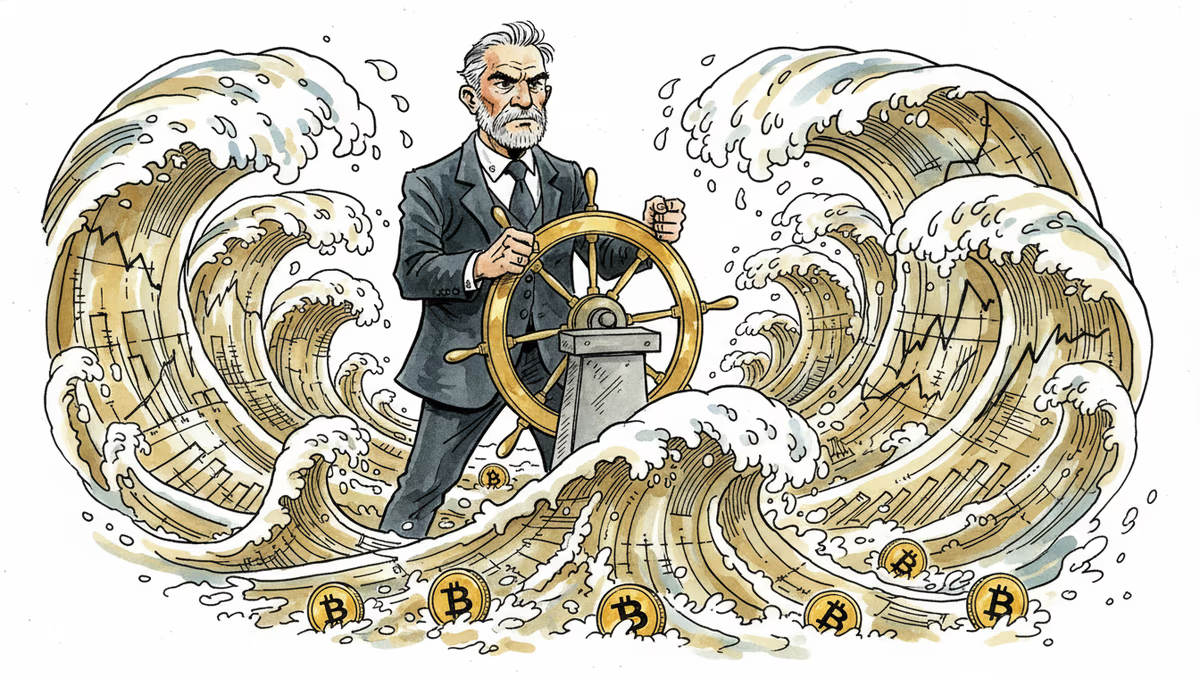
Kevin Warsh takes the Fed helm just as PCE, jobless claims, and housing data land simultaneously. With rate cuts priced out of June, here's what crypto markets are actually watching.

Nvidia posted 85% revenue growth and a $80B buyback. Its stock still dropped — for the fourth straight post-earnings quarter. Here's what that tells us about where AI investing stands right now.
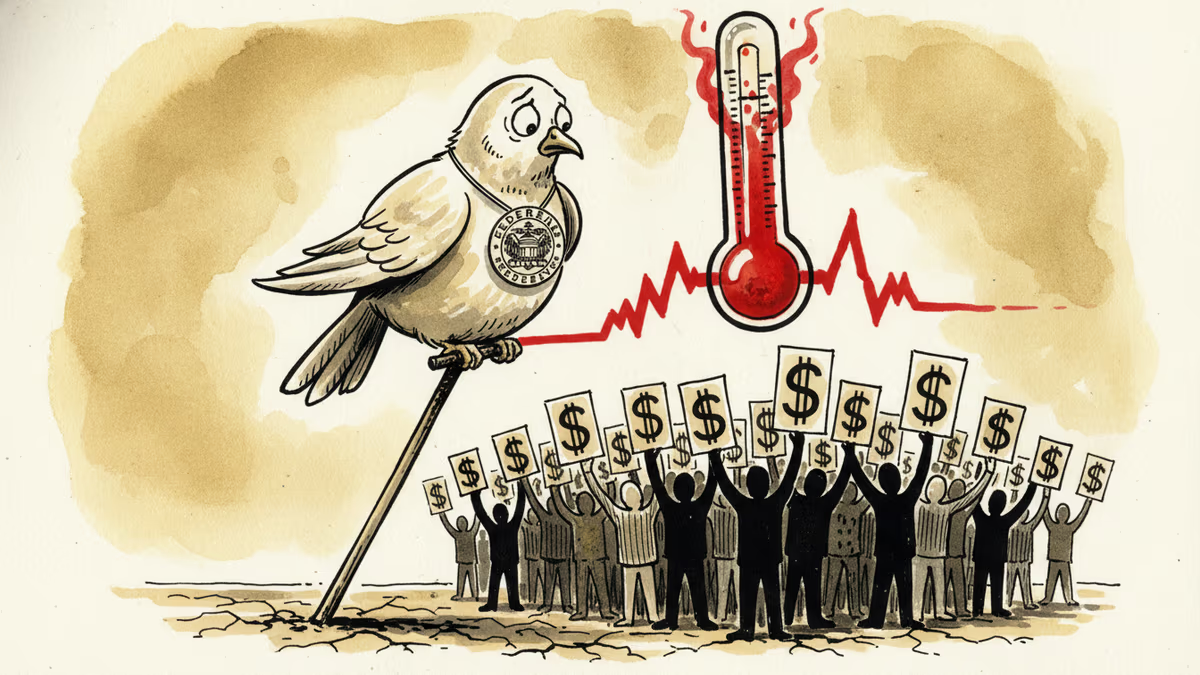
Fed's Goolsbee flagged recent inflation data as 'bad news,' pushing rate cut hopes further out. What that means for mortgages, markets, and your portfolio.
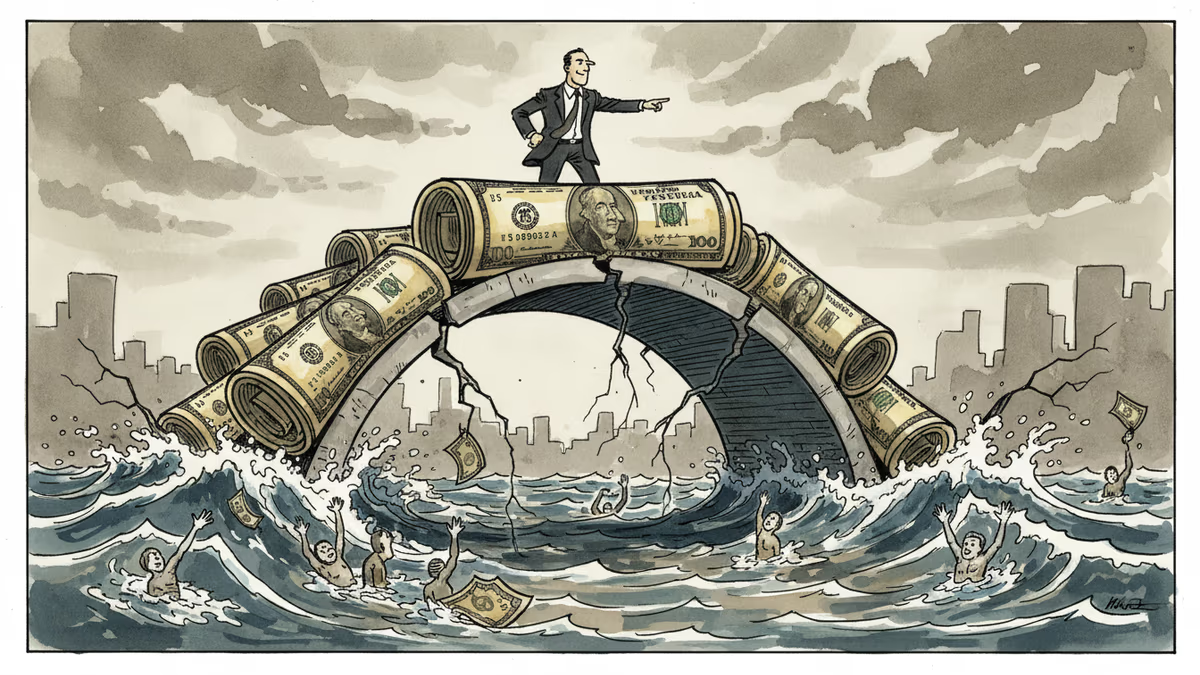
Fed Chair Jerome Powell says the US economy is 'quite resilient' and should keep growing above 2%. But whose resilience? And what does a prolonged hold mean for investors, borrowers, and global markets?
Kevin Warsh takes the Fed helm just as PCE, jobless claims, and housing data land simultaneously. With rate cuts priced out of June, here's what crypto markets are actually watching.
Nvidia posted 85% revenue growth and a $80B buyback. Its stock still dropped — for the fourth straight post-earnings quarter. Here's what that tells us about where AI investing stands right now.
Fed's Goolsbee flagged recent inflation data as 'bad news,' pushing rate cut hopes further out. What that means for mortgages, markets, and your portfolio.
Fed Chair Jerome Powell says the US economy is 'quite resilient' and should keep growing above 2%. But whose resilience? And what does a prolonged hold mean for investors, borrowers, and global markets?
Thoughts
Share your thoughts on this article
Sign in to join the conversation