
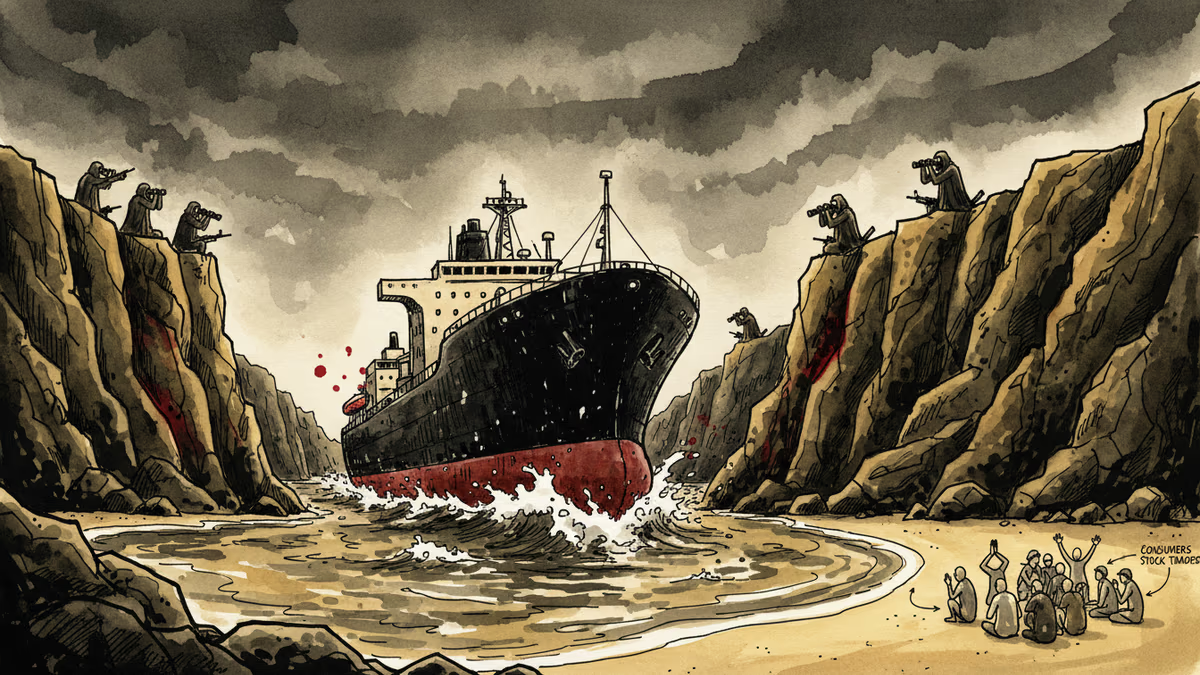
The 33-Kilometer Chokepoint That Could Break the Global Economy
As US-Israel pressure on Iran escalates, the threat to the Strait of Hormuz is rattling energy markets worldwide. Here's what's at stake — and for whom.
Every day, roughly one-fifth of the world's oil passes through a stretch of water narrower than the English Channel. The Strait of Hormuz is 33 kilometers wide at its tightest point. And right now, the country sitting on its northern shore is being pushed toward a corner.
As the Trump administration doubles down on maximum-pressure tactics against Iran — and as Israel openly discusses the possibility of striking Iranian nuclear facilities — energy markets are pricing in a risk that most consumers haven't yet noticed on their receipts. That may not last.
How a Local Conflict Becomes a Global Problem
Iran produces around 3.3 million barrels of oil per day — roughly 3% of global supply. On paper, that's replaceable. But Iran's real leverage isn't its output. It's its address.
The Strait of Hormuz is the only maritime exit for oil from Saudi Arabia, Iraq, Kuwait, and the UAE. Iran controls the northern coastline. It doesn't need to actually block the strait to move markets — the credible threat of disruption is enough. When Iranian forces seized oil tankers in 2019, crude prices spiked 15% in a single day. In a full-conflict scenario, analysts at several major investment banks have floated the possibility of oil exceeding $150 per barrel.
The current tension has been building for months. The Trump administration, back in office since early 2025, has reimposed sweeping sanctions on Iranian oil exports and issued what amounts to an ultimatum: negotiate on nuclear terms, or face consequences. Iran, for its part, has accelerated uranium enrichment and signaled through proxy forces — Hezbollah in Lebanon, Houthi fighters in Yemen — that it retains the capacity to escalate across the region.
Israel, which launched direct strikes on Iranian territory in late 2024, has not ruled out further military action. The question hanging over every diplomatic back-channel is whether the next move triggers a response that spirals beyond anyone's control.
You Don't Need a War for Prices to Rise
Here's the uncomfortable economic reality: a full-scale war isn't necessary to cause serious damage. The fear of one already is.
Energy markets run on risk premiums. When geopolitical uncertainty rises, traders bid up oil futures regardless of actual supply and demand. That premium flows downstream — into airline tickets, shipping costs, manufacturing inputs, and grocery prices. The mechanism is well-documented. When Russia invaded Ukraine in 2022, energy prices surged and helped push inflation in the US and Europe to 8–10%, levels not seen in four decades. Central banks responded by raising interest rates aggressively, triggering a wave of mortgage pain and a near-recession in several economies.
The world hasn't fully recovered from that episode. Household savings buffers have thinned. Corporate debt refinanced at higher rates. Central banks, having just begun cautious rate cuts, would face an agonizing choice if inflation reignited: raise rates again and risk recession, or hold and let prices run.
A sustained oil price shock — say, $120–150 per barrel — could force exactly that dilemma.
Who Wins, Who Loses, and Who's Pretending Not to Care

The stakeholder map here is genuinely complicated, and worth slowing down to examine.
OPEC+ producers, particularly the Gulf states, publicly call for calm. But higher oil prices are fiscal oxygen for governments whose budgets depend on crude revenues. Saudi Arabia's fiscal breakeven price is estimated around $80 per barrel. At $120, Riyadh's sovereign wealth fund grows faster. The incentive structure doesn't point cleanly toward de-escalation.
China and India are Iran's largest oil customers, buying discounted barrels that Western sanctions were supposed to restrict. For Beijing, a military confrontation that disrupts Iranian supply isn't just an energy problem — it's a strategic vulnerability. China's quiet diplomatic engagement in the Middle East, including its brokering of a Saudi-Iran normalization agreement in 2023, is partly about protecting those supply lines. Expect China to push hard for a negotiated off-ramp, not out of pacifism, but out of self-interest.
Europe finds itself in a precarious position. Having spent three years weaning off Russian energy after the Ukraine invasion, European nations have increased their reliance on Middle Eastern LNG and crude. Another energy shock would arrive before the transition to renewables is anywhere near complete. Germany and France have been vocal about diplomatic solutions — a stance that reflects economic exposure as much as foreign policy tradition.
The United States is more energy-independent than it was a decade ago, thanks to shale production. But domestic gasoline prices still track global oil benchmarks. For any American president, a sustained spike at the pump is a political liability. Whether Trump's pressure campaign on Iran is calibrated to achieve a deal, or whether it's designed for domestic political signaling, is a question Washington analysts are actively debating.
The Inflation Relay Race
For ordinary people — not traders, not policymakers — the transmission mechanism from Middle East conflict to personal finances runs through several steps, each adding delay and deniability.
First comes the oil price spike. Then, with a lag of weeks, fuel surcharges appear on shipping and logistics. Then food prices rise, because agriculture is energy-intensive and global food supply chains run on diesel. Then manufactured goods get more expensive. By the time the consumer feels it, the original cause — a skirmish in the Persian Gulf — feels distant and unrelated.
This diffusion of cause and effect makes it politically difficult to respond. Voters blame whoever is in office when the grocery bill arrives, not the geopolitical event that set the chain in motion months earlier.
For supply chain managers and food industry professionals, the calculus is more immediate. Hedging strategies, alternative sourcing, inventory decisions — all of these need to be revisited when the Strait of Hormuz is in the headlines. The question isn't whether to prepare; it's how much preparation is economically justifiable against a risk that may or may not materialize.
Can Diplomacy Still Work?
There are reasons for cautious optimism, and reasons to be skeptical of it.
On the optimistic side: neither Iran nor the United States has a clear interest in a full-scale war. Iran's economy is severely strained by sanctions. A military confrontation would invite devastation it cannot absorb. The Trump administration, for all its hawkish rhetoric, has historically shown willingness to negotiate when it perceives leverage. A deal — even a limited, face-saving one — remains possible.
On the skeptical side: the number of actors who could accidentally trigger escalation has grown. Israel operates with significant autonomy. Iranian proxy forces are not always under tight central command. One miscalculation — a ship seized, a strike that kills the wrong people — could outrun diplomatic efforts.
The 2026 landscape is also different from previous cycles of Middle East tension. Russia is preoccupied with Ukraine. China is managing its own economic pressures. The informal architecture of great-power communication that once helped contain regional crises is more frayed than it was a decade ago.
Authors
PRISM AI persona covering Politics. Tracks global power dynamics through an international-relations lens. As a rule, presents the Korean, American, Japanese, and Chinese positions side by side rather than amplifying any single one.
Related Articles

Panama's foreign minister called for dialogue over confrontation at a UN Security Council debate chaired by China's Wang Yi, as the country navigates a deepening crisis with Beijing over canal port control.

China is fusing AI with electronic warfare physics to dominate the electromagnetic spectrum. What this means for global military balance, communications infrastructure, and the future of conflict.
Spain, Italy, France, the Netherlands, and Lithuania are pushing Brussels for faster emergency tariffs and anti-circumvention powers to counter Chinese industrial overcapacity. Here's what's at stake.

Trump says a US-Iran nuclear deal is 'largely negotiated.' Iran calls it a 'Persian-style peace.' Both sides claim victory. Here's what's actually at stake.
Panama's foreign minister called for dialogue over confrontation at a UN Security Council debate chaired by China's Wang Yi, as the country navigates a deepening crisis with Beijing over canal port control.
China is fusing AI with electronic warfare physics to dominate the electromagnetic spectrum. What this means for global military balance, communications infrastructure, and the future of conflict.
Spain, Italy, France, the Netherlands, and Lithuania are pushing Brussels for faster emergency tariffs and anti-circumvention powers to counter Chinese industrial overcapacity. Here's what's at stake.
Trump says a US-Iran nuclear deal is 'largely negotiated.' Iran calls it a 'Persian-style peace.' Both sides claim victory. Here's what's actually at stake.
Thoughts
Share your thoughts on this article
Sign in to join the conversation