
KATSEYE's UK Chart Rise Is Really a Test of a Business Model
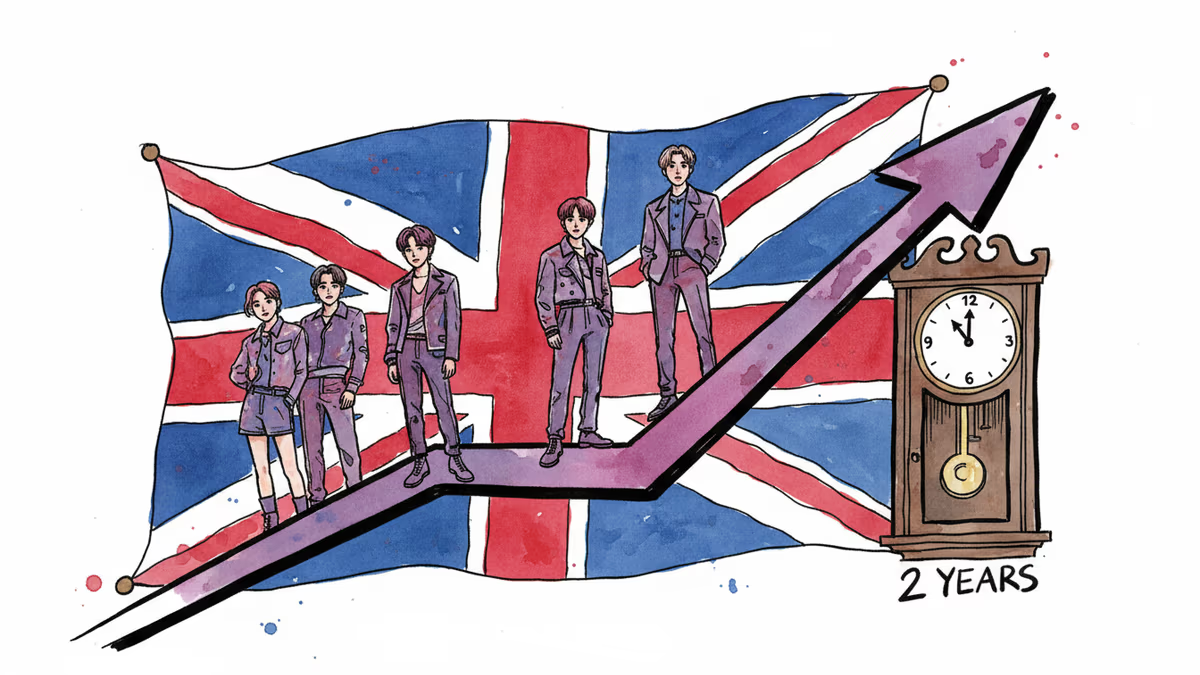
KATSEYE's 'Touch' entering the UK Official Singles Chart nearly two years after release raises a pointed question about Hybe's global pop experiment—and who it's really for.
Most pop songs get one shot at a chart. KATSEYE's "Touch" just took its second—nearly two years after anyone expected it to matter.
Last week, the group's debut-era track entered the UK Official Singles Chart at No. 88, the British music industry's closest equivalent to the Billboard Hot 100. This week it climbed further. Meanwhile, "PINKY UP" continues to hold inside the top 50. Two songs from the same act charting simultaneously isn't a coincidence—it's a signal that KATSEYE's audience is consuming the catalog, not just the single.
The question worth asking isn't whether this is impressive. It's what, exactly, it proves.
What KATSEYE Actually Is
Understanding the chart news requires understanding the project behind it. KATSEYE was formed through Dream Academy, a global audition show co-produced by Hybe—the South Korean entertainment conglomerate behind BTS and NewJeans—and Geffen Records, the storied American major label. The group's members span American, Swiss, Filipino, and Korean-heritage backgrounds, assembled deliberately to reduce the cultural friction that often limits K-pop's crossover into English-language markets.
The underlying thesis of this Hybe-Geffen collaboration—call it the HBE model—is that K-pop's manufacturing process is separable from K-pop's Korean identity. Train non-Korean performers using Korean idol methodology: synchronized choreography, fandom-building infrastructure, layered visual identity, parasocial engagement strategies. Then distribute through Western major-label pipelines. The result, in theory, should be a group that feels native to both markets.
"Touch" was released in summer 2024. At the time, it made minimal impact on mainstream Anglo-American charts. The UK entry nearly two years later is the anomaly that needs explaining.

The Mechanics of a Slow Burn
The most likely driver is catalog pull from recent activity. "PINKY UP" built momentum, and K-pop fandoms reliably reverse-engineer an act's back catalog once they're hooked—streaming older tracks, purchasing downloads, driving chart-eligible consumption. The UK Official Chart is a composite metric that includes downloads and physical sales alongside streams, meaning it captures active fan behavior rather than passive algorithmic plays. That KATSEYE's older material is charting there suggests deliberate fan effort, not just Spotify recommendation traffic.
The UK market context adds another layer. Britain sits alongside France and Germany as one of Europe's most K-pop-receptive markets, but it's also a country with a strong sense of domestic pop identity. Charting on the Official Singles Chart carries a different cultural weight than, say, a Spotify Global ranking. It means KATSEYE has fans in the UK willing to spend money—not just stream.
The timing matters too. In 2026, fourth-generation K-pop groups are increasingly concentrated on the US market, leaving European charts with comparatively less competition from Korean acts. KATSEYE's structural position—simultaneously legible to K-pop fandoms and packaged for Western consumption—gives it an opening that a Seoul-based group might not have.
What This Proves, and What It Doesn't
For Hybe, this is useful data. The HBE model's central bet is that K-pop methodology has universal applicability. A UK chart entry, however modest, is evidence that non-Korean performers trained in Korean idol systems can generate the kind of fandom loyalty that moves charts in English-speaking markets. That's not nothing.
For Geffen, the calculus is different. Major labels measure success in mainstream crossover—the moment a track escapes fandom ecosystems and reaches general listeners. There's no clear evidence yet that KATSEYE has achieved that. The group's chart positions appear sustained by fan-driven consumption, which is a durable but ceiling-limited engine. One Direction and Little Mix didn't chart in the UK because their fandoms were organized—they charted because their music reached beyond the fandom. Whether KATSEYE can replicate that trajectory is still unresolved.
The tension between Hybe's K-pop fandom model and Geffen's mainstream pop ambitions isn't necessarily a contradiction, but it does mean the two partners may be reading the same chart data and drawing different conclusions about what success looks like next.
This content is AI-generated based on source articles. While we strive for accuracy, errors may occur. We recommend verifying with the original source.
Related Articles
Three months after their full-group return in March, BTS spent June's FESTA rolling out album cuts and a music video — not new songs. Come Over cracked a global top 5 with zero new music behind it. Did the play work?
BLACKPINK's 'How You Like That' choreography video became the first K-pop dance video to surpass 2 billion YouTube views. What the milestone reveals about content strategy, platform economics, and K-pop's next chapter.
&TEAM's 'We on Fire' debuted on the Billboard 200 for the first time. Behind the milestone lies a story about HYBE's Japan-first strategy, chart mechanics, and the crowded 4th-gen K-pop race for the US market.
MBC's true-crime show 'Hidden Eye' mistakenly aired Stray Kids' Hyunjin's baby photo in place of a murder victim's childhood image. Five months later, an apology. What does that timeline reveal?
Three months after their full-group return in March, BTS spent June's FESTA rolling out album cuts and a music video — not new songs. Come Over cracked a global top 5 with zero new music behind it. Did the play work?
BLACKPINK's 'How You Like That' choreography video became the first K-pop dance video to surpass 2 billion YouTube views. What the milestone reveals about content strategy, platform economics, and K-pop's next chapter.
&TEAM's 'We on Fire' debuted on the Billboard 200 for the first time. Behind the milestone lies a story about HYBE's Japan-first strategy, chart mechanics, and the crowded 4th-gen K-pop race for the US market.
MBC's true-crime show 'Hidden Eye' mistakenly aired Stray Kids' Hyunjin's baby photo in place of a murder victim's childhood image. Five months later, an apology. What does that timeline reveal?
Thoughts
Share your thoughts on this article
Sign in to join the conversation