
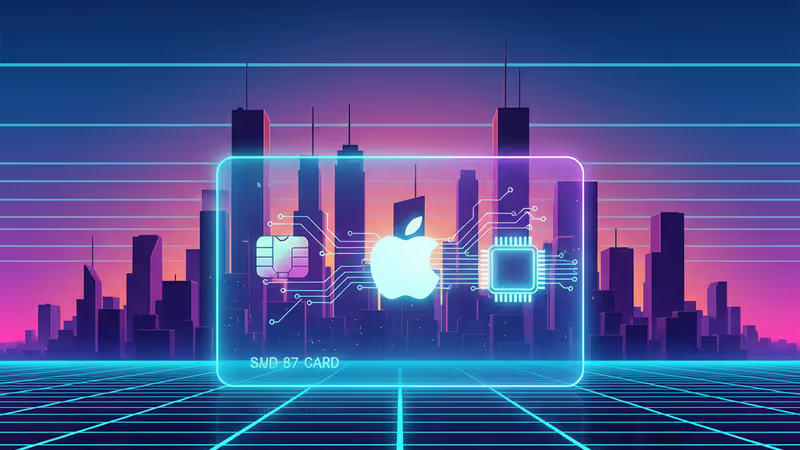
JPMorgan Chase Takes Over Apple Card: A $20 Billion Fintech Shift
Apple has officially named JPMorgan Chase as the new issuer for the Apple Card, replacing Goldman Sachs in a deal involving over $20 billion in balances.
A $20 billion migration has begun in the fintech world. Apple announced Wednesday that JPMorgan Chase is the new issuer for the Apple Card, officially ending the tech giant's rocky partnership with Goldman Sachs.
Implications of the JPMorgan Chase Apple Card Transition
The transition isn't an overnight switch. According to Apple, moving the entire portfolio will likely take up to 24 months. While the banking partner changes, the Apple Card will continue to operate on the Mastercard network. For the millions of current cardholders, the experience remains unchanged for now, with rewards and application processes staying the same.
JPMorgan expects the deal to bring over $20 billion in card balances to its Chase unit. Interestingly, the Wall Street Journal reports that Goldman Sachs is offloading this massive portfolio at a $1 billion discount just to exit the consumer lending space.

The Cost of Separation for Goldman Sachs
The breakup is proving expensive for Goldman Sachs. The bank expects a $2.2 billion provision for credit losses in the fourth quarter of 2025 specifically related to this commitment. It's a clear signal of Goldman's retreat from the ambitious retail banking strategy it launched with Apple back in 2019.
Authors
Related Articles
After 15 years of fragmented mobile messaging, Apple and Google are rolling out end-to-end encrypted RCS messaging between iPhones and Android devices. Here's what changed, why it took so long, and what it means for your privacy.
Venmo's biggest redesign since 2021 adds social features, personalized offers, and a revamped feed. But the timing — amid PayPal's restructuring and Stripe's reported interest — raises a harder question about who this update is really for.
E-commerce fintech Parker filed for Chapter 7 bankruptcy on May 7, despite raising over $200M. The YC-backed startup's abrupt shutdown left small business customers scrambling—and exposed the fragility of vertical fintech models.
Apple agreed to pay $250 million to settle claims it misled iPhone 16 buyers about Apple Intelligence features. What this means for consumers, Big Tech marketing, and the AI industry.
After 15 years of fragmented mobile messaging, Apple and Google are rolling out end-to-end encrypted RCS messaging between iPhones and Android devices. Here's what changed, why it took so long, and what it means for your privacy.
Venmo's biggest redesign since 2021 adds social features, personalized offers, and a revamped feed. But the timing — amid PayPal's restructuring and Stripe's reported interest — raises a harder question about who this update is really for.
E-commerce fintech Parker filed for Chapter 7 bankruptcy on May 7, despite raising over $200M. The YC-backed startup's abrupt shutdown left small business customers scrambling—and exposed the fragility of vertical fintech models.
Apple agreed to pay $250 million to settle claims it misled iPhone 16 buyers about Apple Intelligence features. What this means for consumers, Big Tech marketing, and the AI industry.
Thoughts
Share your thoughts on this article
Sign in to join the conversation