
What Japan's Platinum Certifications Actually Tell Us About K-Pop
&TEAM's triple platinum, RIIZE and TXT's latest RIAJ certifications reveal how K-pop is navigating the world's last major physical music market—and what that strategy costs.
In a world where streaming dominates, 750,000 physical units shipped still means something—but only in one major market.
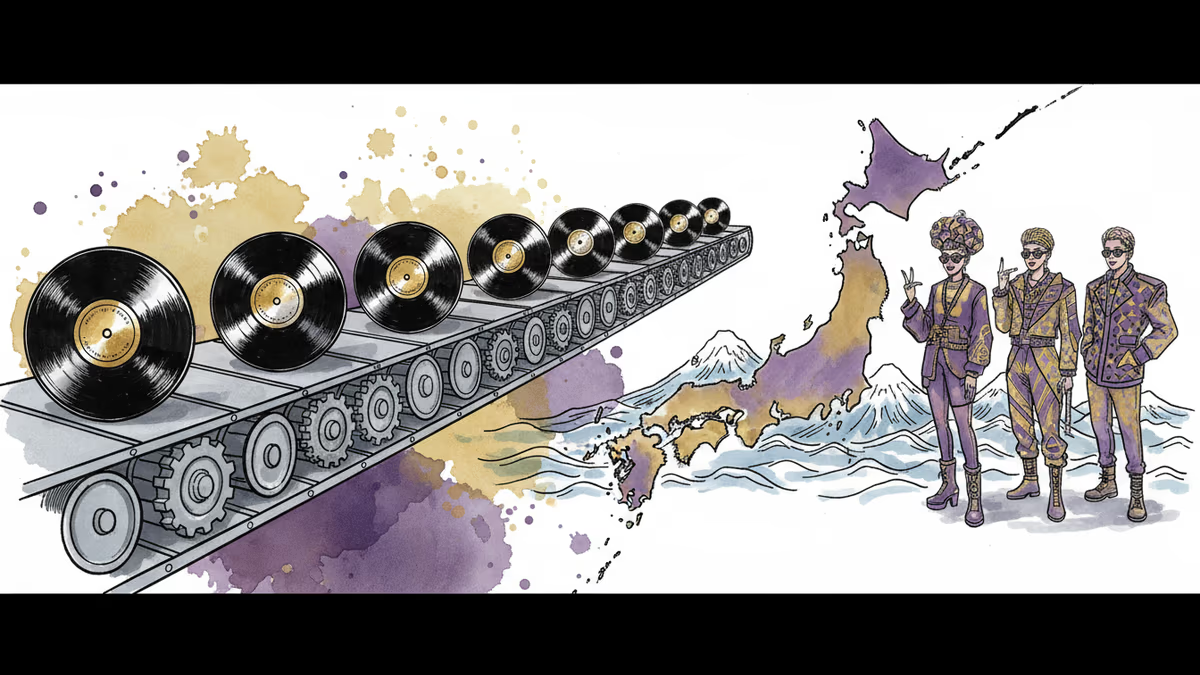
The Recording Industry Association of Japan (RIAJ) dropped its latest round of certifications this month, and the K-pop column is crowded. &TEAM's Japanese EP We on Fire earned a triple platinum certification, crossing the 750,000 units shipped threshold. RIIZE and TXT (Tomorrow X Together) added platinum and gold certifications of their own. On the surface, it reads like another good month for Hallyu. Look closer, and it's a window into one of the music industry's most structurally unusual markets—and the competing strategies K-pop labels are running inside it.
Japan: The Last Big Physical Market
Japan is the world's second-largest music market by revenue. It is also, by a wide margin, the most resistant to the streaming transition. According to IFPI data, physical formats still account for over 60% of total music revenue in Japan—an inversion of virtually every other major market. That structural reality is why the RIAJ still certifies based on units shipped, not streams.
The distinction matters. Shipped units reflect what distributors send to retailers, not what consumers actually buy. In a market where K-pop fan communities routinely purchase multiple copies of the same release as a form of participatory support, shipped figures can run ahead of organic demand. That's not unique to K-pop—Japanese idol acts like AKB48 built their commercial model on exactly the same mechanic—but it does mean RIAJ certifications require context to interpret accurately.
None of that context erases the achievement. BTS built a genuine million-seller catalog in Japan long before their global peak. The infrastructure K-pop labels have built in Japan—local subsidiaries, domestic distribution deals, dedicated fan event circuits—reflects years of market investment, not just viral momentum.
Two Strategies, One Certification System

What makes this month's certifications analytically interesting is that they represent two fundamentally different market approaches arriving at similar outcomes.
RIIZE and TXT follow the classic K-pop export path: debut in Korea, build a global fanbase, then enter Japan as an established act with pre-existing demand. The Japan rollout is a downstream market for an already-proven product.
&TEAM is something different. HYBE assembled the group through a Japanese local audition process, with members who are Japanese nationals or have deep Japan ties. The production language—the choreography philosophy, the visual identity, the sonic template—is unmistakably HYBE. But the talent pipeline is domestic. Triple platinum for this group doesn't just measure fan loyalty to a Korean export; it tests whether the K-pop production system can generate market results when transplanted into local soil.
The answer, at 750,000+ units, appears to be yes. But it raises a harder question for the industry: if a Japanese group made by a Korean company using Korean production methodology outsells many Korean groups in Japan, what exactly is being exported?
What the Certifications Mean Beyond the Numbers
For the labels, RIAJ certifications aren't just trophies. Japan's physical market structure means that certification tiers directly influence negotiating leverage with domestic distributors and retail partners. A triple platinum act gets different shelf placement, different promotional co-investment, different contract renewal terms. The certifications are, in a practical sense, currency.
For investors watching HYBE, SM Entertainment, JYP, and YG—all of which operate Japanese subsidiaries—Japan remains the most reliable high-margin international market for physical revenue. In an era where streaming payouts compress margins globally, Japan's physical ecosystem functions as a margin buffer. That's why every label with serious Japan ambitions maintains a dedicated local operation rather than routing through a third-party licensee.
The risk embedded in that structure is concentration. Japan's physical market resilience is real, but it's also aging. The consumer cohort that sustains CD purchasing behavior in Japan skews older, and generational transition toward streaming is underway—just slower than elsewhere. Labels building Japan strategies around physical certification milestones are, to some degree, optimizing for a market in gradual structural change.
This content is AI-generated based on source articles. While we strive for accuracy, errors may occur. We recommend verifying with the original source.
Related Articles

Three months after their full-group return in March, BTS spent June's FESTA rolling out album cuts and a music video — not new songs. Come Over cracked a global top 5 with zero new music behind it. Did the play work?
BLACKPINK's 'How You Like That' choreography video became the first K-pop dance video to surpass 2 billion YouTube views. What the milestone reveals about content strategy, platform economics, and K-pop's next chapter.
&TEAM's 'We on Fire' debuted on the Billboard 200 for the first time. Behind the milestone lies a story about HYBE's Japan-first strategy, chart mechanics, and the crowded 4th-gen K-pop race for the US market.

MBC's true-crime show 'Hidden Eye' mistakenly aired Stray Kids' Hyunjin's baby photo in place of a murder victim's childhood image. Five months later, an apology. What does that timeline reveal?
Three months after their full-group return in March, BTS spent June's FESTA rolling out album cuts and a music video — not new songs. Come Over cracked a global top 5 with zero new music behind it. Did the play work?
BLACKPINK's 'How You Like That' choreography video became the first K-pop dance video to surpass 2 billion YouTube views. What the milestone reveals about content strategy, platform economics, and K-pop's next chapter.
&TEAM's 'We on Fire' debuted on the Billboard 200 for the first time. Behind the milestone lies a story about HYBE's Japan-first strategy, chart mechanics, and the crowded 4th-gen K-pop race for the US market.
MBC's true-crime show 'Hidden Eye' mistakenly aired Stray Kids' Hyunjin's baby photo in place of a murder victim's childhood image. Five months later, an apology. What does that timeline reveal?
Thoughts
Share your thoughts on this article
Sign in to join the conversation