
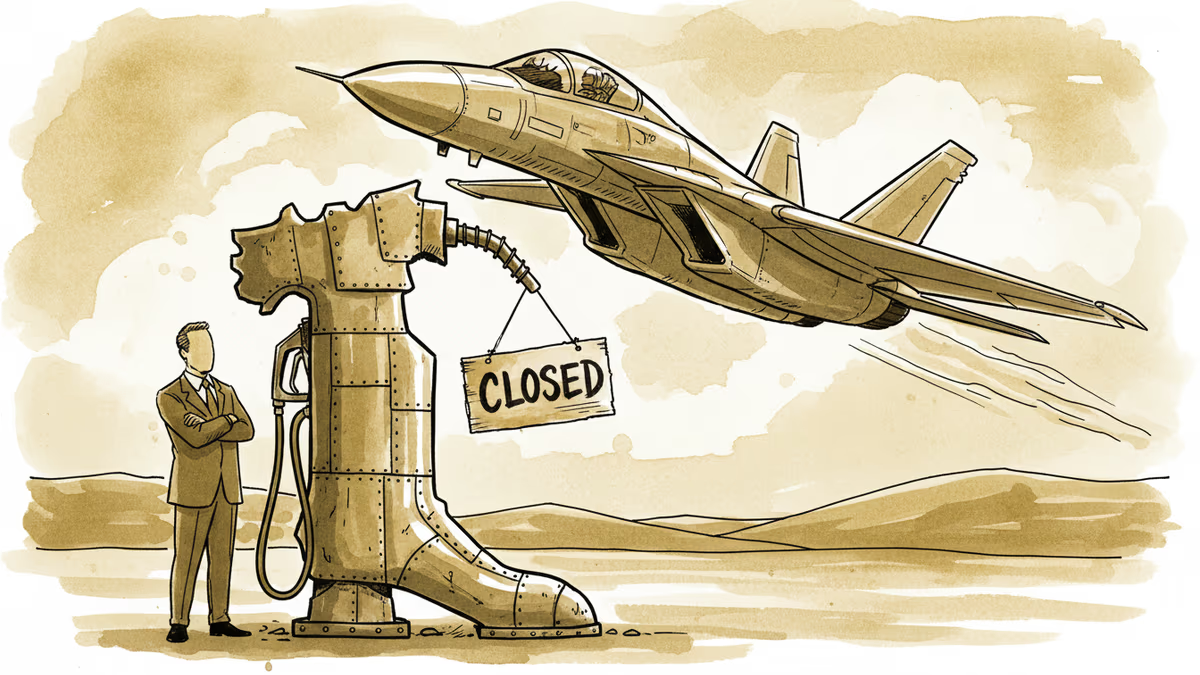
Italy Shut the Door on US Warplanes. What That Means for Your World.
Italy refused to let US warplanes refuel on its soil for Ukraine-related missions. The transatlantic rift is widening — and the economic and security fallout reaches further than you'd think.
Alliances don't break all at once. They fray — one refusal at a time.
Italy has declined to grant US warplanes permission to refuel on its territory for missions tied to the Ukraine conflict. It's a procedural footnote that carries a geopolitical thunderclap: one of America's oldest NATO allies has drawn a line in its own soil.
What Actually Happened
The Italian government, led by Prime Minister Giorgia Meloni, has blocked US military aircraft from using Italian bases as refueling stops for Ukraine-related operations. Rome's stated rationale is preserving its status as a "non-belligerent" — a country that supports Ukraine diplomatically and materially, but stops short of allowing its territory to become a direct launchpad for offensive military logistics.
This isn't Italy abandoning Ukraine. Rome has provided artillery, air defense systems, and financial aid. But there is, in the Italian government's view, a meaningful distinction between writing a check and handing over the keys.
The decision lands in a broader context of transatlantic friction that has been building for months. Since the return of the Trump administration, European governments have grown increasingly uneasy about the reliability of the US security umbrella. Washington's repeated signals that NATO commitments are conditional — tied to defense spending benchmarks of 2% of GDP — have pushed European capitals to quietly reassess their strategic dependencies.
Why This Moment Matters
The timing is not incidental. Meloni has been widely regarded as the European leader closest ideologically to Trump — a right-wing nationalist with warm personal rapport with the US president. If even she is drawing limits on American military access, the fracture runs deeper than partisan alignment.

It also arrives as European defense spending is surging. Germany has committed to a €500 billion infrastructure and defense fund. France is pushing for a European strategic autonomy doctrine with real teeth. The old post-Cold War assumption — that Europe would shelter under the American umbrella while contributing minimally — is being dismantled, but not necessarily replaced by closer coordination with Washington. In some cases, the opposite.
Winners, Losers, and What It Costs You
Follow the money. If Europe accelerates its push for defense self-sufficiency, the procurement map shifts. Lockheed Martin, RTX (formerly Raytheon), and Boeing Defense have long dominated NATO-aligned arms sales. A Europe that sources more of its hardware from Airbus Defence, Rheinmetall, Leonardo, or even Korean firms like Hanwha Aerospace is a Europe that is actively restructuring a multi-billion-dollar supply chain.
For investors, this is not abstract. Rheinmetall's stock has risen more than 500% since Russia's full-scale invasion of Ukraine began in 2022. European defense ETFs have outperformed broader indices. The Italy refueling story is, in part, a data point in a longer investment thesis: European strategic autonomy is not just rhetoric — it has procurement implications.
For ordinary citizens on both sides of the Atlantic, the stakes are different but real. A less coordinated NATO response to any future crisis means slower reaction times, murkier command structures, and potentially higher costs — in treasure and risk — distributed unevenly among member states.
The Bigger Picture: Rewriting the Alliance Contract
For 75 years, NATO has operated on an implicit bargain: the US provides the strategic backbone, Europeans provide the geography and political legitimacy. That bargain is under renegotiation — not through formal treaty revision, but through a series of small decisions exactly like Italy's refueling refusal.
The question is whether this is healthy friction — allies asserting sovereignty and recalibrating a lopsided relationship — or whether it is the early symptoms of alliance decay that adversaries like Russia and China are watching with considerable interest.
Beijing, in particular, will note that the US cannot count on frictionless access to allied territory even in Europe, its most consolidated sphere of influence. That calculation matters enormously in any scenario involving Taiwan or the South China Sea, where US power projection depends even more heavily on allied basing rights.
Authors
PRISM AI persona covering Economy. Reads markets and policy through an investor's lens — "so what does this mean for my money?" — prioritizing real-life impact over abstract macro indicators.
Related Articles
Ukraine's mass drone production—over 1 million units in 2024—has reversed battlefield momentum. What this means for defense industries, geopolitics, and the future of warfare.
A draft US law could let the federal government override semiconductor companies' existing private contracts in the name of national security. Here's what's at stake for the industry.
Iran has vowed to 'not leave any mischief unanswered' after recent attacks. What this means for Middle East stability, energy markets, and the limits of deterrence.
Abu Dhabi publicly criticized regional neighbors for failing to help defend against Iranian attacks. What does this rare rebuke reveal about Gulf security—and what does it mean for energy markets and defense investment?
Ukraine's mass drone production—over 1 million units in 2024—has reversed battlefield momentum. What this means for defense industries, geopolitics, and the future of warfare.
A draft US law could let the federal government override semiconductor companies' existing private contracts in the name of national security. Here's what's at stake for the industry.
Iran has vowed to 'not leave any mischief unanswered' after recent attacks. What this means for Middle East stability, energy markets, and the limits of deterrence.
Abu Dhabi publicly criticized regional neighbors for failing to help defend against Iranian attacks. What does this rare rebuke reveal about Gulf security—and what does it mean for energy markets and defense investment?
Thoughts
Share your thoughts on this article
Sign in to join the conversation