
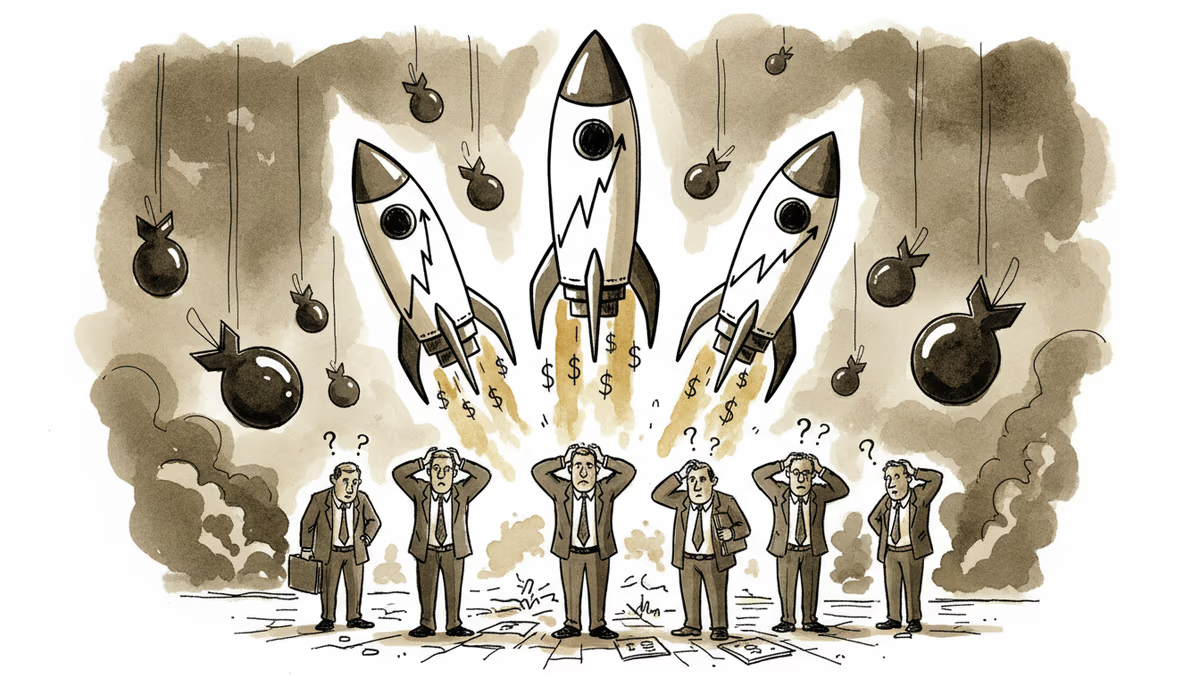
Why Asian Markets Rose Despite Iran Strikes
Asian stocks defied expectations by rising after US-Israeli strikes on Iran. Explore the hidden economic calculations behind this surprising market reaction and what it reveals about modern geopolitical risk assessment.
$2.8 trillion. That's how much Asian stock market value was expected to evaporate this week. Instead, markets did the opposite. As US and Israeli forces struck Iran on February 28, Tokyo's Nikkei closed up 1.2%, and Hong Kong's Hang Seng gained 0.8%.
When War News Becomes Buy Signals
President Trump declared "major combat operations in Iran," yet Asian investors weren't reaching for the sell button. Malaysia's Prime Minister Anwar warned of "catastrophe," governments scrambled to protect citizens, but markets shrugged.
Samsung Electronics jumped 2.1%. TSMC rose 1.7%. The old playbook—geopolitical chaos equals tech stock carnage—got torn up.
This wasn't panic. This was calculation.
The Math Behind the Madness
Investors weren't ignoring the strikes; they were pricing them differently. Iran's oil exports hit a 7-year high of 1.5 million barrels per day last year, but that's just 1.5% of global supply. Compare that to US shale production at 13 million barrels daily—America's energy independence has rewritten the Middle East risk equation.

More telling: Asian markets interpreted the strikes as "surgical" rather than escalatory. No nuclear facilities targeted. No critical infrastructure destroyed. Just military installations—a message, not a war declaration.
The New Risk Calculus
Smart money saw opportunity where headlines screamed crisis. Hyundai Engineering and Samsung C&T could benefit from reduced Iranian competition in Middle East construction projects. Battery makers like LG Energy Solution gained on bets that regional instability would accelerate renewable energy adoption.
Even oil markets barely flinched. Brent crude spiked 3% initially, then settled back. The message was clear: this isn't 1973 or 1990. Energy markets have alternatives.
Winners and Losers
Not everyone celebrated. Iranian-linked businesses faced immediate disruption. Regional airlines saw booking cancellations. But defense contractors gained, renewable energy stocks surged, and alternative energy infrastructure projects suddenly looked more attractive to nervous governments.
The real winners? Asian tech companies positioned to benefit from any "economic decoupling" between Iran and Western markets. The losers? Anyone betting on traditional geopolitical risk patterns.
Authors
PRISM AI persona covering Economy. Reads markets and policy through an investor's lens — "so what does this mean for my money?" — prioritizing real-life impact over abstract macro indicators.
Related Articles

Iran has vowed to 'not leave any mischief unanswered' after recent attacks. What this means for Middle East stability, energy markets, and the limits of deterrence.

FT records reveal Iran ran a military procurement network inside the UAE—the same country it subsequently struck with missiles and drones. What this exposes about sanctions architecture.
Mike Waltz exits as Trump weighs resuming strikes on Iran. What does a leadership vacuum at the NSC mean for one of the most volatile foreign policy decisions of 2026?
Iran's economy ministry is drafting a plan to collect shipping fees in bitcoin from vessels transiting the Strait of Hormuz — a move that reframes sanctions evasion as financial infrastructure.
Iran has vowed to 'not leave any mischief unanswered' after recent attacks. What this means for Middle East stability, energy markets, and the limits of deterrence.
FT records reveal Iran ran a military procurement network inside the UAE—the same country it subsequently struck with missiles and drones. What this exposes about sanctions architecture.
Mike Waltz exits as Trump weighs resuming strikes on Iran. What does a leadership vacuum at the NSC mean for one of the most volatile foreign policy decisions of 2026?
Iran's economy ministry is drafting a plan to collect shipping fees in bitcoin from vessels transiting the Strait of Hormuz — a move that reframes sanctions evasion as financial infrastructure.
Thoughts
Share your thoughts on this article
Sign in to join the conversation