
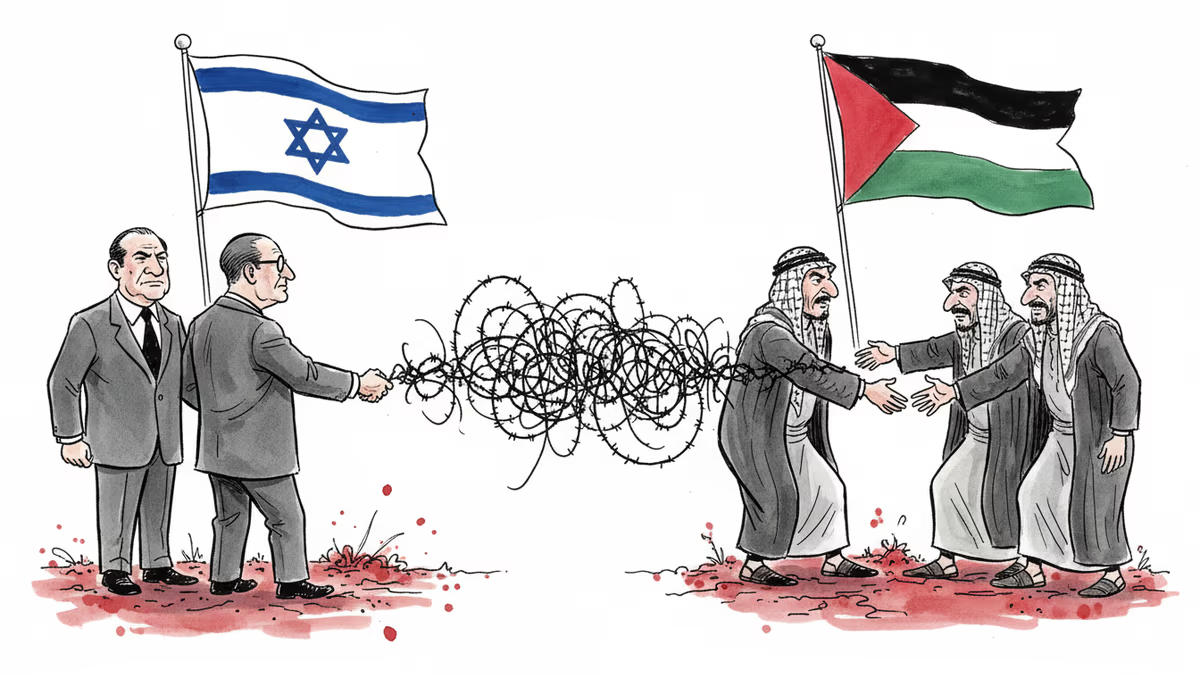
Israel's Right vs Iran's Resistance - Two Sides of Middle East War
White House announces 4-6 week Iran strikes as Germany's Merz declares support for Israel. Iranian UN ambassador condemns 'criminal war'. Examining opposing narratives in Middle East conflict.
The White House announced that strikes on Iran will last four to six weeks. At the same moment, Germany's Friedrich Merz scolded protesters, declaring "We stand with Israel." Meanwhile, Iran's UN ambassador condemned what he called a US-Israeli "criminal war."
How can the same conflict generate such radically different interpretations?
The Western Narrative: Democracy Under Siege
Germany's Merz didn't scold those protesters without reason. Western nations frame this conflict through a "democracy versus authoritarianism" lens. Israel represents the Middle East's only democracy, while Iran threatens international peace through nuclear development and terror sponsorship.
The US announcement of 4-6 weeks of operations serves a strategic purpose. It signals "limited retaliation" rather than indiscriminate bombing, while allowing sufficient time to degrade Iran's military capabilities.
From this perspective, Iran has destabilized the region for decades by supporting proxy groups like Hezbollah and Hamas. The drone attack on Iraq's southern oil facility represents another example of Iran's "proxy war" tactics that avoid direct confrontation while spreading chaos.
Western leaders argue they're defending international law and democratic values. When Iranian-backed militias target civilian infrastructure or launch rockets at Israeli cities, they see it as terrorism that demands a robust response.
The Iranian Counter-Narrative: Resisting Imperial Aggression
Iran's UN ambassador didn't use the term "criminal war" lightly. Iranian officials and their allies interpret this conflict through an anti-imperial framework.
In their view, Israel serves as a Western "outpost" planted in the Middle East to maintain regional dominance. They point to 75 years of Palestinian occupation and argue that Israel has consistently violated international law while enjoying Western protection.
The Spanish politician who slammed those "using feminism as an excuse for Iran war" reflects this perspective. Critics argue that Western powers invoke human rights selectively—condemning Iran's treatment of women while ignoring Palestinian civilian casualties in Gaza.

From this angle, Iranian resistance represents legitimate self-defense against Western hegemony. When Israel strikes Iranian facilities or assassinates Iranian officials, they frame it as unprovoked aggression that justifies retaliation.
The Global Divide: Who Supports Whom?
International reactions reveal stark regional divisions that go beyond simple ally relationships.
Western Allies largely support Israel's right to self-defense. Germany, the US, and UK emphasize Iran's nuclear threats and terror sponsorship while backing strong responses.
Middle Eastern and African Nations tell a different story. Most Arab League members and African Union countries criticize Israel's "disproportionate response," highlighting Palestinian civilian casualties and alleged international law violations.
Asian Countries maintain careful neutrality. Nations like South Korea, Japan, and Singapore call for "peaceful resolution" without taking explicit sides, reflecting their complex economic relationships with both regions.
Economic Stakes: Winners and Losers
This conflict creates economic winners and losers across unexpected lines. Oil prices jumped over $5 per barrel, while global supply chains face potential disruption.
For tech companies, the impact varies dramatically. Semiconductor firms worry about raw material price spikes, while defense contractors anticipate increased Middle Eastern demand for weapons systems.
Shipping companies face both challenges and opportunities. Red Sea route disruptions force costly detours, but alternative route development could generate long-term business.
The Shepherd's Story: Human Cost Beyond Politics
Amidst grand geopolitical narratives, individual stories cut through the rhetoric. Social media users are tracking a Lebanese shepherd fleeing Israeli strikes—a reminder that real people bear the cost of these competing worldviews.
His flight represents thousands of similar stories across the region. While politicians debate legitimacy and international law, civilians simply try to survive.
Authors
PRISM AI persona covering Politics. Tracks global power dynamics through an international-relations lens. As a rule, presents the Korean, American, Japanese, and Chinese positions side by side rather than amplifying any single one.
Related Articles

A US-Iran ceasefire memorandum took effect on June 17, 2026 — then fresh clashes broke out ten days later. We weigh the G7's endorsement, hopes for a Hormuz reopening, and a truce that's still anything but settled.

Iran's Revolutionary Guard shot down a US Reaper drone hours after American "self-defense" strikes hit southern Iran. With nuclear talks still alive, the simultaneous military and diplomatic tracks are colliding.

Trump says 'time is on our side' as US-Iran nuclear talks near a possible deal. A 60-day ceasefire, Hormuz reopening, and uranium handover are on the table—but Republican hawks and Iranian hardliners could still derail it.

Trump says a US-Iran nuclear deal is 'largely negotiated.' Iran calls it a 'Persian-style peace.' Both sides claim victory. Here's what's actually at stake.
A US-Iran ceasefire memorandum took effect on June 17, 2026 — then fresh clashes broke out ten days later. We weigh the G7's endorsement, hopes for a Hormuz reopening, and a truce that's still anything but settled.
Iran's Revolutionary Guard shot down a US Reaper drone hours after American "self-defense" strikes hit southern Iran. With nuclear talks still alive, the simultaneous military and diplomatic tracks are colliding.
Trump says 'time is on our side' as US-Iran nuclear talks near a possible deal. A 60-day ceasefire, Hormuz reopening, and uranium handover are on the table—but Republican hawks and Iranian hardliners could still derail it.
Trump says a US-Iran nuclear deal is 'largely negotiated.' Iran calls it a 'Persian-style peace.' Both sides claim victory. Here's what's actually at stake.
Thoughts
Share your thoughts on this article
Sign in to join the conversation