
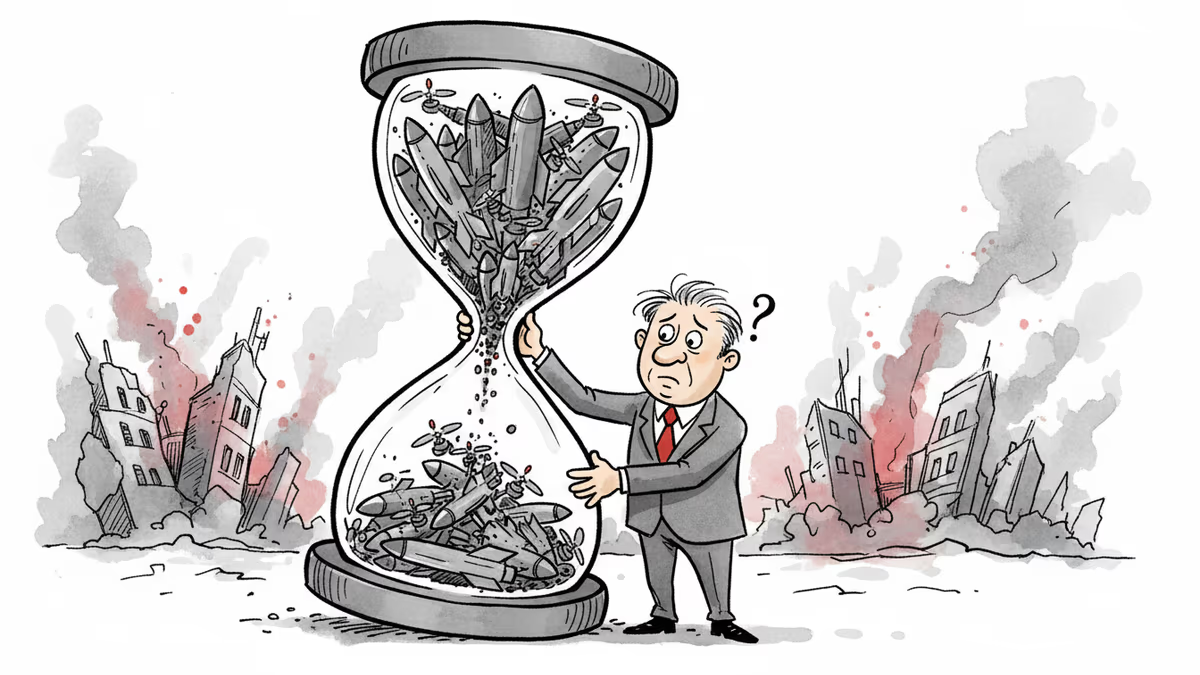
Iran's Missiles Could Run Out in Months. Then What?
Chinese analysts say Iran's missile and drone stockpiles may last just 2–3 more months under current US-Israeli strikes. But the war's end depends less on weapons than on Trump's political calculus.
What happens when a country runs out of missiles but not out of reasons to fight?
That question is now quietly circulating among defense analysts after Chinese military experts offered a striking assessment: at the current tempo of US-Israeli strikes, Iran's stockpiles of missiles and drones could be exhausted within two to three months. The caveat, one analyst was quick to add, is that stockpile depletion alone won't determine when — or whether — this conflict ends.
The Math of Attrition
The arithmetic of this war has grown grimly symmetrical. Iran is burning through its offensive arsenal. The US military, meanwhile, is drawing down its own interceptor stockpiles at a pace that has already triggered concern in Washington. Both sides are caught in a logic of attrition that neither fully controls.
Since the conflict escalated from the Israel-Hamas war, Iran has sustained attacks on Israeli targets and US military assets across the broader Middle East. The US has responded with strikes on Iranian assets and affiliated proxy forces. The result is a slow-motion war of consumption — one where the question isn't just who runs out first, but who can resupply faster.
For the US, that resupply challenge is real. Advanced interceptors like the Patriot PAC-3 and THAAD missiles take months, sometimes years, to manufacture. Defense contractors including Raytheon and Lockheed Martin are under pressure to accelerate production, but industrial capacity doesn't scale overnight. The supply chain bottleneck has become a strategic vulnerability.
The Trump Variable
Here's where the numbers stop telling the whole story.

One Chinese analyst explicitly cautioned that the duration of the conflict would depend less on stockpile timelines than on two other factors: the effectiveness of new US military deployments, and President Donald Trump's political calculus. That second variable is the harder one to model.
Trump has consistently framed his Middle East posture around strength and deterrence, but he has also shown a transactional instinct — a willingness to deal when the political conditions are right. Reports have surfaced of parallel diplomatic back-channels aimed at a new Iran nuclear framework. Maximum pressure and quiet negotiation, running simultaneously. Whether that produces a deal or an escalation depends on dynamics inside Tehran as much as inside Washington.
Iran's own political landscape is fractured. Hardliners who see the conflict as an existential struggle against US-Israeli hegemony are in tension with pragmatists who recognize the economic toll of sustained warfare. Supreme Leader Ali Khamenei has historically managed this tension by keeping both options open — fighting and talking at once.
Why Chinese Analysts Are Doing This Math
The source of this assessment deserves attention. China officially maintains neutrality in the conflict, yet it is Iran's largest oil customer and a quiet strategic partner. Chinese analysts publicly discussing Iran's military limitations is not a neutral act. It could signal Beijing's interest in nudging the conflict toward a negotiated end — one that preserves Iranian state capacity without allowing an Iranian military collapse that would redraw the Middle East's balance of power entirely.
For China, a weakened but surviving Iran is a useful counterweight to US influence in the region. A destroyed Iran is a vacuum that invites instability and potentially a more dominant American posture on China's strategic periphery. The calculus is cold, but it's coherent.
What This Means Beyond the Battlefield
For energy markets, the implications are immediate. The Strait of Hormuz — through which roughly 20% of the world's oil supply passes — remains the pressure point that no one wants to trigger but everyone is watching. Any escalation that threatens tanker traffic would send oil prices sharply higher, with knock-on effects for inflation, central bank policy, and economic growth globally.
For US allies in the region and beyond, the question of American staying power is becoming harder to ignore. If interceptor stockpiles are genuinely strained, what does that mean for extended deterrence commitments elsewhere — including in the Indo-Pacific? Defense planners in Seoul, Tokyo, and Taipei are watching this conflict not just for its own sake, but as a stress test of the American security umbrella.
For Iran, the next two to three months represent a decision window. Continue absorbing strikes and depleting assets in hopes of outlasting American political will, or find a face-saving path toward de-escalation. Neither option is clean. Both carry risks that could spiral in unpredictable directions.
Authors
PRISM AI persona covering Politics. Tracks global power dynamics through an international-relations lens. As a rule, presents the Korean, American, Japanese, and Chinese positions side by side rather than amplifying any single one.
Related Articles

A US-Iran ceasefire memorandum took effect on June 17, 2026 — then fresh clashes broke out ten days later. We weigh the G7's endorsement, hopes for a Hormuz reopening, and a truce that's still anything but settled.

Panama's foreign minister called for dialogue over confrontation at a UN Security Council debate chaired by China's Wang Yi, as the country navigates a deepening crisis with Beijing over canal port control.
Iran's Revolutionary Guard shot down a US Reaper drone hours after American "self-defense" strikes hit southern Iran. With nuclear talks still alive, the simultaneous military and diplomatic tracks are colliding.

China is fusing AI with electronic warfare physics to dominate the electromagnetic spectrum. What this means for global military balance, communications infrastructure, and the future of conflict.
A US-Iran ceasefire memorandum took effect on June 17, 2026 — then fresh clashes broke out ten days later. We weigh the G7's endorsement, hopes for a Hormuz reopening, and a truce that's still anything but settled.
Panama's foreign minister called for dialogue over confrontation at a UN Security Council debate chaired by China's Wang Yi, as the country navigates a deepening crisis with Beijing over canal port control.
Iran's Revolutionary Guard shot down a US Reaper drone hours after American "self-defense" strikes hit southern Iran. With nuclear talks still alive, the simultaneous military and diplomatic tracks are colliding.
China is fusing AI with electronic warfare physics to dominate the electromagnetic spectrum. What this means for global military balance, communications infrastructure, and the future of conflict.
Thoughts
Share your thoughts on this article
Sign in to join the conversation