
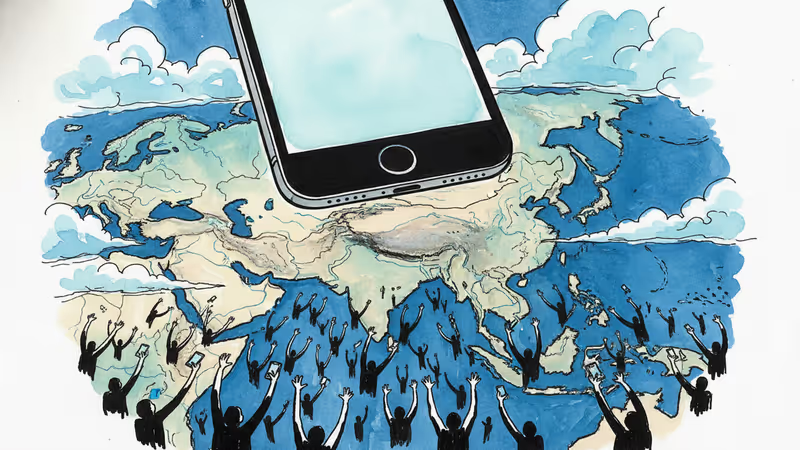
Why China Suddenly Can't Get Enough of iPhone 17
Apple's Q1 earnings hit record highs thanks to explosive iPhone growth in China and India. But what's driving this shift, and what does it mean for the global smartphone landscape?
$85 billion. That's how much Apple made from iPhone sales alone in Q1 – a 23% jump from last year's $69 billion. But here's the real story: it wasn't just about the numbers. It was about where those sales came from.
China and India – two markets where Apple has historically struggled – just became the company's biggest growth engines. And that shift could reshape the entire smartphone industry.
China's Surprising iPhone Renaissance
Greater China revenue exploded from $18.5 billion to $25.5 billion – a 38% surge that caught even seasoned analysts off guard. Tim Cook called it the "best iPhone quarter in history in Greater China," noting that store traffic grew by "strong double digits."
But why now? For years, Chinese consumers seemed to be moving away from American tech, embracing local champions like Huawei, Xiaomi, and Oppo. The trade war only reinforced this trend, making domestic brands feel almost patriotic.
The iPhone 17, launched in September, appears to have changed the game entirely. Cook attributed the success to "unprecedented demand" for the new model, but the reality is more nuanced.
Industry watchers point to several factors: the iPhone 17's genuine technological leap, China's economic recovery boosting premium spending, and perhaps most importantly, a generational shift. Younger Chinese consumers increasingly view smartphones as personal statements rather than political ones.
India: The New Frontier

India's performance was equally striking. Cook highlighted it as "the second largest smartphone market in the world and the fourth largest PC market," where Apple set quarterly records for iPhone, Mac, iPad, and services revenue.
This is remarkable for a market long considered too price-sensitive for Apple. But India's rapidly expanding middle class is changing that narrative. Premium smartphones are becoming status symbols among young professionals, and Apple's local manufacturing strategy is paying dividends.
The company's "Made in India" push isn't just about cost savings – it's about credibility. Local production helps Apple navigate import duties while appealing to nationalist sentiment around domestic manufacturing.
Global Implications
Apple's Asia surge isn't happening in isolation. The company posted growth across every geographic region: Americas revenue jumped from $52.6 billion to $58.5 billion, while Europe grew from $33.8 billion to $38.1 billion.
This global momentum puts pressure on competitors, particularly Samsung, which has been losing ground in premium segments. The Korean giant's struggles in China are well-documented, and now Apple's Indian success threatens Samsung's dominance there too.
For investors, the question isn't just about this quarter's numbers – it's about sustainability. Can Apple maintain this momentum as Chinese economic growth slows? Will Indian consumers stick with premium pricing as local alternatives improve?
The Bigger Picture
Apple's success reveals something deeper about global consumer behavior. Despite geopolitical tensions and economic uncertainty, people still gravitate toward products they perceive as superior – regardless of origin.
This trend has implications beyond smartphones. It suggests that brand loyalty isn't as fragile as many assumed, and that innovation can transcend political boundaries. But it also raises questions about market concentration and whether consumers will have meaningful choices as tech giants consolidate their dominance.
Authors
Related Articles

Huawei's CANN is open source under a license barring software for non-Ascend chips. Inside China's second CUDA, and the two links still outside it: pre-training compute and 5nm capacity.

China is restricting AI researchers and startup founders from traveling abroad as the U.S.-China AI performance gap narrows to just 2.7%. What Beijing's talent lockdown means for the global AI race.
After 15 years of fragmented mobile messaging, Apple and Google are rolling out end-to-end encrypted RCS messaging between iPhones and Android devices. Here's what changed, why it took so long, and what it means for your privacy.
Apple agreed to pay $250 million to settle claims it misled iPhone 16 buyers about Apple Intelligence features. What this means for consumers, Big Tech marketing, and the AI industry.
Huawei's CANN is open source under a license barring software for non-Ascend chips. Inside China's second CUDA, and the two links still outside it: pre-training compute and 5nm capacity.
China is restricting AI researchers and startup founders from traveling abroad as the U.S.-China AI performance gap narrows to just 2.7%. What Beijing's talent lockdown means for the global AI race.
After 15 years of fragmented mobile messaging, Apple and Google are rolling out end-to-end encrypted RCS messaging between iPhones and Android devices. Here's what changed, why it took so long, and what it means for your privacy.
Apple agreed to pay $250 million to settle claims it misled iPhone 16 buyers about Apple Intelligence features. What this means for consumers, Big Tech marketing, and the AI industry.
Thoughts
Share your thoughts on this article
Sign in to join the conversation