
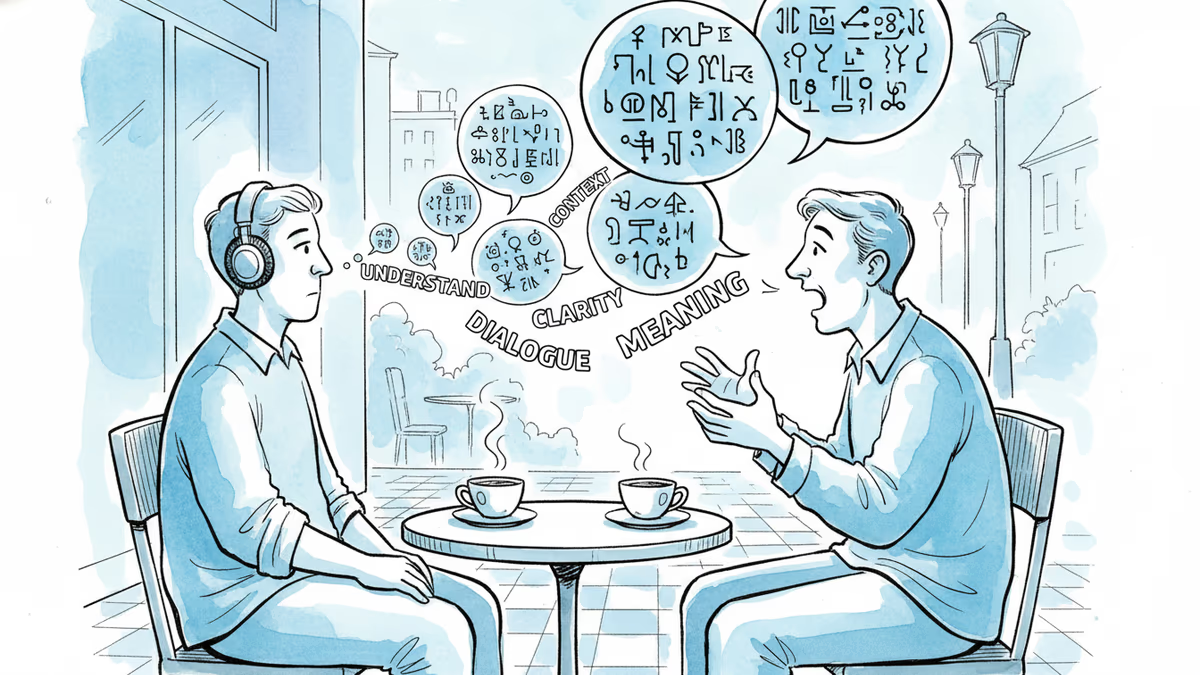
AirPods Max 2: The $549 Earpiece That Wants to Be Your Interpreter
Apple's AirPods Max 2 arrives with AI-powered live translation, 1.5x stronger noise cancellation, and a $549 price tag. Is this the future of wearable AI — or a premium solution to a problem most people don't have?
The last time you paid a human interpreter by the hour, the bill probably stung. Apple just put a competing option on your head for $549.
What Apple Actually Announced
The AirPods Max 2 launched in March 2026 as the first major refresh to Apple's over-ear headphones since their debut in 2020. The price holds steady at $549, but the internals have been rebuilt around the H2 chip — the same processor that powers the AirPods Pro 2.
The headline feature is AI-powered live translation. Wear the headphones, and speech in a foreign language is translated into your preferred language in real time — no app to open, no phone to fumble with. It's a feature that sounds modest in a press release and genuinely disorienting the first time it works.
Beyond translation, the noise cancellation is now 1.5 times more effective than the original — itself considered best-in-class when it launched. Apple has also added conversation awareness, which automatically lowers volume when someone nearby starts talking to you, and voice isolation, which strips background noise from calls so the person on the other end hears only you.
Why This Matters Beyond the Spec Sheet
The timing is deliberate. Apple has spent the past year embedding Apple Intelligence across its device lineup — on-device AI that processes locally rather than in the cloud. The AirPods Max 2 represents something new in that strategy: AI that works through your ears, not your screen.
This is a meaningful shift. The dominant model of AI interaction has been visual — you type a prompt, you read a response. Ambient audio AI, where the device interprets your environment and feeds you information without you asking, is a different paradigm entirely. It's closer to the science fiction vision of AI as a constant, invisible companion.

For Apple, the strategic logic is clear. Every feature that works better inside the Apple ecosystem — translation that syncs with your iPhone, noise cancellation tuned by your Apple Watch health data, Siri integration — is a feature that makes leaving that ecosystem more costly. The headphones are good hardware. They're also a lock-in mechanism.
The Case For and The Case Against
The enthusiast argument is straightforward: $549 for a device that handles noise cancellation, premium audio, hands-free translation, and seamless calls is defensible math for frequent travelers and professionals who currently pay for translation apps, noise-canceling headphones, and dedicated call hardware separately.
The skeptic's argument is equally straightforward: AI translation accuracy in high-stakes, fast-moving conversation remains unproven at this level. A mistranslated phrase in a business negotiation or a medical consultation isn't a minor inconvenience — it's a liability. And the feature requires an iPhone to function, meaning the $549 is really a $549 add-on to a device you already need to own.
There's also a market positioning question. Sony's WH-1000XM series and Samsung's Galaxy Buds line have competed fiercely on noise cancellation and audio quality at lower price points. Apple's move to fold AI translation into the hardware shifts the battleground from acoustic performance to software ecosystem integration — a fight Apple is structurally better positioned to win, but one that leaves non-Apple users entirely on the sidelines.
The Interpreter in the Room
The broader implication of real-time AI translation becoming a consumer hardware feature — rather than a specialized enterprise tool — deserves a moment's consideration. The professional translation and interpretation industry generates roughly $50 billion annually. High-end conference interpreting, legal translation, and medical interpretation require expertise that no current consumer device approaches.
But the lower end of that market — casual business meetings, tourist interactions, informal multilingual conversations — is exactly the kind of repetitive, structured task that AI handles well. If devices like the AirPods Max 2 become reliable enough for everyday cross-language communication, the demand for informal interpretation work contracts. That's not a crisis today. Over five years, it's a structural shift worth watching.
The counterargument, of course, is that removing friction from cross-language communication expands the total volume of international interaction — creating more demand for nuanced, high-quality human translation even as it automates the routine. Technology that lowers barriers tends to grow markets, not simply redistribute them.
Authors
Related Articles

Xreal's Project Aura debuted at Google I/O with OLED displays, hand tracking, and an IPO on the horizon. The industry has burned billions for a decade. So why does it feel like something has actually shifted?
After 15 years of fragmented mobile messaging, Apple and Google are rolling out end-to-end encrypted RCS messaging between iPhones and Android devices. Here's what changed, why it took so long, and what it means for your privacy.
Google is rebranding the Fitbit app as Google Health on May 19, launching an AI Health Coach powered by Gemini. What does this mean for your data, your doctor, and Apple?
Apple agreed to pay $250 million to settle claims it misled iPhone 16 buyers about Apple Intelligence features. What this means for consumers, Big Tech marketing, and the AI industry.
Xreal's Project Aura debuted at Google I/O with OLED displays, hand tracking, and an IPO on the horizon. The industry has burned billions for a decade. So why does it feel like something has actually shifted?
After 15 years of fragmented mobile messaging, Apple and Google are rolling out end-to-end encrypted RCS messaging between iPhones and Android devices. Here's what changed, why it took so long, and what it means for your privacy.
Google is rebranding the Fitbit app as Google Health on May 19, launching an AI Health Coach powered by Gemini. What does this mean for your data, your doctor, and Apple?
Apple agreed to pay $250 million to settle claims it misled iPhone 16 buyers about Apple Intelligence features. What this means for consumers, Big Tech marketing, and the AI industry.
Thoughts
Share your thoughts on this article
Sign in to join the conversation