
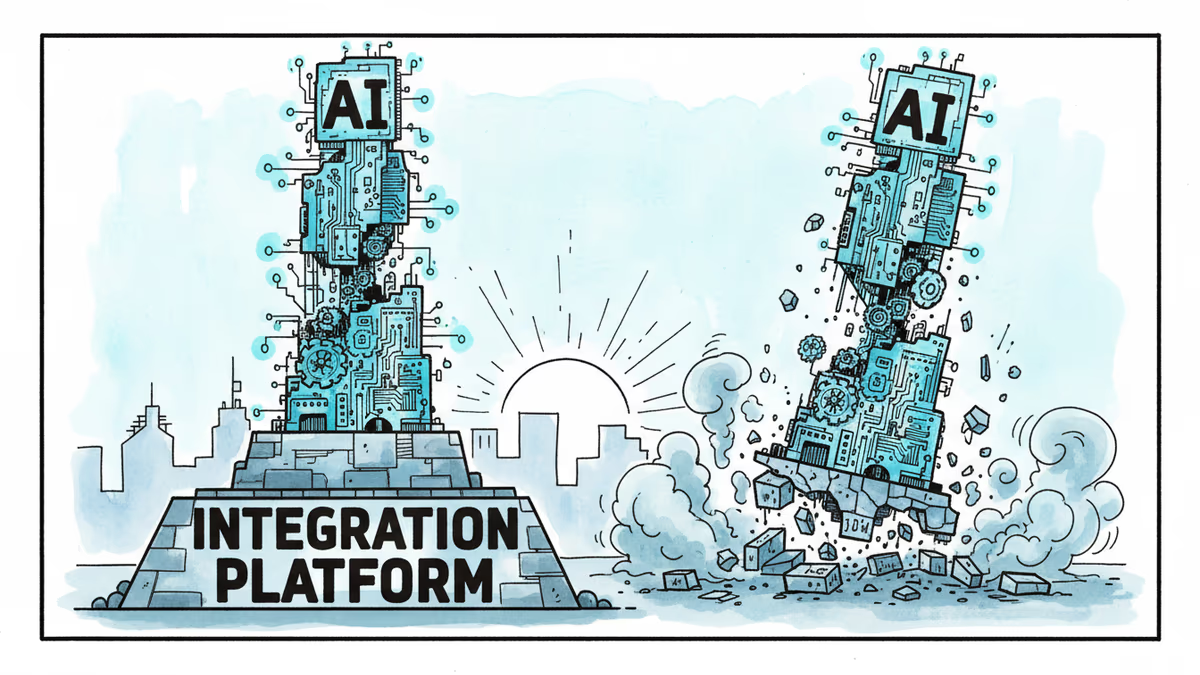
The Integration Divide: Why 40% of AI Projects Will Fail by 2027
MIT survey reveals 76% of companies run AI workflows, yet Gartner predicts 40% of AI projects will be cancelled by 2027. The difference? Integration infrastructure.
The 76% vs 40% Paradox
Two contradictory statistics are shaking up the enterprise AI conversation. MIT Technology Review's survey of 500 companies found 76% already have AI workflows in production. Yet Gartner predicts 40% of agentic AI projects will be cancelled by 2027.
This isn't a contradiction—it's a revelation. The technology isn't the bottleneck anymore. The real challenge is building the operational foundation to make AI actually work at scale.
The Integration Advantage: A 5x Difference
Companies with enterprise-wide integration platforms don't just perform better with AI—they dominate. The survey reveals these organizations are five times more likely to use diverse data sources in their AI workflows.
The numbers tell the story: 59% of companies with comprehensive integration platforms use five or more data sources, compared to just 11% of those with partial integration and 0% of those without integration platforms.
This isn't just about data variety—it's about AI sophistication. More data sources mean richer context, better accuracy, and more autonomous decision-making capabilities.

The Organizational Reality Check
Here's what might surprise executives: two-thirds of organizations don't even have dedicated AI teams. Only 34% have teams specifically maintaining AI workflows, while 21% rely on central IT and 25% push responsibility to individual departments.
This fragmented approach explains why so many AI initiatives stall. Without dedicated ownership and integrated systems, AI projects become expensive experiments rather than operational assets.
Success Patterns: Process Clarity Wins
The most successful AI implementations follow a clear pattern. 43% of organizations find success applying AI to well-defined, automated processes. Another 25% succeed with entirely new processes, while 32% apply AI across various workflows.
The common thread? Process clarity. AI thrives on structured, predictable environments where data flows smoothly and outcomes can be measured consistently.
The 2027 Survival Test
Gartner's prediction of 40% project cancellations centers on three factors: cost, inaccuracy, and governance challenges. But the survey data suggests these are symptoms of a deeper problem—the missing operational foundation.
Companies building on integrated platforms report higher confidence in AI autonomy, more multi-departmental implementations, and better governance oversight. They're not just running AI; they're scaling it sustainably.
Authors
Related Articles

OpenAI killed Sora six months after launch — not because of a data scandal, but because it was hemorrhaging money while users walked away. A WSJ investigation reveals what really happened, and what it means for the AI industry.
At Apple's 50th anniversary, top executives insisted the iPhone will anchor the AI era—and beyond. But is that confidence visionary or a warning sign?

While companies rush into generative AI, most projects fail to deliver value. Mistral AI reveals the 4 criteria that separate successful AI transformations from expensive experiments.
Uber launches AV Labs to share road data with 20+ autonomous vehicle partners at no cost. The real strategy behind this Tesla-inspired move revealed.
OpenAI killed Sora six months after launch — not because of a data scandal, but because it was hemorrhaging money while users walked away. A WSJ investigation reveals what really happened, and what it means for the AI industry.
At Apple's 50th anniversary, top executives insisted the iPhone will anchor the AI era—and beyond. But is that confidence visionary or a warning sign?
While companies rush into generative AI, most projects fail to deliver value. Mistral AI reveals the 4 criteria that separate successful AI transformations from expensive experiments.
Uber launches AV Labs to share road data with 20+ autonomous vehicle partners at no cost. The real strategy behind this Tesla-inspired move revealed.
Thoughts
Share your thoughts on this article
Sign in to join the conversation