
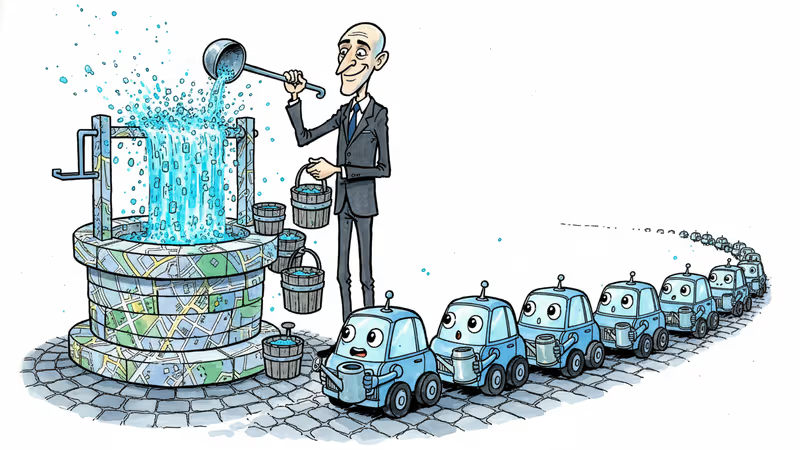
Why Uber Is Giving Away Self-Driving Data for Free (It's Not Charity)
Uber launches AV Labs to share road data with 20+ autonomous vehicle partners at no cost. The real strategy behind this Tesla-inspired move revealed.
Uber has 20+ autonomous vehicle partners, and they all want the same thing: real-world driving data. So the ride-hailing giant just announced it'll give them exactly that—for free.
The company's new AV Labs division will deploy sensor-equipped cars across cities to collect road data for partners like Waymo, Waabi, and Lucid Motors. The twist? Uber isn't charging for it. At least not yet.
"Our goal, primarily, is to democratize this data," says Praveen Neppalli Naga, Uber's Chief Technology Officer. "The value of this data and having partners' AV tech advancing is far bigger than the money we can make from this."
From Tragedy to Strategy Pivot
Uber's relationship with autonomous vehicles hasn't always been collaborative. The company once poured resources into developing its own robotaxis until a 2018 tragedy changed everything. One of its test vehicles killed a pedestrian, leading Uber to eventually sell its entire self-driving division to Aurora in 2020.
Now, instead of building the cars, Uber wants to become the data supplier for everyone else building them. It's a complete strategic reversal—from competitor to enabler.
The Data Bottleneck Problem
Self-driving cars are shifting from rules-based systems to reinforcement learning, making real-world driving data incredibly valuable. But there's a physical constraint: the size of an autonomous vehicle company's fleet limits how much data it can collect.
Even Waymo, which has operated autonomous vehicles for a decade, recently got caught illegally passing stopped school buses. The problem isn't the technology—it's the sheer volume of edge cases that only emerge through massive data collection.
Danny Guo, Uber's VP of Engineering, puts it bluntly: "Partners are saying: 'give us anything that will be helpful.' Because the amount of data Uber can collect just outweighs everything that they can possibly do with their own data collection."

The Tesla Playbook, Uber Style
This approach sounds familiar because Tesla has been doing essentially the same thing for the past decade—using its customer fleet to collect training data. The difference? Tesla has millions of cars on roads worldwide. Uber's starting with just one Hyundai Ioniq 5.
"We don't know if the sensor kit will fall off, but that's the scrappiness we have," Guo laughs, describing his team literally screwing on lidars, radars, and cameras.
But Uber has a different advantage: geographic reach. With operations in 600 cities, the company can deploy targeted data collection based on partner needs. "If a partner tells us they're interested in a particular city, we can just deploy our cars there," Guo explains.
Beyond Raw Data: The Intelligence Layer
Partners won't just receive raw sensor data. Uber plans to add what Naga calls a "semantic understanding" layer—processed data that autonomous vehicle software can actually use for real-time path planning.
The company will even run partners' driving software in "shadow mode" on AV Labs cars. Whenever the human driver does something different from what the AI would do, Uber flags it. This helps discover software shortcomings and train models to drive more like humans and less like robots.
The Long Game: Platform Power
While Uber claims altruistic motives, the business logic is clear. By becoming the go-to data provider for autonomous vehicle development, Uber positions itself at the center of an industry that could reshape transportation.
The company expects to grow AV Labs to "a few hundred people" within a year and hints at eventually leveraging its entire ride-hail fleet for data collection. That would create a data moat that individual AV companies simply couldn't match.
For now, though, it's starting small and scrappy—one car, a handful of sensors, and partnerships that exist more in handshake agreements than signed contracts.
Authors
Related Articles
Waymo's new Ojai robotaxi isn't just a vehicle upgrade. It's the company's most serious attempt yet at cracking the cost problem that has kept autonomous vehicles from scaling. Here's what's really at stake.

Google's Gmail Live lets you ask your inbox questions out loud. Announced at I/O 2026, it's AI's pitch to skeptics — and a reminder of how much Google already knows about you.

OpenAI has reorganized for the second time in a month, merging ChatGPT and Codex into a single agentic platform under president Greg Brockman's unified product leadership.
AI sustainability researcher Sasha Luccioni is launching a new venture to push for energy transparency in AI. Here's why Big Tech keeps the numbers hidden—and what's starting to change.
Waymo's new Ojai robotaxi isn't just a vehicle upgrade. It's the company's most serious attempt yet at cracking the cost problem that has kept autonomous vehicles from scaling. Here's what's really at stake.
Google's Gmail Live lets you ask your inbox questions out loud. Announced at I/O 2026, it's AI's pitch to skeptics — and a reminder of how much Google already knows about you.
OpenAI has reorganized for the second time in a month, merging ChatGPT and Codex into a single agentic platform under president Greg Brockman's unified product leadership.
AI sustainability researcher Sasha Luccioni is launching a new venture to push for energy transparency in AI. Here's why Big Tech keeps the numbers hidden—and what's starting to change.
Thoughts
Share your thoughts on this article
Sign in to join the conversation