
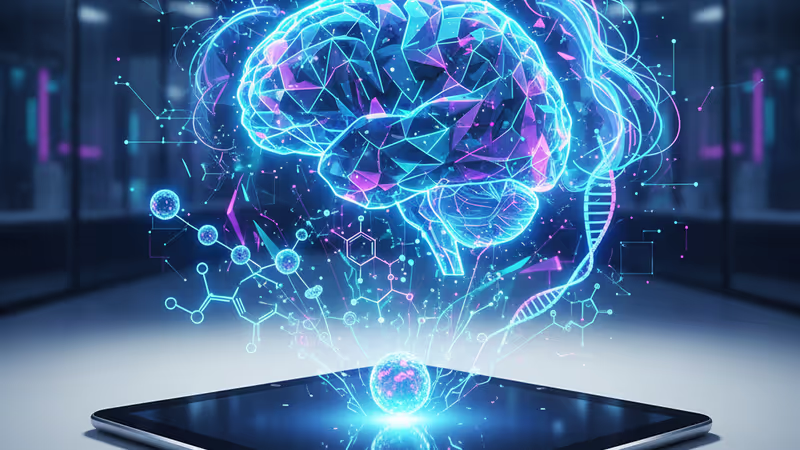
Taming the Molecular Casino: Insilico Medicine Hong Kong IPO and the Rise of Digital Einstein
Insilico Medicine goes public in Hong Kong, unveiling its 'digital Einstein' AI to tackle the 90% failure rate in the 'molecular casino' of drug discovery.
It's a high-stakes gamble in the world of drug discovery, but Insilico Medicine is betting big on AI. The biotech firm made its debut on the Hong Kong Stock Exchange this Tuesday, December 30, 2025. Backed by the Hong Kong Investment Corporation (HKIC), the company's scaling its vision to build a 'digital Einstein'—an AI powerhouse designed to solve the most complex puzzles in medicine.
Insilico Medicine Hong Kong IPO 2025: Navigating High-Risk Biotech
Founder Alex Zhavoronkov hasn't minced words about the industry's volatility, calling biotechnology a 'molecular casino.' Even with advanced AI, scientists face a staggering 90% failure rate in drug development. Despite these odds, the 11-year-old company aims to flip the script by leveraging generative AI to streamline the path from laboratory to patient.

The company's expansion strategy is firmly rooted in China. By listing in Hong Kong, Insilico plans to utilize the region's capital and research infrastructure to maintain its edge over global rivals. The support from HKIC signals a deeper strategic alignment between tech innovation and regional economic goals, providing the necessary fuel for its massive data-crunching operations.
Authors
Related Articles
CAR T cell therapy, proven in blood cancers, is now in hundreds of clinical trials for MS, lupus, and other autoimmune conditions. What the science shows—and what it doesn't yet.
R3 Bio wants to grow human bodies without brains as biological backups. The science is speculative. The ethics are explosive. And the legal framework doesn't exist yet.
Colossal Biosciences raised hundreds of millions to resurrect woolly mammoths and dire wolves. What they're actually doing is more complicated—and more interesting.
California startup R3 Bio quietly pitched investors on 'brainless human clones' as backup bodies—beyond its public story of nonsentient organ sacks for drug testing. A deep dive into biotech's most ethically charged frontier.
CAR T cell therapy, proven in blood cancers, is now in hundreds of clinical trials for MS, lupus, and other autoimmune conditions. What the science shows—and what it doesn't yet.
R3 Bio wants to grow human bodies without brains as biological backups. The science is speculative. The ethics are explosive. And the legal framework doesn't exist yet.
Colossal Biosciences raised hundreds of millions to resurrect woolly mammoths and dire wolves. What they're actually doing is more complicated—and more interesting.
California startup R3 Bio quietly pitched investors on 'brainless human clones' as backup bodies—beyond its public story of nonsentient organ sacks for drug testing. A deep dive into biotech's most ethically charged frontier.
Thoughts
Share your thoughts on this article
Sign in to join the conversation