
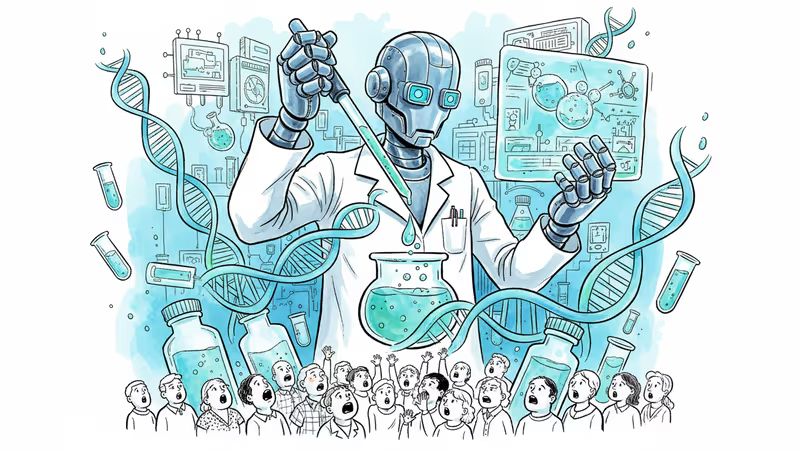
AI Tackles Medicine's Hardest Problem: Rare Diseases
Artificial intelligence is addressing the talent shortage in drug discovery, offering new hope for thousands of untreated rare diseases through automated research and gene editing.
7,000. That's how many rare diseases we know about. Yet only 5% have treatments. The bottleneck isn't technology—we can edit genes and design drugs. The missing ingredient? Smart people to do the work.
Biotech companies like Insilico Medicine and GenEditBio are betting AI can fill that gap. Speaking at Web Summit Qatar, Insilico's founder Alex Aliper outlined his company's ambitious goal: building "pharmaceutical superintelligence." The company recently launched its "MMAI Gym," training generalist large language models like ChatGPT to perform as well as specialist drug discovery systems.
The Talent Crunch Behind Medical Neglect
"There are still thousands of diseases without a cure, without any treatment options, and there are thousands of rare disorders which are neglected," Aliper told TechCrunch. His solution? More intelligent systems to tackle problems the industry has long ignored due to resource constraints.
Insilico's platform ingests biological, chemical, and clinical data to generate hypotheses about disease targets and candidate molecules. By automating steps that once required armies of chemists and biologists, the company claims it can dramatically reduce both cost and time. Recently, they used AI models to identify whether existing drugs could be repurposed to treat ALS, a rare neurological disorder.
But drug discovery is only half the battle. Many diseases require interventions at a more fundamental biological level—that's where gene editing comes in.
Editing Genes Inside the Body
GenEditBio represents the "second wave" of CRISPR gene editing, moving away from editing cells outside the body toward precise delivery inside living tissue. Their goal: make gene editing a one-and-done injection directly into affected areas.

"We have developed a proprietary ePDV, or engineered protein delivery vehicle, and it's a virus-like particle," co-founder and CEO Tian Zhu explained. "We learn from nature and use AI machine learning methods to mine natural resources and find which kinds of viruses have an affinity to certain types of tissues."
The company maintains a massive library of thousands of unique, nonviral, nonlipid polymer nanoparticles—essentially delivery vehicles designed to safely transport gene-editing tools into specific cells. Their NanoGalaxy platform uses AI to analyze how chemical structures correlate with specific tissue targets like the eye, liver, or nervous system. The AI then predicts which chemical tweaks will help a delivery vehicle carry its payload without triggering an immune response.
The Data Problem That Won't Go Away
As with many AI-driven systems, progress ultimately hits a data wall. Modeling the edge cases of human biology requires far more high-quality data than researchers currently possess.
"We still need more ground truth data coming from patients," Aliper noted. "The corpus of data is heavily biased over the western world, where it is generated. I think we need to have more efforts locally, to have a more balanced set of original data."
Zhu takes a different approach, arguing the data AI needs already exists—in the human body itself, shaped by thousands of years of evolution. Only a small fraction of DNA directly "codes" for proteins, while the rest acts like an instruction manual for how genes behave. That information has historically been difficult for humans to interpret but is increasingly accessible to AI models, including recent efforts like Google DeepMind's AlphaGenome.
Racing Against Time and Biology
The stakes couldn't be higher. The FDA approves around 50 drugs annually—a plateau that hasn't budged much in recent years. Meanwhile, chronic disorders are rising as the global population ages. Aliper's hope? "In 10 to 20 years, we will have more therapeutic options for the personalized treatment of patients."
GenEditBio recently received FDA approval to begin trials of CRISPR therapy for corneal dystrophy. But scaling from individual successes to systematic solutions remains the industry's biggest challenge. The next frontier, according to Aliper, involves building digital twins of humans to run virtual clinical trials—a process he admits is "still in nascence."
Authors
Related Articles

Samsung and SK unveiled a chip and AI investment package worth thousands of trillions of won on June 29. The headline number swings wildly by outlet, but the real contest isn't capital — it's water and power.

Viral videos show 2026 graduates jeering executives who praise AI at commencement ceremonies. It's not just rudeness — it's a signal about who pays for technological optimism.

Filipino virtual assistants using AI to ghost-manage LinkedIn profiles for executives is now a structured industry. 30 comments a day, fake engagement rings, and a platform struggling to tell real from fabricated.
Two commencement speakers learned the hard way that AI enthusiasm doesn't land well with today's graduates. The backlash reveals a widening gap between tech optimism and Gen Z's economic reality.
Samsung and SK unveiled a chip and AI investment package worth thousands of trillions of won on June 29. The headline number swings wildly by outlet, but the real contest isn't capital — it's water and power.
Viral videos show 2026 graduates jeering executives who praise AI at commencement ceremonies. It's not just rudeness — it's a signal about who pays for technological optimism.
Filipino virtual assistants using AI to ghost-manage LinkedIn profiles for executives is now a structured industry. 30 comments a day, fake engagement rings, and a platform struggling to tell real from fabricated.
Two commencement speakers learned the hard way that AI enthusiasm doesn't land well with today's graduates. The backlash reveals a widening gap between tech optimism and Gen Z's economic reality.
Thoughts
Share your thoughts on this article
Sign in to join the conversation