
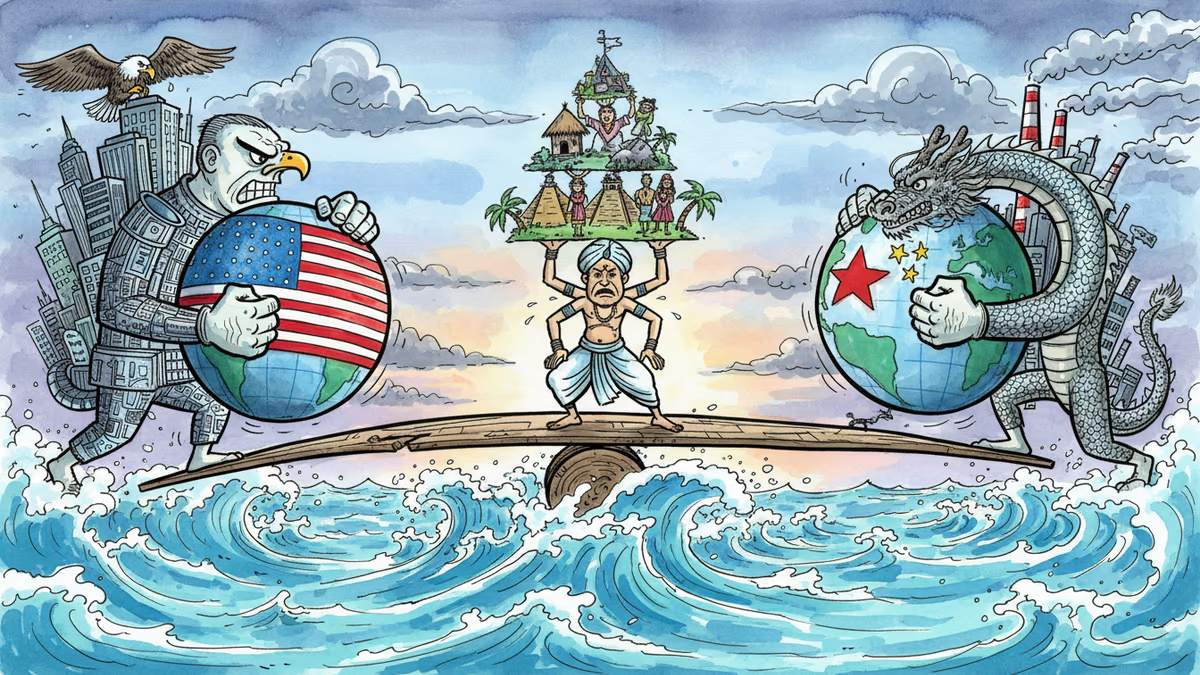
India's AI Summit Dreams of a 'Third Way'—But Is It Real?
As India hosts the first AI Impact Summit for developing nations, can it truly offer an alternative to US-China AI dominance, or is it just another market expansion play for Big Tech?
When 1.4 Billion People Become an AI Testing Ground
India is hosting the first AI Impact Summit among developing countries, promising to "give voice to the Global South" and democratize AI resources. But beneath the noble rhetoric lies a harder truth: India wants to carve out a third way between US and Chinese AI dominance, using its 1.4 billion citizens as both market and proof of concept.
The question isn't whether India can host a successful summit—it's whether this "third way" is genuinely different or just a more sophisticated form of the same old power dynamics.
The Global South's Faustian Bargain
India isn't alone in this game. Rwanda and Nigeria position themselves as scaling hubs, while the UAE courts Big Tech capital for AI infrastructure. The pattern is clear: developing nations are essentially advertising their populations as paths to scale for AI companies.
The pitch sounds familiar because it mirrors earlier development narratives. Promise to solve poverty and climate crisis with AI, but obscure who bears the costs and who captures the value. The reality is stark: these countries provide AI's fuel through content moderation, data labeling, and even humans pretending to be AI. Their critical minerals power the AI supply chain, while their land, energy, and water—already scarce resources—get diverted to data centers.
India's DPI Strategy: Innovation or Repackaging?
India's ace card is Digital Public Infrastructure (DPI)—a state-backed technology stack modeled on India's digital identity program Aadhaar, unified payments interface, and data exchange systems. It promises scalable, context-specific, cost-effective tech solutions as an alternative to Big Tech-dominated systems.
But there's a gap between promise and practice. Despite messaging around "openness," many DPI applications are experienced as closed, inscrutable systems enabling surveillance and facilitating private capture of public functions. Algorithmic decision-making for welfare access has locked people out of benefits with little accountability. And despite challenging Big Tech hegemony, India's open payment protocol is dominated by Google Pay and Walmart-owned PhonePe.

This tension reveals a deeper contradiction: India wants to be both challenger and partner to Big Tech simultaneously.
Big Tech's India Play: Sovereignty as a Service
While India emphasizes homegrown products, it's wide open for Big Tech business. OpenAI's Learning Accelerator focuses on expanding AI access for educators. Anthropic's India strategy targets agriculture, education, and Indian languages. Google pushes DPI-AI integration in healthcare while using India for model testing and improvement.
The result? India becomes a site for localizing existing models and achieving scale, but not a locus of control or leadership. These partnerships effectively make India a sophisticated testing ground rather than a sovereign AI power.
In courting US tech capital, India's own digital sovereignty aspirations don't even appear in the summit documentation—even as Big Tech offers "sovereignty-as-a-service" to governments worldwide.
The Governance Sleight of Hand
India's recently released AI Governance Guidelines reveal another contradiction. They ask regulators to "support innovation while mitigating real harms; avoid compliance-heavy regimes; promote techno-legal approaches." Translation: keep AI governance depoliticized, adaptable, and innovation-friendly to maintain global competitiveness.
This approach swings between techno-solutionism (code is law) and voluntary self-regulation (rules aren't enforceable). It's governance theater designed to reassure investors while avoiding hard questions about power distribution.
What This Means for the West
For Western observers, India's experiment offers a preview of how developing nations might navigate AI sovereignty while remaining dependent on Western (and Chinese) technology infrastructure. It's a case study in the limits of "alternative" approaches when the fundamental power structures remain unchanged.
The broader question for democratic societies: Can genuine alternatives to Big Tech dominance emerge from the Global South, or will these initiatives inevitably become sophisticated forms of market expansion for existing AI powers?
Authors
Related Articles

Samsung and SK unveiled a chip and AI investment package worth thousands of trillions of won on June 29. The headline number swings wildly by outlet, but the real contest isn't capital — it's water and power.

SolarSquare is raising $55-60M at a $450-500M valuation, more than doubling its worth in 18 months. Here's what's driving investor conviction in India's residential solar market.

Viral videos show 2026 graduates jeering executives who praise AI at commencement ceremonies. It's not just rudeness — it's a signal about who pays for technological optimism.

Filipino virtual assistants using AI to ghost-manage LinkedIn profiles for executives is now a structured industry. 30 comments a day, fake engagement rings, and a platform struggling to tell real from fabricated.
Samsung and SK unveiled a chip and AI investment package worth thousands of trillions of won on June 29. The headline number swings wildly by outlet, but the real contest isn't capital — it's water and power.
SolarSquare is raising $55-60M at a $450-500M valuation, more than doubling its worth in 18 months. Here's what's driving investor conviction in India's residential solar market.
Viral videos show 2026 graduates jeering executives who praise AI at commencement ceremonies. It's not just rudeness — it's a signal about who pays for technological optimism.
Filipino virtual assistants using AI to ghost-manage LinkedIn profiles for executives is now a structured industry. 30 comments a day, fake engagement rings, and a platform struggling to tell real from fabricated.
Thoughts
Share your thoughts on this article
Sign in to join the conversation