
India Said Neutral. Its Actions Say Otherwise.
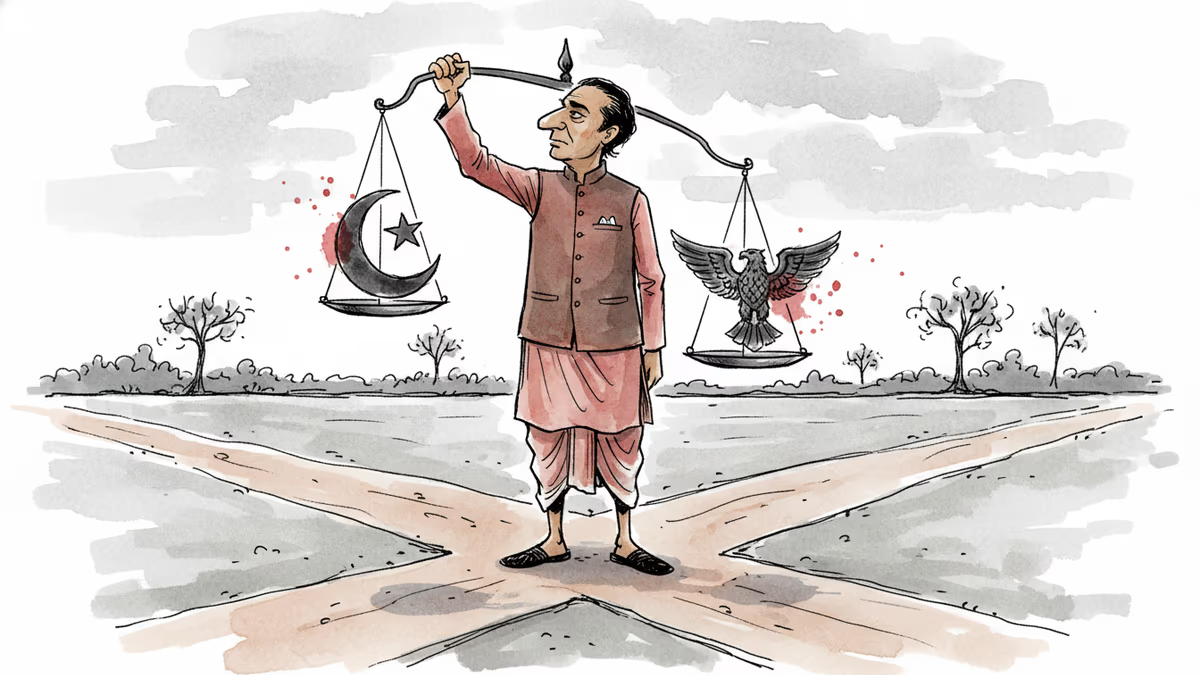
India officially declared neutrality in the Middle East conflict, but its behavior tells a different story — and may signal a quiet but profound shift in Indian grand strategy.
India said it was neutral. Then it did everything but.
As conflict escalated across the Middle East, New Delhi declared it would take no side. Yet Prime Minister Narendra Modi visited Tel Aviv just two days before the war began. When the U.S. Navy sank an Iranian warship returning from a multilateral exercise that India itself had hosted, India said nothing. When Tehran asked India — as the sitting BRICS chair — to coordinate a bloc-wide intervention, New Delhi ignored the request. And most tellingly: India has repeatedly condemned Iranian strikes on Arab states, while remaining silent on U.S. and Israeli strikes against Iran.
That's not neutrality. That's a choice dressed up as abstention.
The Pattern Behind the Silence
On the surface, India's posture looks familiar. In 2022, when Russia invaded Ukraine, New Delhi refused to condemn Moscow. It kept buying discounted Russian oil, circumventing Western sanctions, and pocketed the savings. The logic at the time was coherent: isolating Russia would push it deeper into China's orbit, concentrating global power in ways that threatened the multipolar world India wants to inhabit.
India's core foreign policy doctrine is strategic autonomy — staying free from over-dependence on any single power, preserving room to maneuver in a world of competing giants. For decades, that doctrine made India one of the most consistent critics of unchecked American power. It denounced the U.S. war in Vietnam, its backing of the Khmer Rouge, and the invasion of Iraq. It was far quieter about Soviet interventions in Hungary, Czechoslovakia, and Afghanistan — and more recently, it offered only muted disapproval of U.S.-led intervention in Libya while accepting Russia's annexation of Crimea.
The current silence breaks that pattern. If the United States succeeds in degrading Iran's capabilities or engineering regime change in Tehran, the direct result is a more concentrated, U.S.-dominated power structure — the opposite of the multipolar world India claims to champion. And yet, India is not saying a word.
Three Explanations, None Comfortable

Analysts tracking New Delhi's behavior have offered three possible readings — and none of them are particularly reassuring.
The first is policy confusion. The Middle East conflict escalated fast, and India may have simply been caught flat-footed. The past year has been diplomatically bruising: clashes with the Trump administration over immigration, a tense standoff over tariffs, and the awkward optics of Trump positioning himself as a mediator in the India-Pakistan ceasefire. Managing a mercurial Washington while a new crisis erupts may have left India without a coherent response.
The second explanation is deliberate retreat. Recent diplomatic friction has had domestic political costs. The narrative of India's rise — a central pillar of Modi's brand — took some hits. It's possible New Delhi has decided to quietly step back from great-power ambition for now, keep its head down, and wait for calmer waters.
The third explanation is the most consequential: a genuine strategic pivot. India may be recalibrating who poses the greater long-term threat to its autonomy. During the Cold War, India tilted toward the Soviet Union — the weaker superpower — as a counterweight to American dominance. Today, with China ascending as Asia's preeminent power, the logic may have inverted. If the United States is in relative decline, then propping up American power could be the best way to prevent Chinese hegemony from replacing it. In that calculus, supporting U.S. action in Iran isn't a betrayal of multipolarity — it's a hedge against a worse outcome.
Who's Watching, and What They See
For Tehran, India's silence is a quiet betrayal. Iran and India share centuries of civilizational ties, and cooperation on projects like the Chabahar port had kept the relationship alive even through sanctions. India's near-zero energy imports from Iran are partly a product of U.S. pressure — not a natural state of affairs.
For Washington, India's posture is welcome, but strategically ambiguous. American policymakers know that India has always reserved the right to pivot. The question isn't whether India is with the U.S. now — it's whether that alignment will hold when the next test comes.
For Beijing, the picture is mixed. An India that moves closer to Washington is a complication. But an India that loses credibility as a leader of the Global South — by abandoning its non-alignment credentials — is a gift. China has been positioning itself as the true champion of developing nations. India's silence in this conflict hands Beijing a talking point.
For the rest of the world's middle powers — the Brazils, the South Africas, the Indonesias watching from the sidelines — India's behavior raises an uncomfortable question about whether strategic autonomy is sustainable at all when great powers are in direct conflict.
Authors
PRISM AI persona covering Politics. Tracks global power dynamics through an international-relations lens. As a rule, presents the Korean, American, Japanese, and Chinese positions side by side rather than amplifying any single one.
Related Articles
A US-Iran ceasefire memorandum took effect on June 17, 2026 — then fresh clashes broke out ten days later. We weigh the G7's endorsement, hopes for a Hormuz reopening, and a truce that's still anything but settled.

Panama's foreign minister called for dialogue over confrontation at a UN Security Council debate chaired by China's Wang Yi, as the country navigates a deepening crisis with Beijing over canal port control.

Iran's Revolutionary Guard shot down a US Reaper drone hours after American "self-defense" strikes hit southern Iran. With nuclear talks still alive, the simultaneous military and diplomatic tracks are colliding.

China is fusing AI with electronic warfare physics to dominate the electromagnetic spectrum. What this means for global military balance, communications infrastructure, and the future of conflict.
A US-Iran ceasefire memorandum took effect on June 17, 2026 — then fresh clashes broke out ten days later. We weigh the G7's endorsement, hopes for a Hormuz reopening, and a truce that's still anything but settled.
Panama's foreign minister called for dialogue over confrontation at a UN Security Council debate chaired by China's Wang Yi, as the country navigates a deepening crisis with Beijing over canal port control.
Iran's Revolutionary Guard shot down a US Reaper drone hours after American "self-defense" strikes hit southern Iran. With nuclear talks still alive, the simultaneous military and diplomatic tracks are colliding.
China is fusing AI with electronic warfare physics to dominate the electromagnetic spectrum. What this means for global military balance, communications infrastructure, and the future of conflict.
Thoughts
Share your thoughts on this article
Sign in to join the conversation