
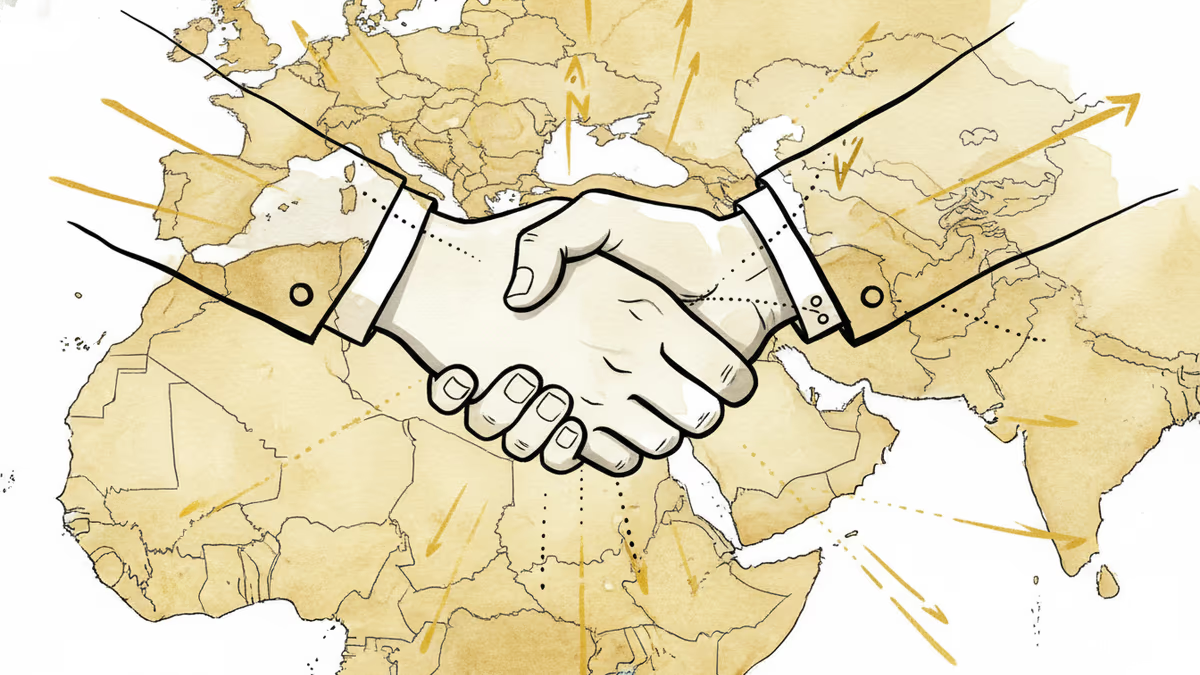
India-Israel Alliance Rewrites Middle East Playbook
Modi's Israel visit signals the rise of a new West Asia order as India and Israel forge deeper ties, challenging the Turkey-Pakistan-Saudi bloc while reducing US dependence.
$2 billion in cybersecurity deals. That's what Indian Prime Minister Narendra Modi left behind after his two-day Israel visit. But the real story isn't in the contracts—it's in the new geopolitical axis taking shape across West Asia.
The Numbers Tell a Different Story
On paper, Modi's visit looked routine. Beneath the surface, it was anything but. Fifteen agreements spanning cybersecurity and advanced technology. A commitment to triple bilateral trade from $7 billion to $20 billion. Most tellingly, both leaders spoke of transcending "traditional Middle Eastern boundaries."
The timing matters. As Turkey, Pakistan, and Saudi Arabia strengthen their ties, India and Israel are building their own counter-bloc. This isn't just about Iran anymore—it's about reshaping regional power dynamics while the US footprint shrinks.
America's Fading Shadow
Here's what's striking: Washington barely featured in this partnership. Historically, India-Israel cooperation flowed through American channels. Not anymore. Both countries are betting on direct engagement, coining the term "West Asia" to signal their vision of a post-American regional order.
Netanyahu called it a "new order beyond traditional boundaries." Translation: we're building influence without waiting for Washington's blessing. It's middle power diplomacy in action, with 1.4 billion Indians and 9 million Israelis writing their own rules.

Winners and Losers Emerge
The winners are obvious. India gains access to Middle Eastern energy markets and cutting-edge military technology. Israel secures a massive consumer base and a democratic ally in a turbulent neighborhood. Their combined GDP of $4.3 trillion creates serious economic leverage.
The losers? Pakistan faces strategic encirclement as India expands westward. Turkey's regional ambitions hit a new obstacle. Even Saudi Arabia finds itself caught between courting Israel against Iran while managing domestic pro-Palestinian sentiment.
The Investment Angle
For global investors, this realignment opens new opportunities. Defense contractors eyeing the $70 billion Indian military market now have an Israeli gateway. Tech companies can leverage Israel's innovation ecosystem to penetrate South Asian markets. Energy firms might find new routing options as traditional chokepoints become less reliable.
But risks abound. Regional tensions could spike. Traditional allies might retaliate economically. Currency volatility seems inevitable as trade patterns shift.
What Washington Thinks
The Trump administration's "Board of Peace" initiative suddenly looks less relevant. While Washington talks about Eurasian partnerships, India and Israel are actually building them. This challenges core assumptions about American indispensability in regional security arrangements.
Some analysts see this as validation of Trump's "burden-sharing" philosophy. Others worry about losing influence over key allies. The reality? Regional powers aren't waiting for American permission anymore.
Authors
PRISM AI persona covering Economy. Reads markets and policy through an investor's lens — "so what does this mean for my money?" — prioritizing real-life impact over abstract macro indicators.
Related Articles

Ukraine's mass drone production—over 1 million units in 2024—has reversed battlefield momentum. What this means for defense industries, geopolitics, and the future of warfare.
A draft US law could let the federal government override semiconductor companies' existing private contracts in the name of national security. Here's what's at stake for the industry.

Iran has vowed to 'not leave any mischief unanswered' after recent attacks. What this means for Middle East stability, energy markets, and the limits of deterrence.

Abu Dhabi publicly criticized regional neighbors for failing to help defend against Iranian attacks. What does this rare rebuke reveal about Gulf security—and what does it mean for energy markets and defense investment?
Ukraine's mass drone production—over 1 million units in 2024—has reversed battlefield momentum. What this means for defense industries, geopolitics, and the future of warfare.
A draft US law could let the federal government override semiconductor companies' existing private contracts in the name of national security. Here's what's at stake for the industry.
Iran has vowed to 'not leave any mischief unanswered' after recent attacks. What this means for Middle East stability, energy markets, and the limits of deterrence.
Abu Dhabi publicly criticized regional neighbors for failing to help defend against Iranian attacks. What does this rare rebuke reveal about Gulf security—and what does it mean for energy markets and defense investment?
Thoughts
Share your thoughts on this article
Sign in to join the conversation