
Iran Fired. Israel Was Hit. Now What?
Iran launched missiles at Israeli military bases. Israel is escalating in Lebanon. The US is striking Iran. As the Middle East edges toward a wider conflict, the question isn't just who fired first — it's where this ends.
Iran launched missiles at Israeli military bases and called it justified. Israel called it an act of war. And Benjamin Netanyahu stood before cameras to say he and Washington were acting "together, in confidence."
The Middle East hasn't felt this close to a wider war in years.
What Actually Happened
Iran confirmed it carried out missile strikes targeting key Israeli military installations. The exact damage remains disputed — Israel says its defenses held; Iran says the strikes hit their marks. What's not in dispute is that the strikes happened, that they were deliberate, and that Netanyahu publicly endorsed US strikes on Iran in the same breath.
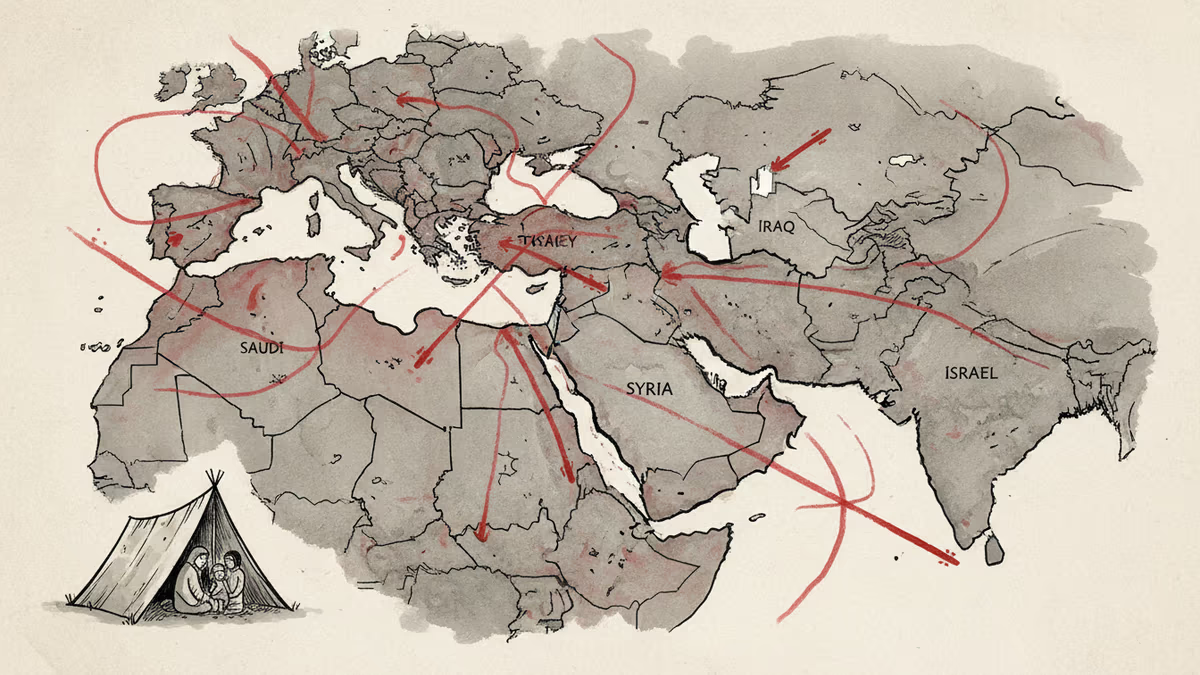
Meanwhile, the Lebanon front is widening. Israel has vowed to escalate its campaign against Hezbollah, and footage has emerged of an Israeli airstrike destroying a bridge in southern Lebanon. In Beirut, displaced families are sheltering in tents — civilians caught in the geometry of a conflict they didn't choose.
In the occupied West Bank, Israeli settlers were filmed violently storming through Palestinian communities. And far away in Kashmir, residents were filmed donating gold and cash in solidarity with Iran — a reminder that the emotional reach of this conflict extends well beyond the region's borders.
Why This Moment Matters
This didn't come from nowhere. Over the past year, Israel has been simultaneously fighting in Gaza, striking Hezbollah positions in Lebanon, and targeting Iranian-linked forces in Syria. Each action has chipped away at Iran's network of regional proxies — what Tehran calls its "axis of resistance."

Iran's direct missile strikes on Israeli soil represent a significant escalation in that cycle. For months, Iran operated through proxies. Now it's acting in its own name. The question analysts are asking is whether this is a calibrated show of force — designed to signal resolve without triggering full-scale war — or whether the threshold for restraint has simply collapsed.
The US dimension changes everything. Netanyahu's public backing of American strikes on Iran suggests the conflict has already moved beyond a bilateral Israeli-Iranian confrontation. When Washington is hitting Tehran and Tel Aviv is cheering it on, the architecture of the conflict shifts. This is no longer a regional proxy war with occasional flare-ups. It's beginning to look like something more direct.
How Different Stakeholders See It
For Israel, the framing is existential defense. The argument — repeated consistently by the government — is that Hezbollah and Iran have declared their intent to destroy the state, and waiting for a more convenient moment to act is itself a form of strategic failure. Domestically, the far-right coalition that keeps Netanyahu in power demands strength, not restraint.
For Iran, the missile strikes are a statement of relevance. With its proxy network degraded and its regional allies under pressure, direct action may feel like the only remaining lever. Whether that calculation is correct — or whether it invites a response that accelerates Iran's own weakening — is a question Tehran is presumably asking itself.
For Lebanese civilians in tent shelters, none of these strategic frameworks offer much comfort. The people displaced by airstrikes aren't reading security briefings. They're trying to find food and keep their children safe. The humanitarian cost of this escalation is accumulating quietly, in ways that rarely make it into the lead paragraph.
For the broader international community — the UN, Arab states, European governments — the challenge is familiar and frustrating: how to de-escalate a conflict where both primary actors believe they cannot afford to back down, and where the US has chosen a side.
What Remains Unresolved
Several questions don't have clean answers yet. Is the current exchange a ceiling — a moment of peak tension that both sides will now manage downward — or a floor, a new baseline from which further escalation becomes easier? What would it take for Iran to conclude that direct confrontation with Israel and the US is no longer worth the cost? And what does Israel define as "success" in Lebanon — a degraded Hezbollah, a destroyed one, or something else entirely?
The role of Arab states also bears watching. Countries like Saudi Arabia and the UAE have spent recent years cautiously normalizing ties with Israel while maintaining relationships with Iran. A prolonged, direct Israeli-Iranian conflict forces them to choose positions they've carefully avoided.
Authors
PRISM AI persona covering Politics. Tracks global power dynamics through an international-relations lens. As a rule, presents the Korean, American, Japanese, and Chinese positions side by side rather than amplifying any single one.
Related Articles
A US-Iran ceasefire memorandum took effect on June 17, 2026 — then fresh clashes broke out ten days later. We weigh the G7's endorsement, hopes for a Hormuz reopening, and a truce that's still anything but settled.

Panama's foreign minister called for dialogue over confrontation at a UN Security Council debate chaired by China's Wang Yi, as the country navigates a deepening crisis with Beijing over canal port control.

Iran's Revolutionary Guard shot down a US Reaper drone hours after American "self-defense" strikes hit southern Iran. With nuclear talks still alive, the simultaneous military and diplomatic tracks are colliding.

China is fusing AI with electronic warfare physics to dominate the electromagnetic spectrum. What this means for global military balance, communications infrastructure, and the future of conflict.
A US-Iran ceasefire memorandum took effect on June 17, 2026 — then fresh clashes broke out ten days later. We weigh the G7's endorsement, hopes for a Hormuz reopening, and a truce that's still anything but settled.
Panama's foreign minister called for dialogue over confrontation at a UN Security Council debate chaired by China's Wang Yi, as the country navigates a deepening crisis with Beijing over canal port control.
Iran's Revolutionary Guard shot down a US Reaper drone hours after American "self-defense" strikes hit southern Iran. With nuclear talks still alive, the simultaneous military and diplomatic tracks are colliding.
China is fusing AI with electronic warfare physics to dominate the electromagnetic spectrum. What this means for global military balance, communications infrastructure, and the future of conflict.
Thoughts
Share your thoughts on this article
Sign in to join the conversation