

Humans& Raises $480M Seed Round to Build AI with Social Intelligence
Humans&, founded by AI veterans, has raised a $480M seed round to build a new foundation model focused on social intelligence and team collaboration.
The era of one-on-one AI assistants is evolving into something far more complex: collective intelligence. Humans&, a startup founded by a "dream team" of alumni from Anthropic, OpenAI, and Google DeepMind, just announced a massive $480 million seed round. According to TechCrunch, this capital will fund the development of a "central nervous system" for human-AI collaboration.
Humans& AI Collaboration Seed Round 2026: Beyond Individual Chatbots
At just three months old, Humans& has already sparked a bidding war among investors. The company isn't just building another chatbot; it's designing a foundation model for social intelligence. CEO Eric Zelikman, formerly of xAI, argues that while current models are smart, workflows aren't. Humans& aims to close this gap by creating AI that can coordinate people with competing priorities and track long-running decisions.
The Technical Frontier: Long-Horizon and Multi-Agent RL

To achieve this, the team is focusing on Long-horizon Reinforcement Learning (RL) and Multi-agent RL. Unlike typical LLMs optimized for immediate user satisfaction, these models are trained to plan, act, and revise over time. Co-founder Yuchen He noted that the model needs to remember things about itself and the users to function as "connective tissue" across organizations.
We believe this is going to be a generational company, and we think that this has the potential to fundamentally change the future of how we interact with these models.
The stakes are high. Humans& is entering a field crowded by established giants. Anthropic is pushing Claude Cowork, while Google embeds Gemini directly into Workspace. Even smaller players like Granola—which recently raised $43 million at a $250 million valuation—are vying for the collaboration layer.
Authors
Related Articles

Samsung Electronics' union branch revealed that 84% of survey respondents oppose the government's roughly $290 billion (₩400 trillion) semiconductor megaproject in Gwangju. Government, management, the union and shareholders are all reading the same national project in sharply different ways.

Nvidia shipped roughly a billion RISC-V cores in 2024, then announced it would run CUDA on the open standard. We break down how royalty-free instruction sets and open software stacks are trying to route around CUDA's lock-in. Part 2 of the Semiconductor Sovereignty series.
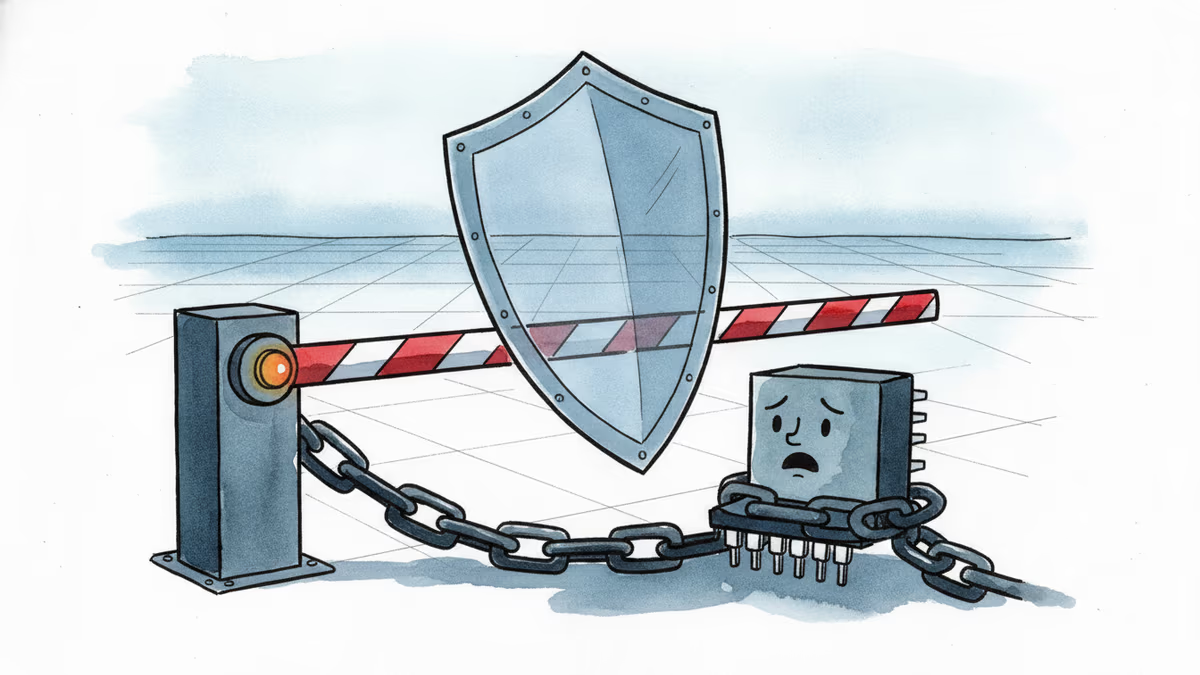
US AI-chip export controls split into three layers in the first half of 2026 — January easing, a May crackdown on circumvention, and a pending bill. Nvidia erased China from its guidance and still posted a record $81.6 billion quarter. A look at the export policy that both shields and cages it.
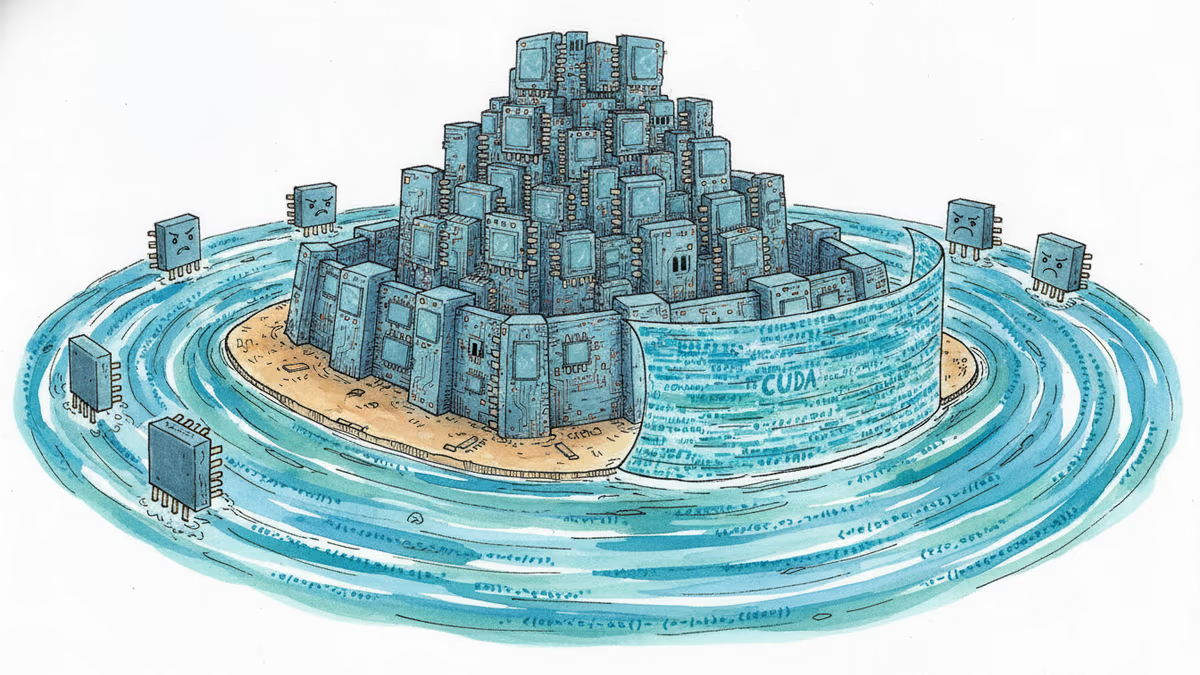
AMD's MI325X matches or beats Nvidia on memory and bandwidth — yet Nvidia's 86-92% share holds. The real moat is CUDA, 20 years in the making. Part 1 of 4.
Samsung Electronics' union branch revealed that 84% of survey respondents oppose the government's roughly $290 billion (₩400 trillion) semiconductor megaproject in Gwangju. Government, management, the union and shareholders are all reading the same national project in sharply different ways.
Nvidia shipped roughly a billion RISC-V cores in 2024, then announced it would run CUDA on the open standard. We break down how royalty-free instruction sets and open software stacks are trying to route around CUDA's lock-in. Part 2 of the Semiconductor Sovereignty series.
US AI-chip export controls split into three layers in the first half of 2026 — January easing, a May crackdown on circumvention, and a pending bill. Nvidia erased China from its guidance and still posted a record $81.6 billion quarter. A look at the export policy that both shields and cages it.
AMD's MI325X matches or beats Nvidia on memory and bandwidth — yet Nvidia's 86-92% share holds. The real moat is CUDA, 20 years in the making. Part 1 of 4.
Thoughts
Share your thoughts on this article
Sign in to join the conversation