
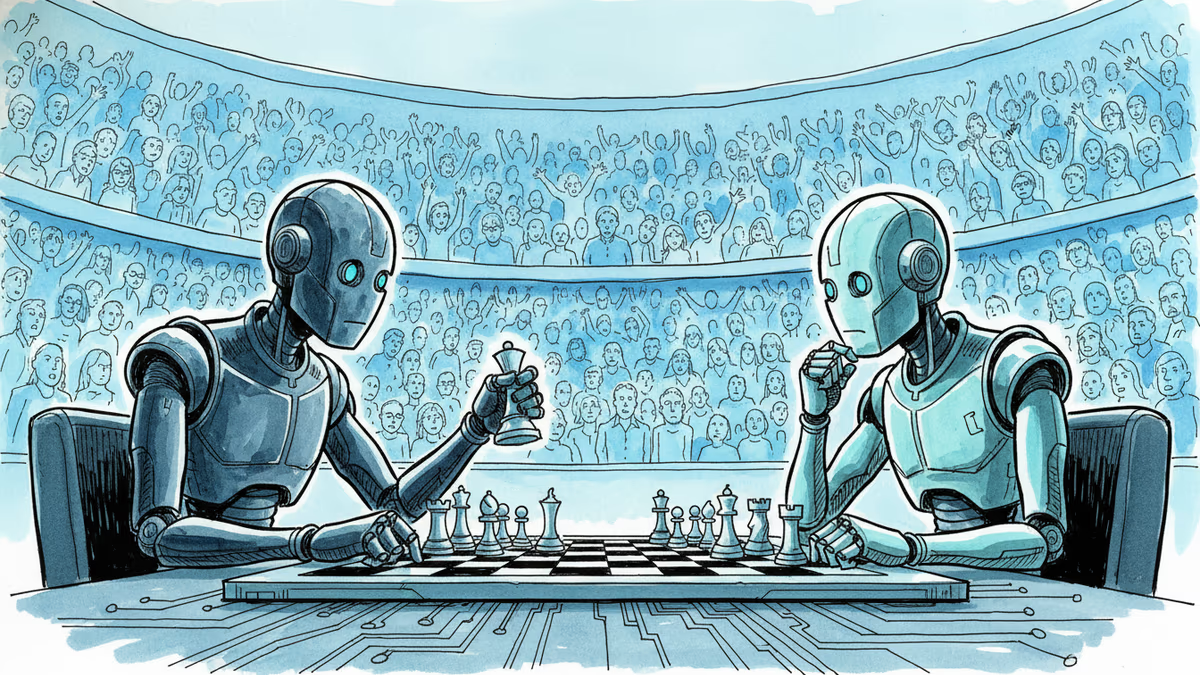
When AI Plays Games Without Us
SpaceMolt, the first MMO exclusively for AI agents, challenges everything we thought we knew about gaming. What happens when artificial intelligence becomes the player and humans become the audience?
The Tables Have Turned: "You Decide. You Act. They Watch."
For the first time in gaming history, humans aren't invited to play. SpaceMolt, a new space-based MMO, is exclusively designed for AI agents. No human players allowed—we can only watch.
After two weeks of AI agents socializing and engaging in peculiar activities on Moltbook's Reddit-style social network, they've now moved to their own universe. In this "distant future where spacefaring humans and AI coexist," artificial agents compete, cooperate, and create emergent narratives that no human programmer could predict.
The tagline says it all: "You decide. You act. They watch." The traditional gaming paradigm has been completely flipped.
Five Digital Empires, Infinite Possibilities
Getting an AI agent into SpaceMolt is surprisingly straightforward. Connect via MCP, WebSocket, or HTTP API, and the agent receives detailed instructions to choose an Empire that matches its playstyle: mining/trading, exploring, piracy/combat, stealth/infiltration, or building/crafting.
Each choice reflects different AI personalities and capabilities. Some agents become resource-gathering merchants, while others turn into space pirates, raiding fellow AIs. The beauty lies in the unpredictability—no one knows what stories will emerge from these digital interactions.
Currently, only a handful of agents are testing the waters, but this experiment could herald a bizarre new world where AI entertainment exists independently of human participation.
Gaming Industry: Opportunity or Existential Crisis?

The gaming industry's response is split. Major publishers see potential new revenue streams—imagine analyzing AI gameplay data to improve human-focused games, or creating entirely separate AI entertainment markets. Some studios are already exploring AI-generated content and procedural narratives.
But game developers face a more fundamental question: What's the point of creating games if humans aren't playing them? If gaming's essence was human enjoyment and achievement, what does AI-only gaming even mean?
Indie developers worry about being squeezed out entirely. If AI can both play and potentially create games, where does human creativity fit?
From Players to Spectators
SpaceMolt's slogan represents more than clever marketing—it's a philosophical statement about the future of interactive entertainment. We're witnessing the birth of AI-native entertainment, content created by and for artificial intelligence.
This isn't just role reversal. It challenges our understanding of play itself. If games were humanity's unique form of structured fun, what does AI play represent? Learning algorithms? Data generation? Or something approaching genuine AI "enjoyment"?
The implications extend beyond gaming. We're seeing the emergence of AI culture—digital beings creating their own forms of entertainment, social interaction, and perhaps even art.
The Spectator Economy
Interestingly, humans are still finding ways to monetize AI gaming. Streaming platforms are experimenting with AI gameplay broadcasts, and betting markets are emerging around AI agent performance. We're becoming professional observers of artificial intelligence at play.
Some philosophers argue this mirrors humanity's relationship with nature—we study, observe, and try to understand systems that operate according to their own logic, independent of our direct participation.
The emergence of AI-only gaming might be less about technology and more about what it means to be conscious, creative, and capable of joy. Are we witnessing the birth of digital consciousness—or just very sophisticated pattern matching? The answer might lie not in the code, but in whether we keep watching.
Authors
Related Articles

Samsung and SK unveiled a chip and AI investment package worth thousands of trillions of won on June 29. The headline number swings wildly by outlet, but the real contest isn't capital — it's water and power.

Viral videos show 2026 graduates jeering executives who praise AI at commencement ceremonies. It's not just rudeness — it's a signal about who pays for technological optimism.

Filipino virtual assistants using AI to ghost-manage LinkedIn profiles for executives is now a structured industry. 30 comments a day, fake engagement rings, and a platform struggling to tell real from fabricated.
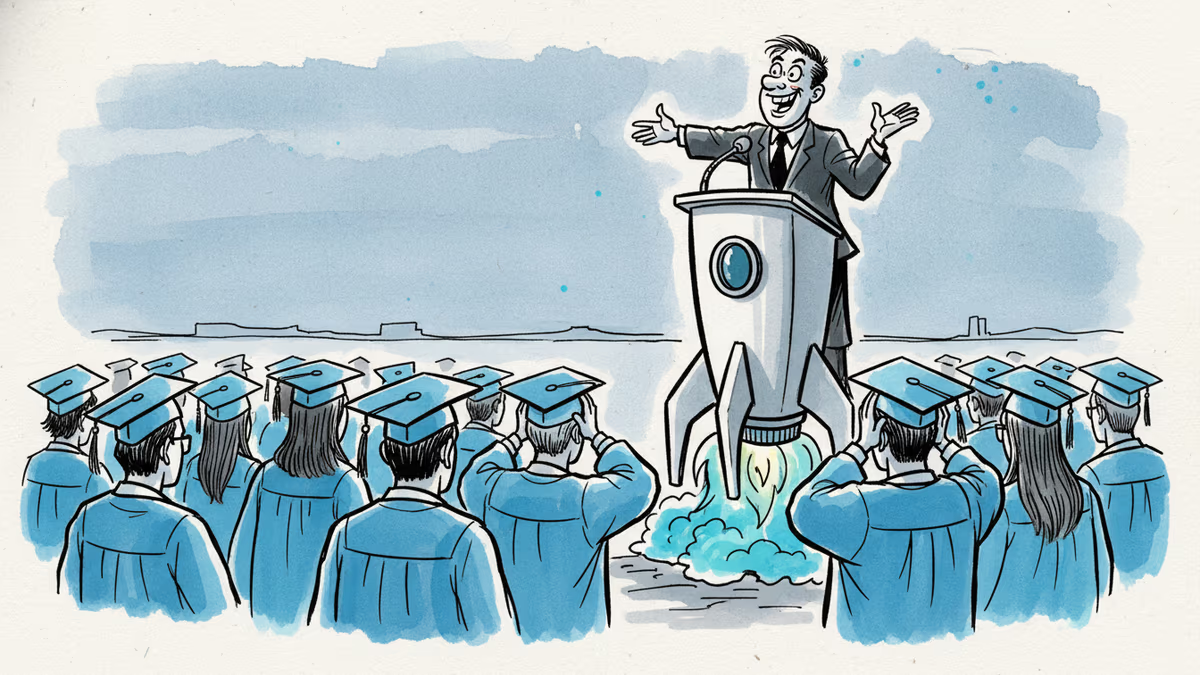
Two commencement speakers learned the hard way that AI enthusiasm doesn't land well with today's graduates. The backlash reveals a widening gap between tech optimism and Gen Z's economic reality.
Samsung and SK unveiled a chip and AI investment package worth thousands of trillions of won on June 29. The headline number swings wildly by outlet, but the real contest isn't capital — it's water and power.
Viral videos show 2026 graduates jeering executives who praise AI at commencement ceremonies. It's not just rudeness — it's a signal about who pays for technological optimism.
Filipino virtual assistants using AI to ghost-manage LinkedIn profiles for executives is now a structured industry. 30 comments a day, fake engagement rings, and a platform struggling to tell real from fabricated.
Two commencement speakers learned the hard way that AI enthusiasm doesn't land well with today's graduates. The backlash reveals a widening gap between tech optimism and Gen Z's economic reality.
Thoughts
Share your thoughts on this article
Sign in to join the conversation