

Inside AI Coding Agents: How OpenAI, Google, and Anthropic Are Changing Software Development
AI coding agents from OpenAI, Anthropic, and Google are transforming software development. Understand how LLM technology works, its potential pitfalls, and what developers need to know.
Your next co-worker might be an AI, but can you trust it with your project? AI coding agents from major players like OpenAI, Anthropic, and Google can now work for hours, writing entire apps, running tests, and fixing bugs under human supervision. However, these tools aren't magic, and without a proper understanding, they can complicate a software project rather than simplify it.
Under the Hood: The Pattern-Matching Machine
At the core of every AI coding agent is a large language model (LLM), a type of neural network trained on vast amounts of text and code. It’s essentially a pattern-matching machine. It uses a prompt to 'extract' compressed statistical patterns it saw during training and provides a plausible continuation. When this interpolation across concepts works well, it results in useful logical inferences. When it fails, it leads to confabulation errors—fabricating plausible but incorrect information.

Why Blind Trust Is a Pitfall
These base models are refined through techniques like fine-tuning and Reinforcement Learning from Human Feedback (RLHF), shaping them to follow instructions and produce better outputs. Still, developers who use these agents without understanding their probabilistic nature risk falling into common traps. They might unknowingly accept flawed or inefficient code, ultimately adding complexity to their projects. Knowing how these tools work is crucial for judging when—and if—to use them effectively.
Authors
Related Articles
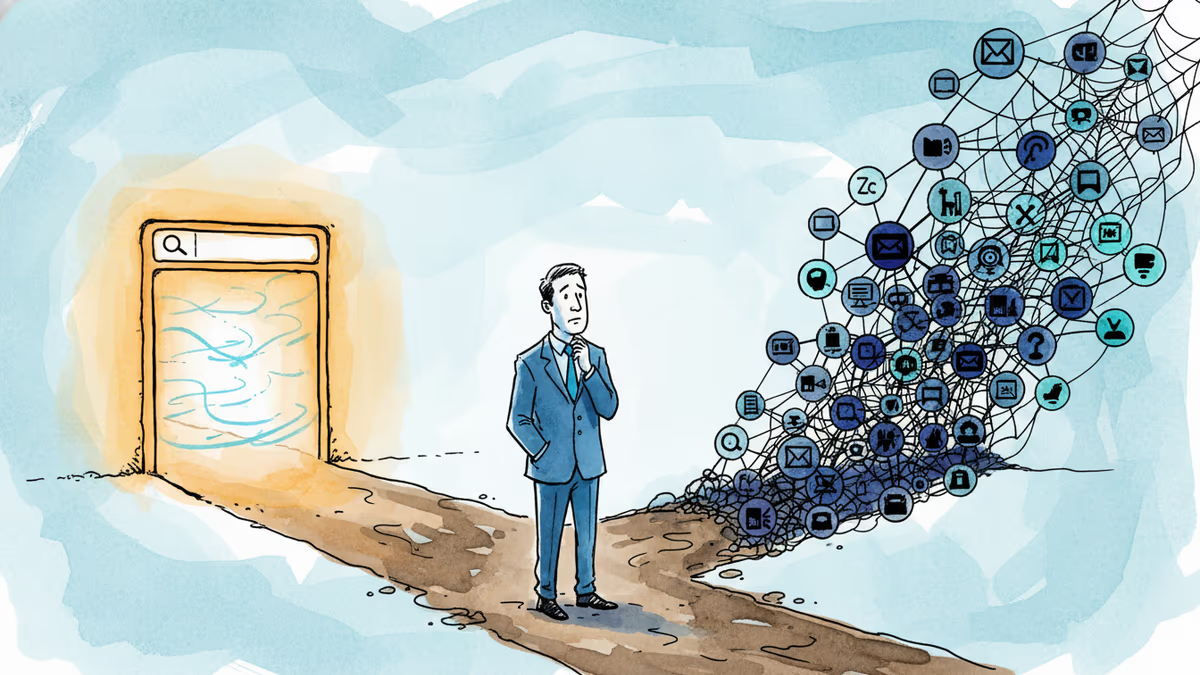
In a post-Google I/O interview, Sundar Pichai acknowledged flawed search results, real AI anxiety, and an AGI timeline that makes the label irrelevant. Here's what he said — and what it means.
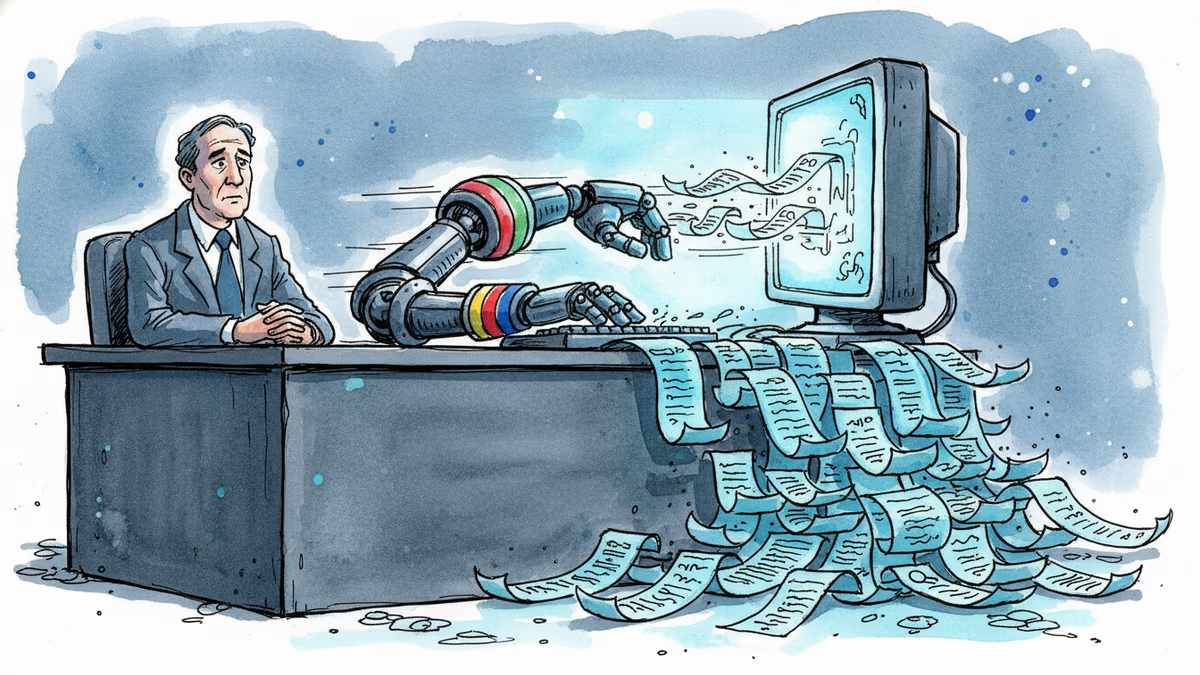
Google is building AI agents that search the web proactively, without user prompting. That's not just a product update — it's a fundamental shift in who controls the information you receive.

OpenAI has reorganized for the second time in a month, merging ChatGPT and Codex into a single agentic platform under president Greg Brockman's unified product leadership.

Google unveiled the 'Googlebook' platform to replace Chromebook and ChromeOS—but revealed zero hardware specs. What's the strategy, and what does it mean for users, manufacturers, and the education market?
In a post-Google I/O interview, Sundar Pichai acknowledged flawed search results, real AI anxiety, and an AGI timeline that makes the label irrelevant. Here's what he said — and what it means.
Google is building AI agents that search the web proactively, without user prompting. That's not just a product update — it's a fundamental shift in who controls the information you receive.
OpenAI has reorganized for the second time in a month, merging ChatGPT and Codex into a single agentic platform under president Greg Brockman's unified product leadership.
Google unveiled the 'Googlebook' platform to replace Chromebook and ChromeOS—but revealed zero hardware specs. What's the strategy, and what does it mean for users, manufacturers, and the education market?
Thoughts
Share your thoughts on this article
Sign in to join the conversation