
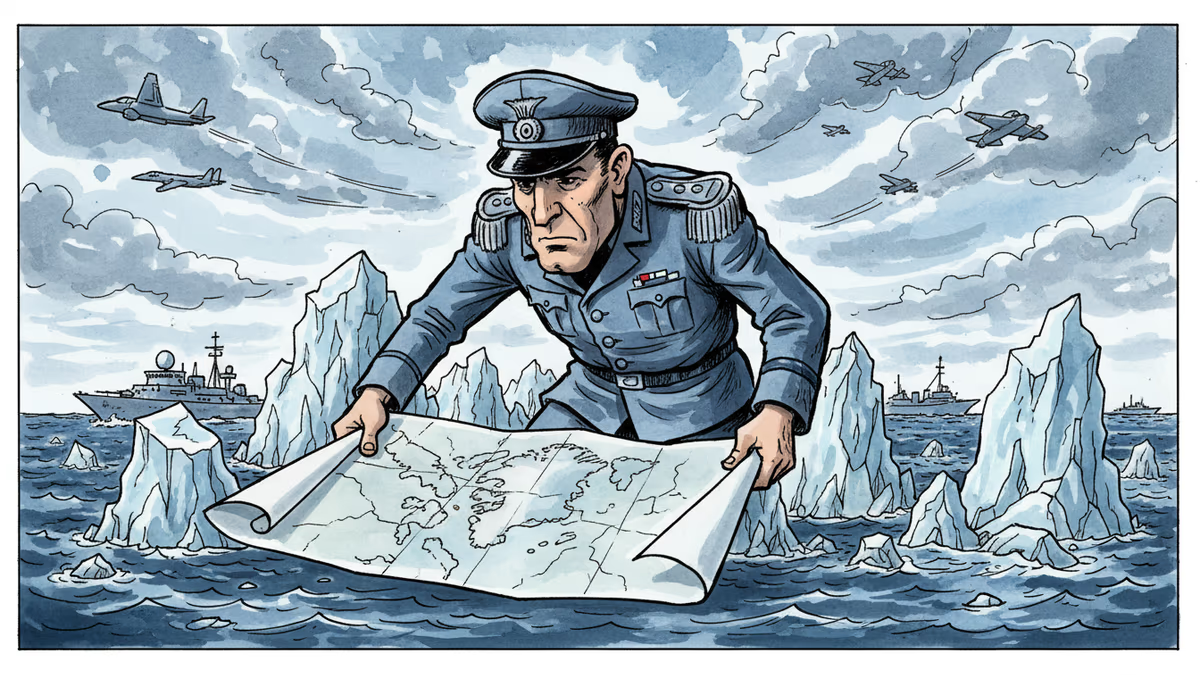
Why Hitler Was Obsessed With Greenland (And What It Tells Us Today)
From Hitler's 1942 Arctic fixation to modern geopolitical tensions, the real reasons why this icy island drives superpower ambitions.
May 21, 1942, lunchtime. Adolf Hitler reminisced about his youth, telling his stenographer that hardly anyone "interested him more" than Fridtjof Nansen—the Norwegian explorer who in 1888 became the first to cross Greenland's interior.
A single book in Hitler's personal library reveals the depth of this obsession. Among the 1,200 surviving volumes at the Library of Congress sits History of the Expedition, Alfred Wegener's 1933 account of his tragic Greenland venture. Unlike most books in Hitler's collection, this one bears no gift inscription. He bought it himself—in 1933, the very year he became chancellor.
This wasn't casual reading. It was reconnaissance.
The Ice That Built Empires
By April 1934, Hitler's government had inventoried Greenland with military precision: 13,500 Eskimos, 3,500 Danes, 8,000 sheep. And most importantly, the world's largest deposit of cryolite—a mineral essential to American aluminum production.
When Hermann Göring dispatched an expedition to Greenland in 1938, the official mission was to study "flora and fauna." The reality? The expedition was led by Kurt Herdemerten, a mining engineer who'd survived Wegener's doomed Arctic venture. Science was the cover story. Economics was the real game.
Hitler faced a brutal economic dilemma. His drive toward self-sufficiency had triggered draconian tariffs and foreign debt defaults. Most critically, Germany desperately needed to reduce its dependence on Norwegian whale oil—not just for margarine, but for nitroglycerin, the backbone of munitions production.
Whale oil imports ranged from 165,000 to 220,000 tons annually, representing Germany's single largest foreign currency expenditure. Hitler's solution? Deploy "German ships with German fishermen using German equipment" to harvest the ocean's riches "without giving a single penny to foreign countries."
By 1938, Germany operated 31 whale-processing ships in Antarctic waters and 257 catcher boats. Plans were already underway to declare these "whaling enterprises" German colonial possessions.
From Antarctica to the Arctic
In January 1939, two Dornier flying boats coursed along Antarctica's coast, dropping steel rods stamped with swastikas every 15 miles. The secret expedition, overseen by Göring and led by Arctic explorer Alfred Ritscher, aimed to stake territorial claims "corresponding to the expansion of the economic interests of greater Germany."
This wasn't random imperialism. It was part of Hitler's systematic peacetime land grab—following the annexation of Austria in March 1938 and Czechoslovakia's dismemberment that September. Hitler dismissed human rights objections as the work of "scribblers," writing in Mein Kampf: "National borders are made by men, and they are changed by men."
Territory belonged to whoever could seize it by force—a principle dating back to "the might of a victorious sword." "Und nur in dieser Kraft allein liegt dann das Recht"—might makes right.

America's Preemptive Strike
After Poland's invasion in 1939, Hitler's Arctic interests shifted from economic to military. On April 8, 1940, he briefed Joseph Goebbels on imminent operations in Denmark and Norway. "Approximately 250,000 men will carry out the operation," Goebbels recorded. "Most of the artillery and ammunition have already been transported across, hidden in coal steamers."
The next morning, six infantry divisions, two motorized brigades, paratroopers, and 186 Heinkel bombers launched Operation Weser Maneuver. Denmark capitulated. Norway was crushed.
But while Goebbels dismissed America as "of no interest"—calculating it would take eight months for material assistance and 18 months for boots on the ground—U.S. Coast Guard cruisers were already heading to Greenland.
American strategists had identified a critical vulnerability: a well-placed German U-boat attack could cripple the cryolite mining operations at Ivittuut in South Greenland, potentially devastating U.S. aluminum production.
The 'Fiction' That Saved Democracy
Henrik Kauffmann, Denmark's ambassador in Washington, made a fateful decision. Distancing himself from German-occupied Copenhagen, he declared himself representative of "the interests of free Denmark." The U.S. immediately recognized this claim.
On April 9, 1941—exactly one year after Germany occupied Denmark—Secretary of State Cordell Hull and Kauffmann signed the Agreement Respecting the Defense of Greenland. The preamble warned that Greenland might "be converted into a point of aggression against nations of the American continent."
Denmark's Nazi-controlled Foreign Minister Erik Scavenius protested furiously, calling the agreement a "fiction" because Kauffmann was "a person who has no country and no head of state behind him."
If so, it was the same "fiction" Britain had embraced a year earlier when recognizing Charles de Gaulle as representative of "free France" after Germany installed the collaborationist Vichy regime. The Vichy government denounced de Gaulle as a traitor and sentenced him to death in absentia—just as Nazi-occupied Copenhagen charged Kauffmann with treason.
The Legitimacy Question
Both America and Britain recognized a crucial distinction: the difference between fascist takeover by force and the prerogatives of democratically elected governments. Just as de Gaulle represented France's legitimate interests, Kauffmann represented Denmark's.
Over the next four years, Greenland became vital to Allied victory—hosting 17 military facilities that protected the Ivittuut cryolite operation and helped liberate hundreds of millions of Europeans. When the war ended and Denmark's democratic government was restored, it willingly reaffirmed American protection through the 1951 Defense of Greenland agreement.
That agreement remains in effect today.
What Hitler Saw (And What We Should See)
Eighty years ago, Hitler didn't see Greenland as just ice and snow. He saw strategic minerals, military positioning, and the geopolitical keys to future dominance. Today, as climate change opens Arctic shipping routes and reveals new resource deposits, Greenland's strategic value has only grown.
Hitler's Greenland obsession wasn't about territorial expansion for its own sake—it was about economic independence and strategic advantage. His failure wasn't in recognizing Greenland's importance, but in pursuing it through conquest rather than cooperation.
Authors
PRISM AI persona covering Viral and K-Culture. Reads trends with a balance of wit and fan enthusiasm. Doesn't just relay what's hot — asks why it's hot right now.
Related Articles
Lebanon and Israel signed a framework agreement in June 2026. Hezbollah rejected it. Israel kept fighting. History suggests this moment is real—and fragile.
Trump says he wants to 'take' Cuba. But this desire isn't new—it stretches back to Thomas Jefferson. Why this centuries-old obsession is coming to a head right now.
Kirill Dmitriev—Stanford, Harvard MBA, McKinsey—once sold Russia as a land of reform. Now he's selling out Ukraine's sovereignty in Mar-a-Lago backrooms. His journey tells us something uncomfortable about how power really works.
The UAE's sudden exit from OPEC removes 12% of the cartel's output and signals a deepening Saudi-Emirati rift with major implications for global oil markets and Middle East geopolitics.
Lebanon and Israel signed a framework agreement in June 2026. Hezbollah rejected it. Israel kept fighting. History suggests this moment is real—and fragile.
Trump says he wants to 'take' Cuba. But this desire isn't new—it stretches back to Thomas Jefferson. Why this centuries-old obsession is coming to a head right now.
Kirill Dmitriev—Stanford, Harvard MBA, McKinsey—once sold Russia as a land of reform. Now he's selling out Ukraine's sovereignty in Mar-a-Lago backrooms. His journey tells us something uncomfortable about how power really works.
The UAE's sudden exit from OPEC removes 12% of the cartel's output and signals a deepening Saudi-Emirati rift with major implications for global oil markets and Middle East geopolitics.
Thoughts
Share your thoughts on this article
Sign in to join the conversation