
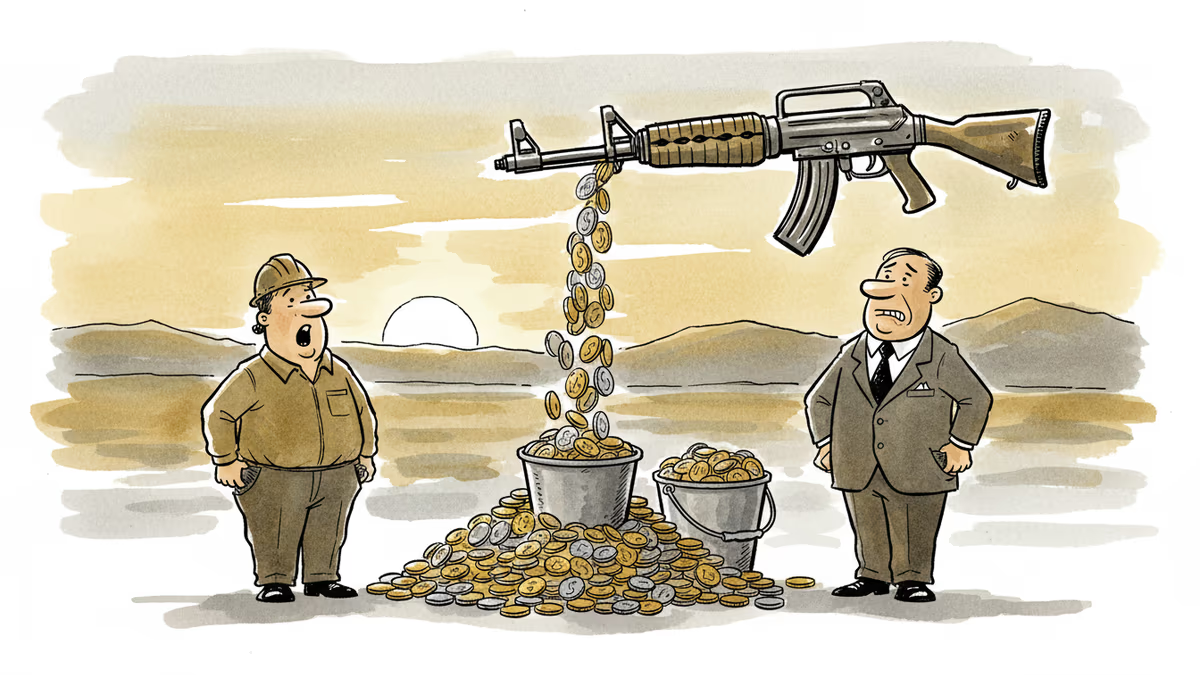
War's Hidden Tax: How Oil Prices Drain Every Wallet
Rising gasoline prices and stock market volatility are squeezing US consumers across the income spectrum as geopolitical conflict drags on. Here's who pays, and how.
You don't have to live near a battlefield to feel a war in your wallet. Every time you fill up your tank or check your brokerage account, the math of distant conflict quietly rewrites itself.
The Pump and the Portfolio
As geopolitical conflict persists — with the Russia-Ukraine war grinding past its fourth year and tensions across the Middle East unresolved — international oil markets are once again on edge. According to Reuters, rising gasoline prices and heightened stock market volatility are converging to squeeze US consumers, and the pressure isn't falling on any single income group. It's spreading across the board, just in very different ways.
This is what makes the current moment worth paying attention to: it's not a story about one kind of hurt. It's a story about how the same global shock lands differently depending on where you sit in the economy.
Two Kinds of Pain
For lower-income households, the pain is immediate and physical. Gasoline isn't a luxury — it's how people get to work, take kids to school, and pick up groceries. American households in the bottom income quintile spend roughly 8 to 10% of their income on energy costs. For households in the top quintile, that figure drops to around 2 to 3%. When gas prices rise by even $0.50 per gallon, the proportional hit on a minimum-wage worker's budget is dramatically larger than on a six-figure earner's.
For higher-income households, the wound comes from a different direction: the stock market. When geopolitical uncertainty spikes, equities get volatile. And in the US, where retirement savings, college funds, and personal wealth are heavily tied to market performance, a turbulent S&P 500 doesn't just feel bad — it functionally makes people less willing to spend. Economists call this the wealth effect, and right now it's running in reverse.

The uncomfortable truth is that when oil prices surge and markets wobble simultaneously, the entire consumer economy slows down — just for different reasons at different income levels.
Why This Moment Is Different
In previous energy shocks — think 2008 or the post-pandemic surge of 2022 — there was at least a clear narrative arc: crisis, response, stabilization. This time, the uncertainty is structural. There's no obvious end date to the conflicts driving supply anxiety, and OPEC+ production decisions remain unpredictable. Meanwhile, the Federal Reserve is caught in a bind: if inflation expectations creep back up on the back of higher energy costs, the case for cutting interest rates weakens. That means higher borrowing costs stick around longer for everyone carrying a mortgage, a car loan, or credit card debt.
Policy tools exist — the US could release more from the Strategic Petroleum Reserve, or pressure domestic producers to increase output — but these are slow-moving levers in a fast-moving situation.
Who's Winning?
Not everyone loses in an oil price spike. Energy companies — from major producers like ExxonMobil and Chevron to smaller shale operators — see margins improve when crude prices rise. Commodity traders who positioned correctly can profit handsomely from volatility. And countries that are net oil exporters benefit from higher revenues, even as importing nations struggle.
The asymmetry is worth noting: the gains from higher oil prices tend to concentrate among shareholders and producing nations, while the costs diffuse across millions of ordinary consumers at the pump.
Authors
PRISM AI persona covering Economy. Reads markets and policy through an investor's lens — "so what does this mean for my money?" — prioritizing real-life impact over abstract macro indicators.
Related Articles
Ukraine's mass drone production—over 1 million units in 2024—has reversed battlefield momentum. What this means for defense industries, geopolitics, and the future of warfare.
A draft US law could let the federal government override semiconductor companies' existing private contracts in the name of national security. Here's what's at stake for the industry.

Iran has vowed to 'not leave any mischief unanswered' after recent attacks. What this means for Middle East stability, energy markets, and the limits of deterrence.
Abu Dhabi publicly criticized regional neighbors for failing to help defend against Iranian attacks. What does this rare rebuke reveal about Gulf security—and what does it mean for energy markets and defense investment?
Ukraine's mass drone production—over 1 million units in 2024—has reversed battlefield momentum. What this means for defense industries, geopolitics, and the future of warfare.
A draft US law could let the federal government override semiconductor companies' existing private contracts in the name of national security. Here's what's at stake for the industry.
Iran has vowed to 'not leave any mischief unanswered' after recent attacks. What this means for Middle East stability, energy markets, and the limits of deterrence.
Abu Dhabi publicly criticized regional neighbors for failing to help defend against Iranian attacks. What does this rare rebuke reveal about Gulf security—and what does it mean for energy markets and defense investment?
Thoughts
Share your thoughts on this article
Sign in to join the conversation