
US Immigration Agents Use AI Face Recognition on Citizens Too
DHS reveals Mobile Fortify app details - NEC-developed tool operational since May 2025. Misidentifications lead to detention. AI surveillance reality check.
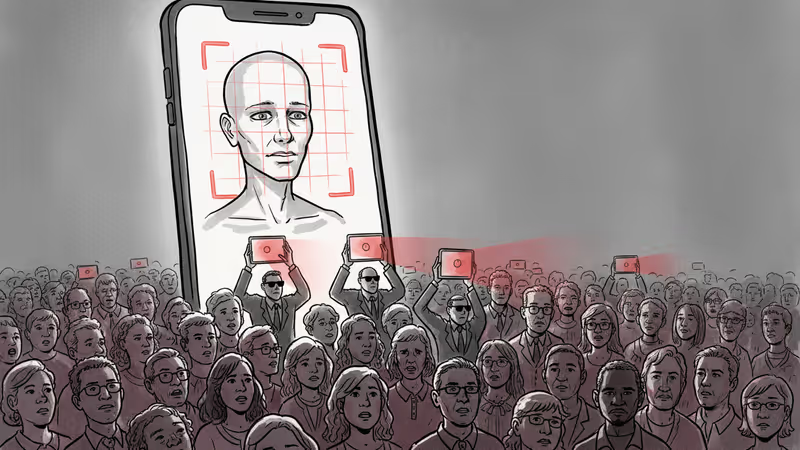
Federal immigration agents are using an AI-powered face recognition app to identify people in the field—and it doesn't distinguish between undocumented immigrants and US citizens.
The Department of Homeland Security on Wednesday published new details about Mobile Fortify, the controversial app that's been quietly operating since May 2025. The disclosure came through DHS's mandatory AI Use Case Inventory, revealing for the first time that Japanese tech giant NEC developed the surveillance tool.
A $24 Million Surveillance Contract
Both Customs and Border Protection (CBP) and Immigration and Customs Enforcement (ICE) list Mobile Fortify as "deployed" and operational. CBP says the app went live in early May 2024, while ICE gained access on May 20, 2025—about a month before 404 Media first exposed its existence.
The app's vendor, NEC, wasn't publicly known until now. The Japanese company advertises a face recognition solution called Reveal that can perform one-to-many searches against databases of any size. A $23.9 million contract between NEC and DHS from 2020 to 2023 authorized the use of biometric matching products for "unlimited facial quantities, on unlimited hardware platforms, and at unlimited locations."
Mobile Fortify captures faces, "contactless" fingerprints, and photographs of identity documents. This data gets sent to CBP for submission to government biometric matching systems, where AI algorithms match faces and fingerprints against existing records, returning possible matches with biographical information.
When AI Gets It Wrong

The consequences of misidentification can be devastating. 404 Media reported that one woman was detained after being twice misidentified by the app. In another case documented in court filings, a Minnesota woman had her Global Entry and TSA PreCheck privileges revoked after interacting with a federal agent who mentioned "facial recognition."
Even more chilling: agents have reportedly told vehicle owners they'll have "a fun time trying to travel" after encounters with the system.
Deployment Before Safeguards
Here's where things get problematic from a governance standpoint. While CBP claims there are "sufficient monitoring protocols" in place, ICE admits that developing monitoring protocols is still "in progress." Both agencies classify Mobile Fortify as "high-impact" and "deployed"—yet ICE is still working on its AI impact assessment.
According to Office of Management and Budget guidance issued before the app's deployment, agencies should complete AI impact assessments before deploying high-impact use cases. ICE also says developing an appeals process is "in-progress."
The Broader Surveillance Infrastructure
CBP used "Vetting/Border Crossing Information/Trusted Traveler Information" to train, fine-tune, or evaluate Mobile Fortify's performance, though they won't specify which. This likely includes data from programs like TSA PreCheck and Global Entry—meaning information from voluntary traveler programs may be feeding surveillance systems used against the general public.
The timing raises questions too. Why deploy a high-impact AI system before completing required impact assessments? Why develop appeals processes after deployment rather than before?
Authors
Related Articles

The Pentagon's clash with AI companies exposes a legal gray area around mass surveillance. OpenAI and Anthropic's opposing choices reveal deeper questions about privacy in the AI age.
The Department of Homeland Security is consolidating biometric technologies into a unified system, raising concerns about political surveillance and civil liberties as the tech spreads beyond borders.

After Super Bowl ad backlash and AI surveillance features, Ring's founder explains himself. But the real issue isn't the ads—it's the technology itself.

Ring's Super Bowl ad sparked backlash over AI surveillance capabilities. The company canceled its Flock Safety partnership amid concerns about privacy and ICE data sharing.
The Pentagon's clash with AI companies exposes a legal gray area around mass surveillance. OpenAI and Anthropic's opposing choices reveal deeper questions about privacy in the AI age.
The Department of Homeland Security is consolidating biometric technologies into a unified system, raising concerns about political surveillance and civil liberties as the tech spreads beyond borders.
After Super Bowl ad backlash and AI surveillance features, Ring's founder explains himself. But the real issue isn't the ads—it's the technology itself.
Ring's Super Bowl ad sparked backlash over AI surveillance capabilities. The company canceled its Flock Safety partnership amid concerns about privacy and ICE data sharing.
Thoughts
Share your thoughts on this article
Sign in to join the conversation