
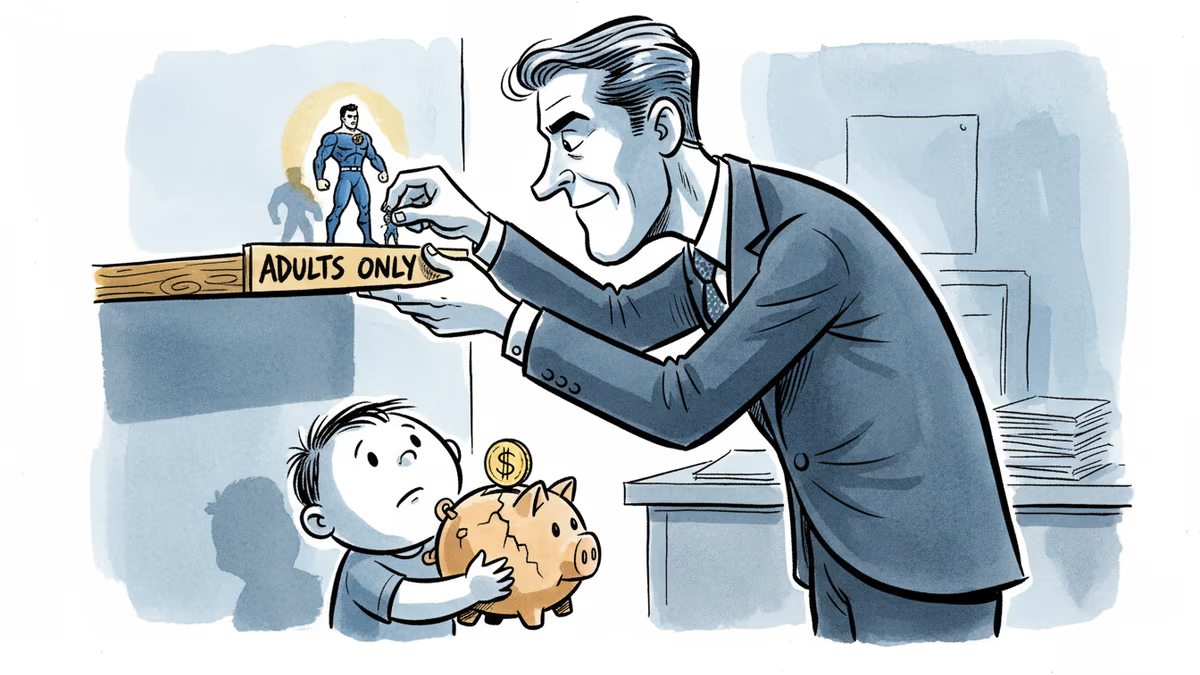
Hasbro's Bet: Adults Are the New Kids
Hasbro CEO Chris Cocks on why adults are now the toy industry's core customer, how AI is reshaping product design, and what the Harry Potter controversy reveals about IP in the creator economy.
The Toy Industry's Dirty Secret Is Now Its Business Strategy
The average Hasbro customer is not eight years old. They're closer to thirty-eight — and that's not an accident.
Chris Cocks, CEO of Hasbro, sat down for an extended interview and made the company's strategic pivot explicit: adults are the growth market, and children are increasingly a shrinking one. "A 26-year-old has more spending power than a 6-year-old," he said, "and they tend to want more sophisticated playthings and collectibles." For a company that built its identity on Saturday morning cartoon tie-ins, this is a significant admission — and a calculated one.
The demographic math is blunt. Birth rates across Western markets are lower than they were a decade ago. Children are shifting to smartphones and mobile games at younger ages. And the attention economy has fragmented in ways that make building a durable toy brand around a six-year-old nearly impossible. Hasbro's answer: stop chasing that shrinking cohort and double down on the adults who never stopped wanting to play.
How AI Cut the Product Pitch Cycle from Months to Days
The clearest demonstration of this new Hasbro came from an unlikely source: a Netflix animated film no one initially wanted.
When KPop Demon Hunters dropped, every major toy company passed on the license. Cocks stumbled onto it via a LinkedIn post on a weekend, watched thirty minutes, and immediately texted his head of toys. By Monday morning, Hasbro was on the phone with Netflix. By the end of that week, they had pitched a full product line — complete with high-fidelity physical models.
That used to take six to eight weeks. Now it takes days. The reason is a suite of AI design tools that Hasbro has embedded into its creative workflow, combined with high-resolution 3D printing that no longer requires a trip to Shenzhen for prototypes.
But Hasbro has gone further than most companies in how it deploys these tools. The company has trained AI models on its own IP and built character personas that function as co-designers. Peppa Pig co-designs Peppa Pig products. Optimus Prime and Megatron serve as the office DJ system — Optimus delivering soulful rationales for song choices, Megatron mocking anyone who doesn't request thrash metal. It's playful, but it reflects a serious structural shift: the characters themselves are now part of the creative process.
On the productivity side, Cocks cited estimates of over 1 million man-hours saved annually across the company, with employees using AI tools 20 to 40 times per week on average. Purchase order processing — previously a massive outsourced operation — is being automated by AI agents. "No one likes to touch an order from a toy store in Peoria," he said.
The carve-outs are telling, though. Magic: The Gathering and Dungeons & Dragons game development: no AI in the pipeline. The fanbase doesn't want it, so it doesn't go in. The speed of adoption, Cocks suggested, is calibrated to community tolerance — not just technical capability.

The Tariff Problem No One Has Solved
Making toys in the United States costs 50 to 60 percent more than Southeast Asia. That number hasn't changed, and Cocks was direct about why: it's labor, and automation hasn't caught up.
"For there to be meaningful nearshoring for something like toys, you would need a step-change technology — 3D printing at mass scale, equivalent quality and cost to plastic mold injection. That doesn't exist yet."
Hasbro's response to tariff uncertainty has been to build redundancy rather than repatriate production. The company now maintains production tooling across multiple countries and factories — more expensive upfront, but more resilient to sudden policy shifts. They've also filed legal briefs seeking tariff refunds, though Cocks acknowledged there won't be much to pass back to consumers since the company absorbed most of the costs rather than raising prices broadly.
This is the quiet reality of the tariff debate that tends to get lost in the political framing: for labor-intensive, high-SKU-turnover industries like toys — where close to 60 percent of products are new every year — reshoring isn't a policy choice, it's an engineering problem that hasn't been solved.
The Harry Potter Question Nobody Wants to Answer Directly
Hasbro recently signed a multi-year deal to distribute Harry Potter merchandise. The timing raises an uncomfortable question that Cocks was asked directly: J.K. Rowling's vocal transphobia has driven a measurable segment of younger fans away from the franchise. How does a company that publicly champions diversity and inclusion justify investing in IP whose creator is actively alienating part of its potential customer base?
Cocks's answer was the corporate standard: separate the art from the artist, focus on what the fans want, support inclusion internally. He didn't pretend the tension doesn't exist, but he also didn't resolve it.
What makes this more than a PR question is the structural shift it reveals. In the creator economy, IP and creator are increasingly inseparable. Fans don't just consume the work — they follow the person. When the person becomes a liability, the question of whether the IP can survive the separation is genuinely open. The music industry analogy Cocks invoked — Napster looked catastrophic, streaming eventually worked out — is instructive, but it took two decades and hollowed out the middle class of working musicians in the process.
The same pattern may be playing out in IP. The franchises at the top — Harry Potter, Marvel, Star Wars — may be resilient enough to outlast creator controversy. The question is what happens to the mid-tier IP, and to the creators who don't have that institutional buffer.
Three Stakeholders, Three Very Different Problems
For Hasbro's creative employees, the AI question is existential in a way that corporate messaging hasn't fully addressed. Cocks's position — that better tools make better creatives, not fewer creatives — is plausible and also convenient. The honest answer is that no one knows yet. What's clear is that the skills that made a toy designer valuable five years ago are being partially commoditized, and the new value lies in taste, curation, and the ability to direct AI output rather than produce original work from scratch.
For retailers and platform companies, the adult toy market represents a structural opportunity. Adult collectors spend more per transaction, are less price-sensitive than parents buying for children, and are more likely to buy online. Hasbro's licensing business — which Cocks described as the largest digital licensing operation in the world by a significant margin — is essentially a bet that brand equity, not distribution control, is the durable moat.
For investors and analysts, the video game ambitions are the highest-risk element of the portfolio. Hasbro is building internal game studios, has a major original IP (Exodus) slated for the first half of next year, and recently saw the studio head depart shortly after the latest trailer. Cocks acknowledged that any individual game has less than a 50 percent chance of being profitable — and framed the licensing revenue from Monopoly Go and other mobile titles as the financial cushion that makes the bet survivable. Whether that cushion is thick enough depends on how the next few releases land.
Authors
Related Articles
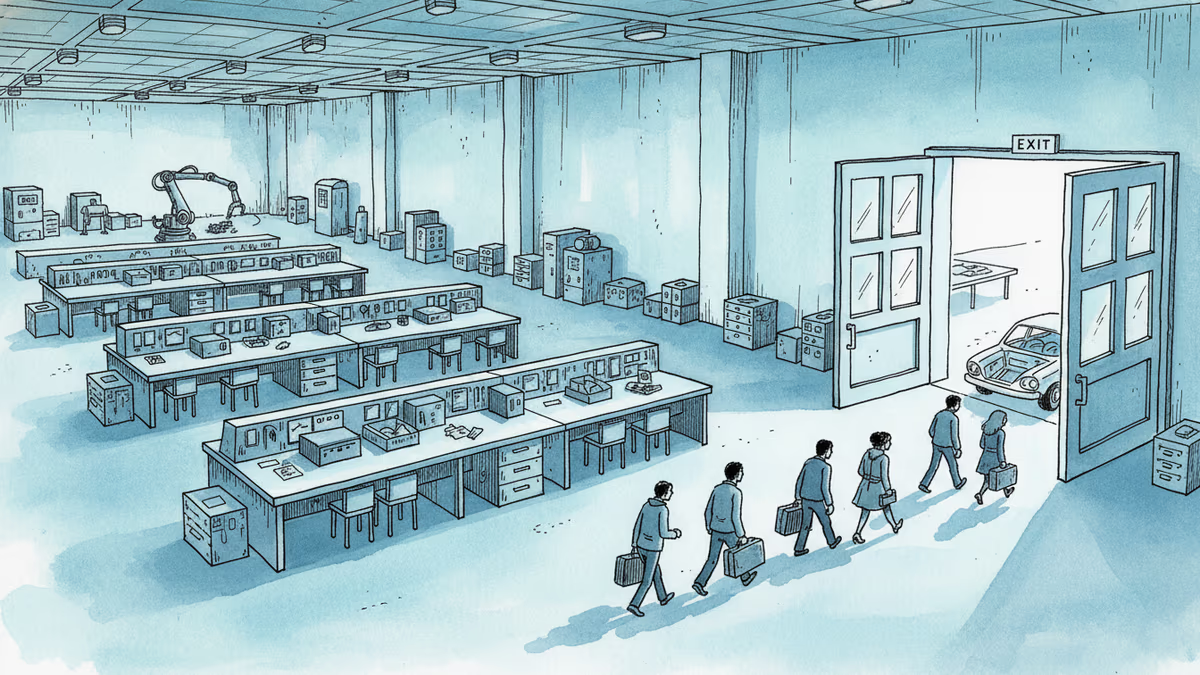
Tesla's Austin gigafactory shed 4,685 workers in 2025—a 22% drop—even as its global headcount grew. What does this tell us about the future of EV manufacturing?
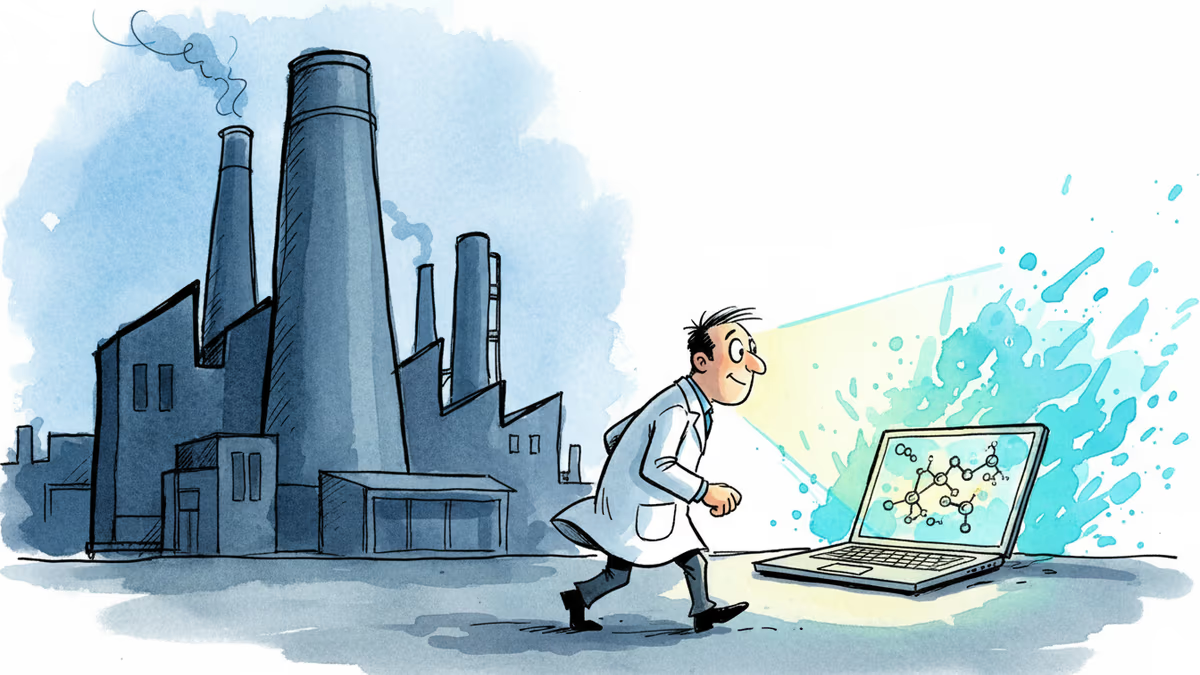
SES AI once partnered with GM, Hyundai, and Honda to build next-gen EV batteries. Now it's pivoting to AI-powered materials discovery. What does this tell us about the future of Western energy manufacturing?
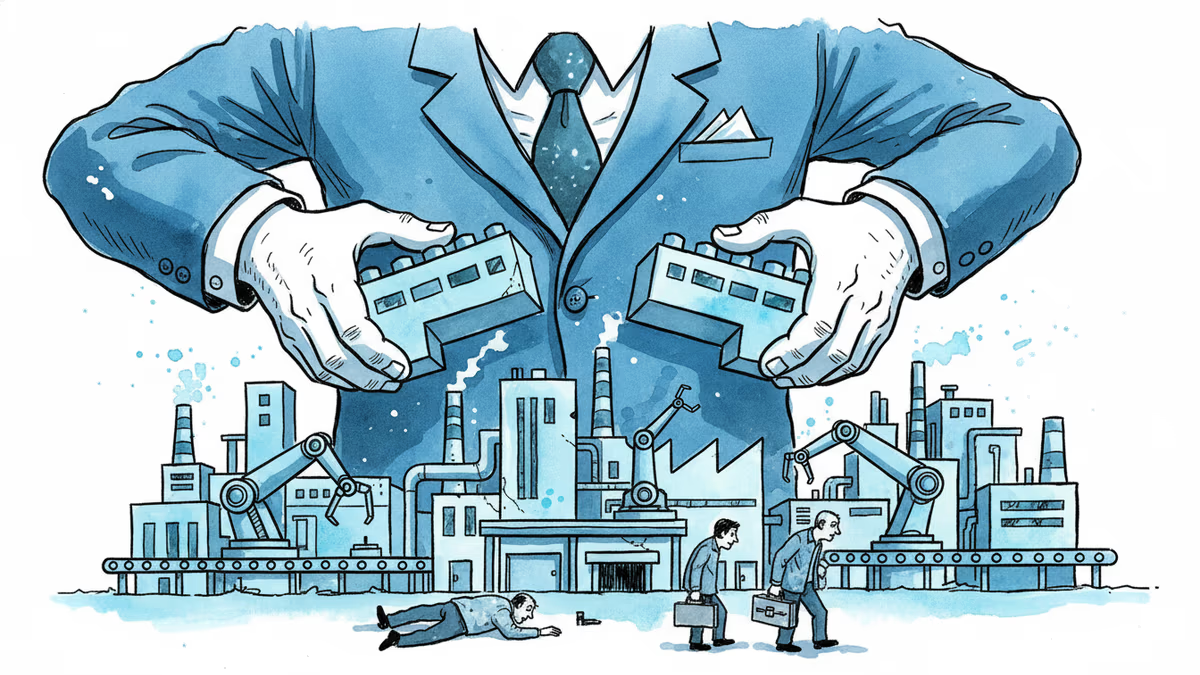
Jeff Bezos is raising a $100 billion fund to acquire aerospace, chipmaking, and defense firms—then rebuild them with AI from his startup Project Prometheus. What it means for manufacturing, labor, and the AI race.
90% of product engineering orgs are increasing AI investment—but cautiously. When the output is a car or a medical device, a flawed algorithm doesn't just crash a server. It crashes a car.
Tesla's Austin gigafactory shed 4,685 workers in 2025—a 22% drop—even as its global headcount grew. What does this tell us about the future of EV manufacturing?
SES AI once partnered with GM, Hyundai, and Honda to build next-gen EV batteries. Now it's pivoting to AI-powered materials discovery. What does this tell us about the future of Western energy manufacturing?
Jeff Bezos is raising a $100 billion fund to acquire aerospace, chipmaking, and defense firms—then rebuild them with AI from his startup Project Prometheus. What it means for manufacturing, labor, and the AI race.
90% of product engineering orgs are increasing AI investment—but cautiously. When the output is a car or a medical device, a flawed algorithm doesn't just crash a server. It crashes a car.
Thoughts
Share your thoughts on this article
Sign in to join the conversation