
Bezos Wants $100B to Buy Factories. Then Automate Them.
Jeff Bezos is raising a $100 billion fund to acquire aerospace, chipmaking, and defense firms—then rebuild them with AI from his startup Project Prometheus. What it means for manufacturing, labor, and the AI race.
He Built the Everything Store. Now He Wants the Everything Factory.
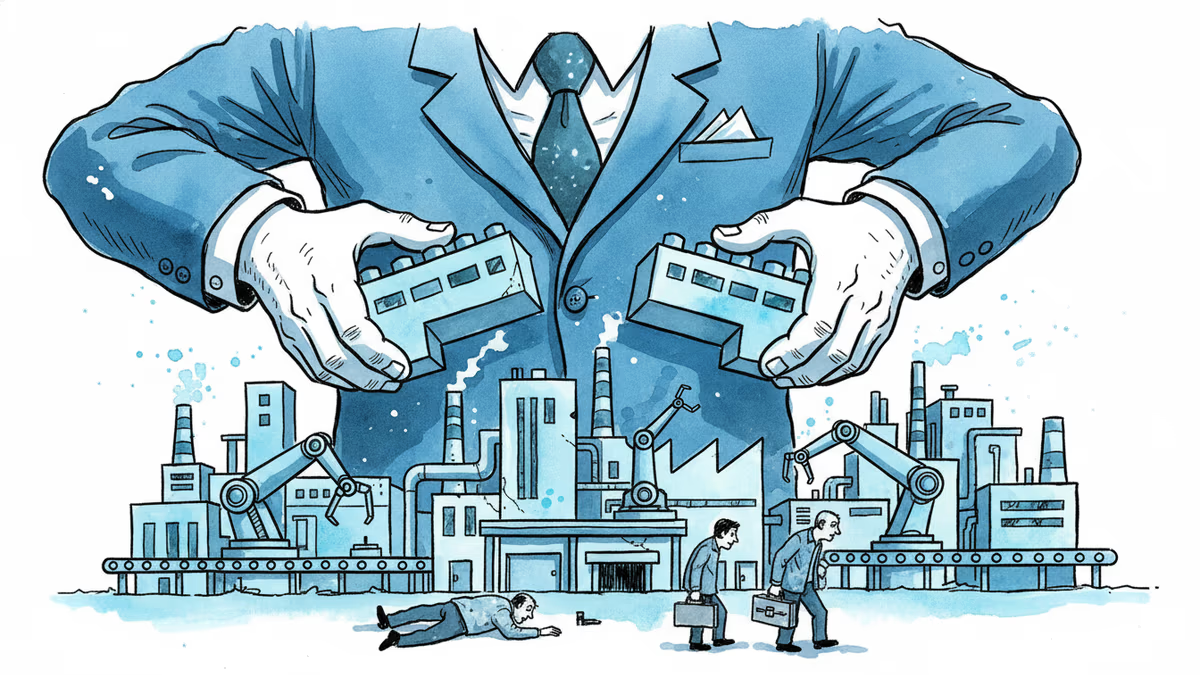
For two decades, Jeff Bezos reshaped retail, cloud computing, and logistics. His next target isn't an app or a platform—it's the factory floor. And he's reportedly willing to spend $100 billion to get there.
According to sources cited by the Wall Street Journal on March 19, Bezos is actively raising a massive new fund aimed at acquiring companies in aerospace, chipmaking, and defense—then overhauling them with artificial intelligence. The vehicle for that transformation is Project Prometheus, an AI startup Bezos co-founded and co-leads alongside former Google executive Vik Bajaj.
What Is Project Prometheus?
Project Prometheus first surfaced publicly in November 2025, when Bezos' involvement was initially reported. The company launched with $6.2 billion in initial funding—already a substantial war chest by any measure—and has been quietly developing high-level AI models tailored specifically to manufacturing and engineering environments.
This is not a general-purpose chatbot play. Prometheus is building AI designed to work inside the complexity of aerospace assembly lines, semiconductor fabrication processes, and automotive engineering. The models are meant to optimize, automate, and ultimately redesign how physical things get made.
The new $100 billion fund is the industrial arm of that strategy. The logic is straightforward: acquire the companies, install the AI, own the output. Bezos has reportedly already traveled to Singapore and the Middle East to court potential investors for the effort.
The Strategy Hiding in Plain Sight
What makes this move structurally interesting is that Bezos isn't just betting on AI—he's betting that AI's next frontier is physical, not digital.

While OpenAI, Anthropic, and Google DeepMind compete fiercely over language models and software applications, Bezos is pivoting toward hard assets. The reasoning has a certain logic to it. White-collar AI adoption has accelerated dramatically over the past two years. But walk into most manufacturing plants—especially in legacy sectors like aerospace and defense—and you'll find systems that predate the smartphone era. The gap between AI's current capabilities and what's actually deployed on factory floors is enormous. That gap is the opportunity.
There's also a political tailwind. The push to reshore American manufacturing, rebuild domestic semiconductor capacity, and expand defense production has created a policy environment unusually friendly to industrial investment. A fund that buys U.S. manufacturers and modernizes them with AI can credibly pitch itself as patriotic capitalism.
Three Ways to Read This
For investors, the structure is a vertically integrated AI play unlike anything currently on the market. Most AI companies sell software. Prometheus wants to own the factories that run on it—capturing value at both the technology layer and the industrial output layer. If it works, the returns could be substantial. If it doesn't, $100 billion is a very expensive proof of concept.
For workers, the implications are harder to ignore. Automation at this scale, across aerospace, chipmaking, and defense, would affect hundreds of thousands of jobs. Bezos' team would likely frame this as productivity enhancement rather than replacement. Labor unions and affected communities may see it differently. The political backlash to large-scale industrial automation has historically been fierce, and this plan is large-scale by any definition.
For competitors—both AI companies and traditional manufacturers—this signals that the race isn't just about who builds the best model anymore. It's about who controls the deployment environment. Prometheus wouldn't just be selling AI to manufacturers; it would be the manufacturer. That's a different kind of moat.
The Skeptic's Corner
None of this is a done deal. Raising $100 billion is not a routine task, even for Bezos. Sovereign wealth funds in the Middle East and Singapore have deep pockets, but commitments of this magnitude require compelling risk-adjusted returns—and the track record of tech-driven industrial turnarounds is mixed at best.
There's also the question of execution. Buying a company is not the same as transforming it. Aerospace and defense firms operate within dense regulatory frameworks, long procurement cycles, and deeply embedded organizational cultures. Parachuting AI into that environment has produced uneven results across the industry. Amazon's acquisition of Whole Foods was supposed to reinvent grocery retail with tech; years later, the results have been modest.
And then there's the timeline. Industrial AI transformation isn't a software update. It's a multi-year, capital-intensive process that requires retraining workforces, rebuilding supply chains, and navigating government oversight—especially in defense contracting, where national security considerations add another layer of complexity.
Authors
Related Articles
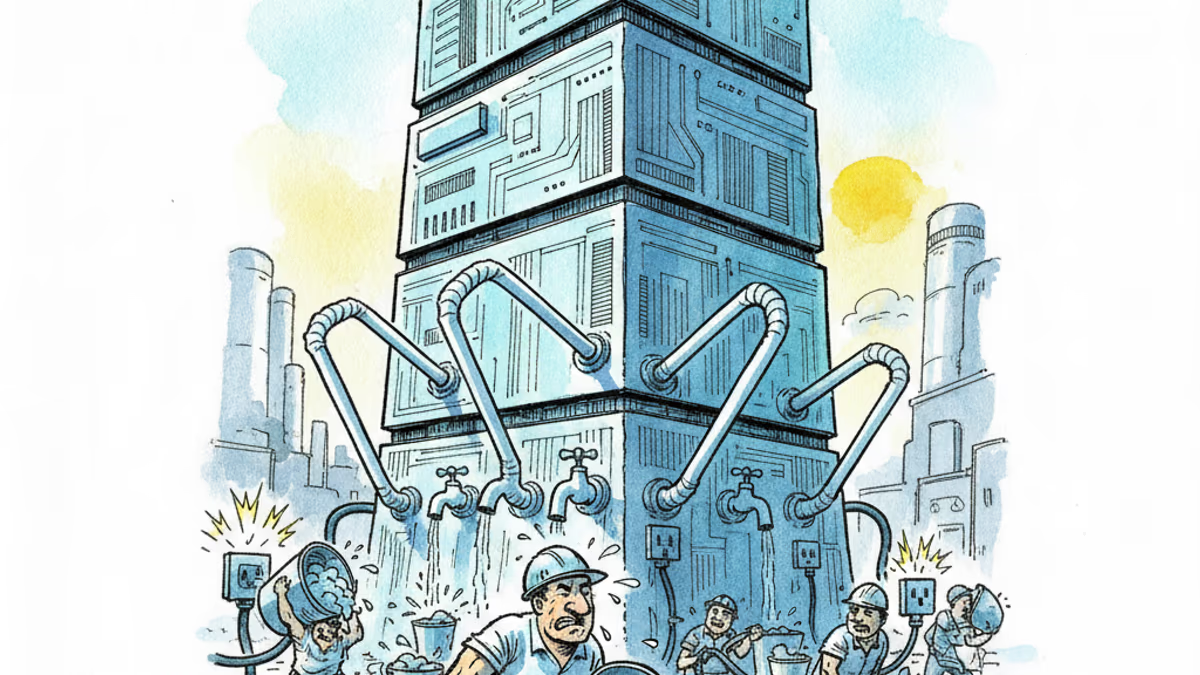
Samsung and SK unveiled a chip and AI investment package worth thousands of trillions of won on June 29. The headline number swings wildly by outlet, but the real contest isn't capital — it's water and power.

Viral videos show 2026 graduates jeering executives who praise AI at commencement ceremonies. It's not just rudeness — it's a signal about who pays for technological optimism.

Filipino virtual assistants using AI to ghost-manage LinkedIn profiles for executives is now a structured industry. 30 comments a day, fake engagement rings, and a platform struggling to tell real from fabricated.
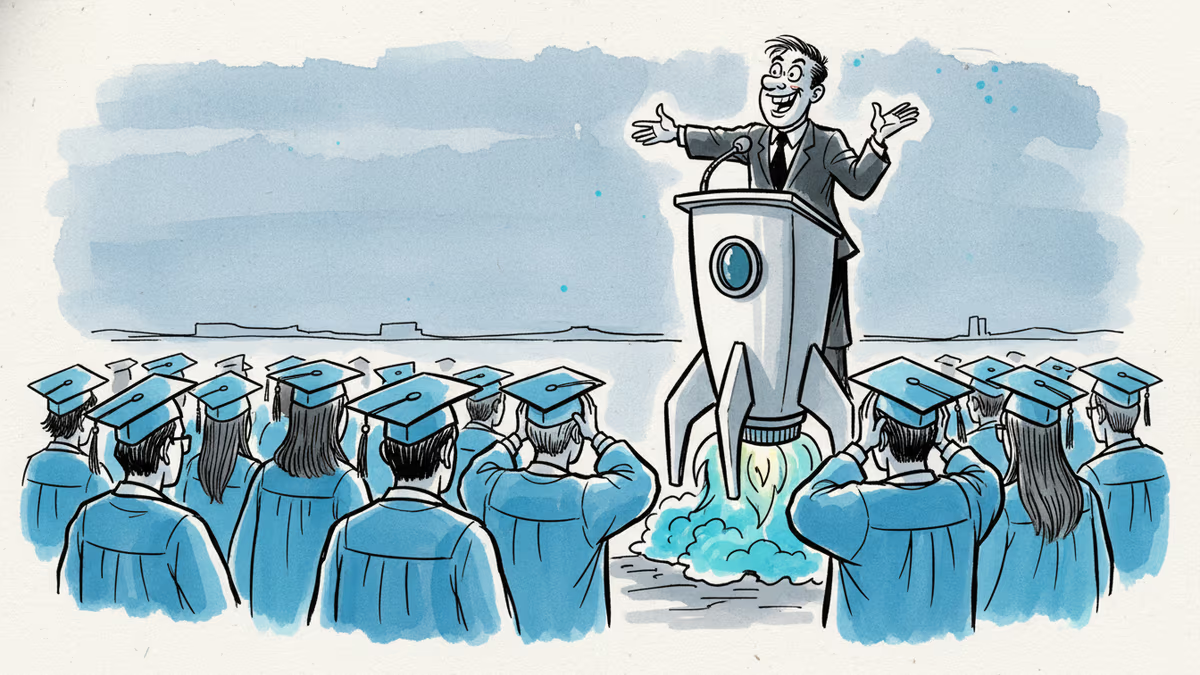
Two commencement speakers learned the hard way that AI enthusiasm doesn't land well with today's graduates. The backlash reveals a widening gap between tech optimism and Gen Z's economic reality.
Samsung and SK unveiled a chip and AI investment package worth thousands of trillions of won on June 29. The headline number swings wildly by outlet, but the real contest isn't capital — it's water and power.
Viral videos show 2026 graduates jeering executives who praise AI at commencement ceremonies. It's not just rudeness — it's a signal about who pays for technological optimism.
Filipino virtual assistants using AI to ghost-manage LinkedIn profiles for executives is now a structured industry. 30 comments a day, fake engagement rings, and a platform struggling to tell real from fabricated.
Two commencement speakers learned the hard way that AI enthusiasm doesn't land well with today's graduates. The backlash reveals a widening gap between tech optimism and Gen Z's economic reality.
Thoughts
Share your thoughts on this article
Sign in to join the conversation