
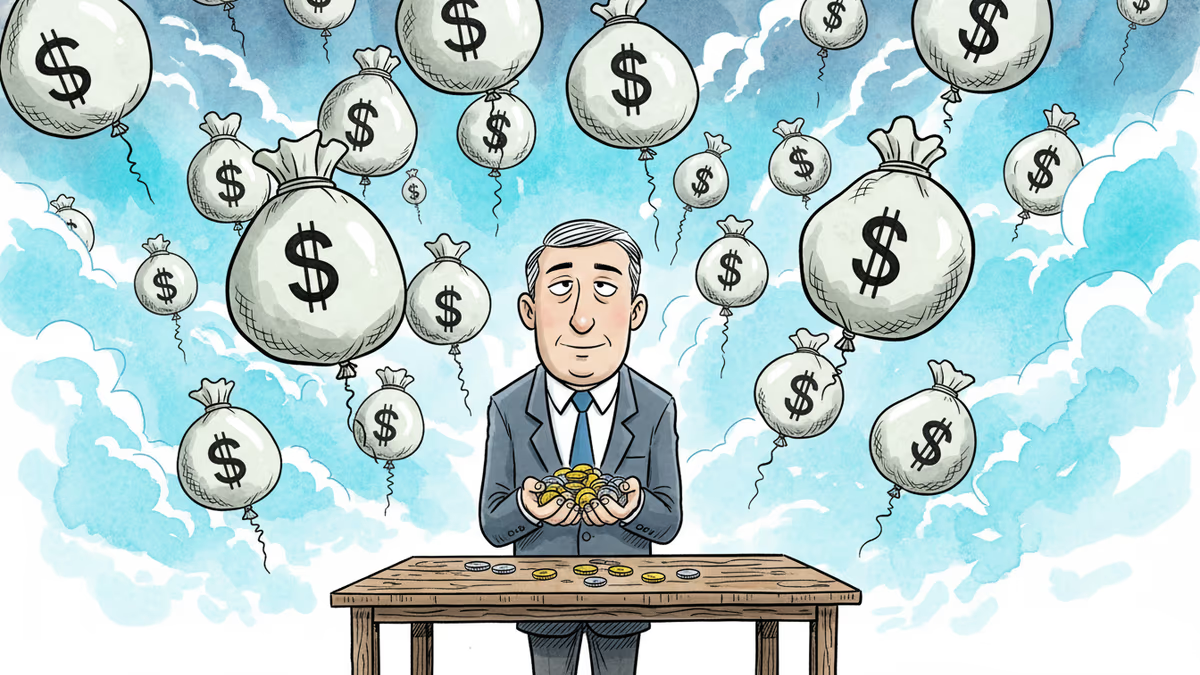
The Finnish Founder Who Said No to a Billion Dollars
QuTwo, the Finnish AI lab led by former AMD Silo AI CEO Peter Sarlin, raised a $29M angel round at a $380M valuation — deliberately avoiding VC money. Here's the logic behind that bet.
Last week, a former DeepMind researcher raised $1.1 billion for a company that barely exists yet. The same week, a serial founder in Helsinki closed $29 million — and called it exactly right.
The contrast isn't just about round sizes. It's a thesis statement about how to build AI in Europe.
What QuTwo Actually Is (And Isn't)
QuTwo is a Finnish AI lab founded by Peter Sarlin, the former CEO of Silo AI — the company AMD acquired for $665 million in 2024. The name nods to quantum computing, but Sarlin is quick to correct any misreading: "AI is the North Star that we will continue to aim for. Quantum is just a new type of compute."
The core product, QuTwo OS, is an orchestration layer — software that routes enterprise computing tasks to classical processors, quantum hardware, or hybrid combinations depending on what each workload actually needs. The key insight here is "quantum-inspired" computing: using classical chips to simulate quantum behavior, capturing some of the computational logic without depending on quantum hardware that still isn't reliable enough for most enterprise use cases.
It's a pragmatic position. Pure quantum computing remains years away from solving real business problems at scale. QuTwo is building for the transition period — and for what comes after.
The company has already secured roughly $23 million in committed revenue through design partnerships, including work with European retail giant Zalando on AI assistants. The team now includes 50 quantum and AI scientists, with two notable co-founders: Kaj-Mikael Björk, Sarlin's former co-founder at Silo AI, and Kuan Yen Tan, a co-founder of Finnish quantum company IQM, which is preparing to go public.
The $29M Round That Could Have Been $1B
Until earlier this year, QuTwo was funded entirely by Sarlin's family office, PostScriptum. The plan was to stay that way. But a quiet product launch generated enough inbound interest that Sarlin reconsidered — partially.
He said no to VCs. He said no to strategic investors. He said yes to an angel round that closed at €25 million ($29 million), valuing the company at €325 million ($380 million).

The investor list reads like a who's-who of European tech and capital: Yuri Milner, Xavier Niel, Formula 1 champion Nico Rosberg, retail billionaire Dieter Schwarz, and Niklas Zennström (Skype co-founder). Alongside them: founders from Hugging Face, Miro, Supercell, Wolt, Legora, and Skype.
Sarlin's framing is deliberate. These aren't just check-writers — they're door-openers across European markets in automotive, life sciences, and gaming, sectors where Europe already has serious industrial depth and ambitious R&D appetite.
The Logic of Deliberate Restraint
Sarlin has been here before. At Silo AI, he turned down investors who wanted to pour in capital to build "Europe's OpenAI." He didn't believe in that playbook then, and he doesn't now.
"The main difference is that QuTwo wants the freedom to think long term, with a five- to ten-year horizon," he told TechCrunch. The implication: large VC rounds come with large VC expectations — quarterly metrics, growth-at-all-costs pressure, and an implicit pressure to compete on the current AI paradigm's terms.
Sarlin is candid that Europe lost that race. "We are on a mission to build the globally leading AI company for the next paradigm, given that Europe did not succeed in building the AI company for this era." That's not defeatism — it's a reframe. If the current paradigm is already spoken for, the strategic bet is on what comes next.
The geopolitical moment amplifies this. Europe is actively trying to reduce dependence on U.S. tech infrastructure. That creates genuine tailwinds for AI built in Finland, not just in sentiment but in procurement decisions by European enterprises wary of regulatory and supply-chain exposure.
For what it's worth, Sarlin isn't anti-large-round in principle. He's an investor in Ami Labs (Yann LeCun's new venture, which raised $1.03 billion) and in Recursive Superintelligence, reportedly heading toward a similar figure. He just doesn't think that's the right structure for QuTwo — at least not yet.
Three Ways to Read This
For investors, the angel structure is a signal. Sarlin is betting that patient capital with strategic network value outperforms fast capital with board pressure, at least in the five-to-ten-year timeframe where quantum-classical hybrid computing might actually reshape enterprise infrastructure. The $380M valuation on $29M raised leaves significant room to grow without dilution pressure.
For European founders, QuTwo is a data point in a larger argument: that building deliberately, with the right backers rather than the most backers, can be a competitive advantage rather than a concession. Silo AI's $665M exit was built the same way.
For the quantum computing industry, QuTwo's framing matters. By positioning quantum as "a new type of compute" rather than a paradigm-breaking technology, it sidesteps the hype cycle that has burned investors before. The connection to IQM — a company actually building quantum hardware and preparing for an IPO — suggests QuTwo is watching the quantum timeline closely, even if it's not betting the company on it arriving on schedule.
This content is AI-generated based on source articles. While we strive for accuracy, errors may occur. We recommend verifying with the original source.
Related Articles
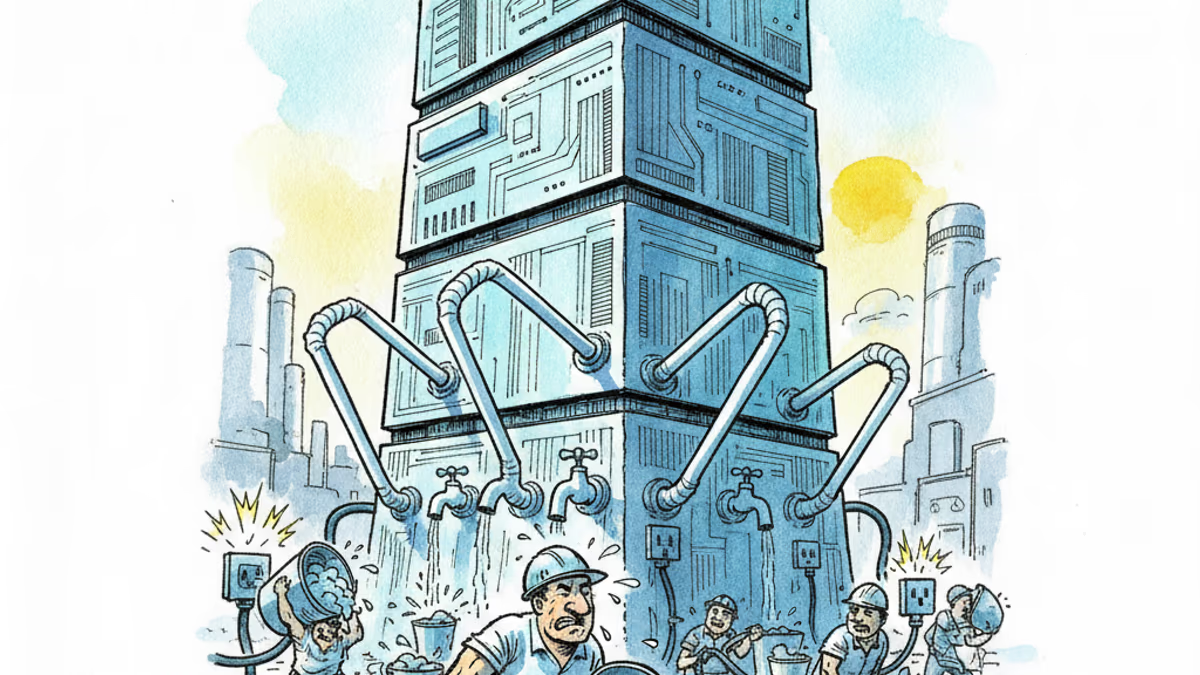
Samsung and SK unveiled a chip and AI investment package worth thousands of trillions of won on June 29. The headline number swings wildly by outlet, but the real contest isn't capital — it's water and power.

Viral videos show 2026 graduates jeering executives who praise AI at commencement ceremonies. It's not just rudeness — it's a signal about who pays for technological optimism.

Filipino virtual assistants using AI to ghost-manage LinkedIn profiles for executives is now a structured industry. 30 comments a day, fake engagement rings, and a platform struggling to tell real from fabricated.
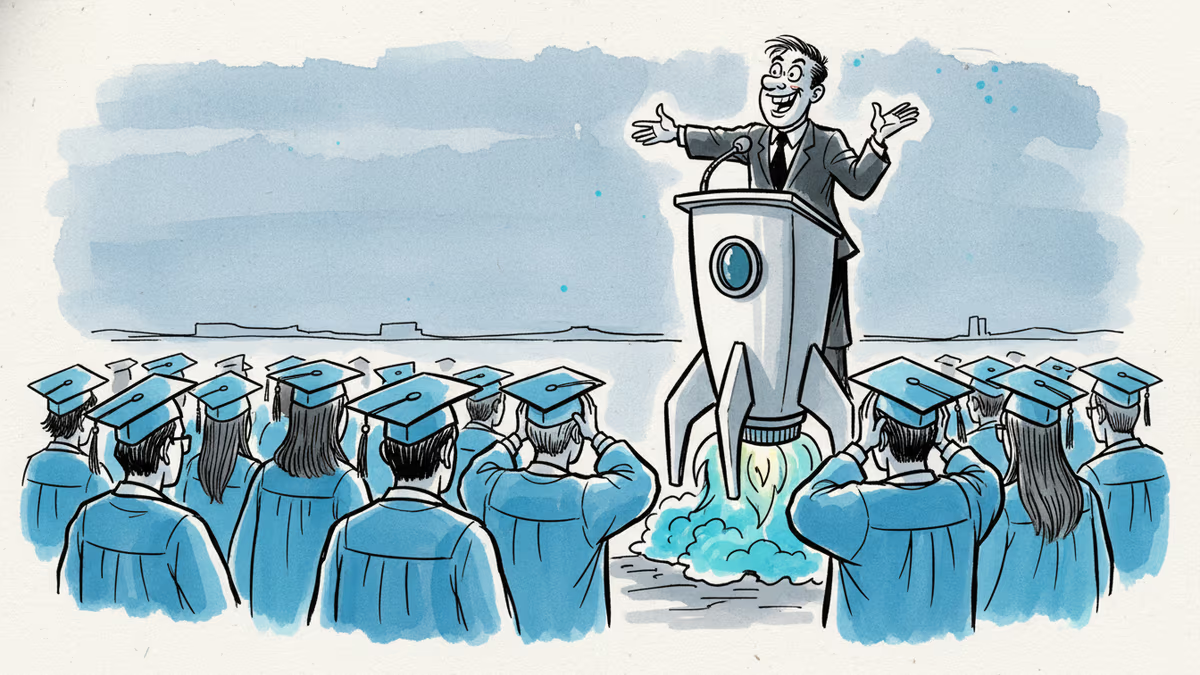
Two commencement speakers learned the hard way that AI enthusiasm doesn't land well with today's graduates. The backlash reveals a widening gap between tech optimism and Gen Z's economic reality.
Samsung and SK unveiled a chip and AI investment package worth thousands of trillions of won on June 29. The headline number swings wildly by outlet, but the real contest isn't capital — it's water and power.
Viral videos show 2026 graduates jeering executives who praise AI at commencement ceremonies. It's not just rudeness — it's a signal about who pays for technological optimism.
Filipino virtual assistants using AI to ghost-manage LinkedIn profiles for executives is now a structured industry. 30 comments a day, fake engagement rings, and a platform struggling to tell real from fabricated.
Two commencement speakers learned the hard way that AI enthusiasm doesn't land well with today's graduates. The backlash reveals a widening gap between tech optimism and Gen Z's economic reality.
Thoughts
Share your thoughts on this article
Sign in to join the conversation