
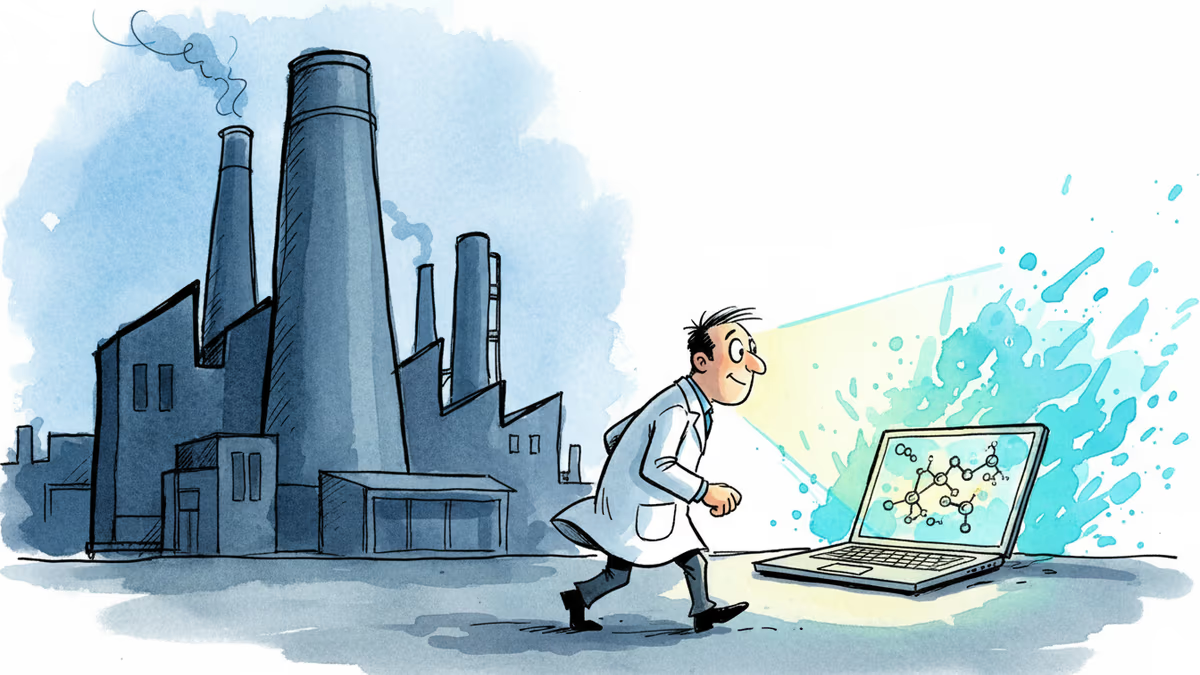
The Battery Company That Quit Making Batteries
SES AI once partnered with GM, Hyundai, and Honda to build next-gen EV batteries. Now it's pivoting to AI-powered materials discovery. What does this tell us about the future of Western energy manufacturing?
"Almost every Western battery company has either died or is going to die."
That's not a competitor talking. That's Qichao Hu, CEO of SES AI — a Massachusetts-based battery company — describing his own industry.
From MIT Lab to EV Darling to Strategic Pivot
The story of SES AI is, in many ways, the story of the American battery dream. Hu started his research at MIT, developing batteries tough enough to survive underground oil exploration — environments where temperatures can exceed 120°C. The chosen technology: solid polymer lithium metal batteries, which pair a lithium metal anode with a polymer electrolyte for significantly higher energy density than the lithium-ion cells in your phone or your Tesla.
The company spun out of MIT in 2012 under the name Solid Energy, raised its first private investment in 2013, and spent years quietly building toward a bigger market. When the EV boom hit in 2021, the timing seemed perfect. GM, Hyundai, and Honda were all at the table. Heavy American SUVs and trucks — the vehicles that dominate US sales — would need lighter, denser batteries to achieve reasonable range. Next-gen lithium metal tech looked like the answer.
By 2022, the company had also shifted its anode chemistry from lithium metal to silicon, hoping to make manufacturing more practical. Everything seemed to be moving in the right direction.
Then it wasn't.
Two Walls Hit at Once
US EV adoption slowed. The Trump administration ended federal EV tax credits in late 2025, removing one of the key financial incentives pushing American consumers toward electric vehicles. With large-format EV battery demand softening, the economics of scaling up a Western manufacturing operation stopped making sense.
The second wall was China. CATL and BYD have built cost structures that Western competitors simply can't match — the result of years of state support, supply chain integration, and sheer scale. Hu doesn't hedge on this point: "It's just not possible for a Western company to build a sustainable business" in high-volume battery manufacturing.

So SES AI stopped trying. Large EV batteries are out. The company still makes batteries, but only for smaller, lower-volume markets like drones.
The New Bet: Sell the Knowledge, Not the Cell
The company's future is now pinned on Molecular Universe, an AI-powered materials discovery platform. The idea: use machine learning to comb through vast chemical spaces and identify new battery materials faster than traditional lab-based research. Those materials can then be licensed to other battery companies, or the platform itself can be offered as a service.
The platform has already surfaced six new electrolyte materials. One of the most promising is an additive designed to solve a stubborn problem with silicon anode batteries. Silicon anodes are attractive because they can hold more energy — but they swell significantly during charge cycles, causing physical degradation. The industry currently uses a compound called fluoroethylene carbonate (FEC) to manage this, but FEC breaks down at high temperatures, releasing gases that shorten battery life. SES AI says its platform identified a compound that does what FEC does, without the thermal degradation problem.
Hu's argument for why this works as a business model is straightforward: "By not actually making the physical battery, we're actually able to scale and generate revenue faster." The company's years of hands-on battery development — the data, the failures, the domain expertise — become the product itself, rather than a means to a manufacturing end. It's a model closer to ARM Holdings (which designs chip architectures and licenses them) than to a traditional manufacturer.
Not Everyone Is Convinced
The pivot makes strategic sense on paper. Whether it works in practice is a different question.
Kara Rodby, a technical principal at Volta Energy Technologies — a VC firm focused on energy storage — is skeptical about the near-term commercial impact. "New materials development, as much as we thought that was what people wanted — I don't know that that seems to be the real linchpin of the battery industry's progress," she says. "I don't know that the ability to discover any new material is going to unlock anything new for the battery industry at this point in time."
The concern is timing. Even if AI accelerates materials discovery from years to months, the path from a promising compound to a commercially validated, mass-manufactured battery additive is long and expensive. Investors are already pulling back from the sector. Public funding support is shrinking. The window for a discovery-to-revenue cycle may be narrower than the platform's ambitions.
The Bigger Question This Raises
Zoom out, and SES AI's story is part of a larger reckoning. The US and Europe spent years assuming that technological superiority would be enough to compete in advanced manufacturing. In batteries — as in solar panels before them — that assumption has been tested hard by China's industrial scale.
The response emerging from some Western companies isn't to out-manufacture China. It's to move up the value chain: own the IP, the data, the discovery process, and let others handle production. This is the same logic that kept ARM relevant even as semiconductor fabrication moved almost entirely to Asia.
But there's a tension here. Energy security — the ability to produce batteries domestically — is increasingly a geopolitical priority, not just an economic one. A world where Western companies own battery IP but Asian factories build every cell may be commercially rational and strategically uncomfortable at the same time.
Authors
Related Articles
Waymo's new Ojai robotaxi isn't just a vehicle upgrade. It's the company's most serious attempt yet at cracking the cost problem that has kept autonomous vehicles from scaling. Here's what's really at stake.
Mercedes-AMG's new GT 4-door coupe packs three YASA axial flux motors producing 1,153 hp and 1,475 lb-ft of torque. Here's what it means for the EV performance race—and who actually wins.
Auto China 2026 set records with 1,451 vehicles and 181 world premieres. But the real story isn't the size—it's how Chinese automakers stopped competing on price and started competing on brains.
Expiring leases will flood the US used car market with over a million electric vehicles by 2028. Could this do what subsidies couldn't — make EVs genuinely affordable?
Waymo's new Ojai robotaxi isn't just a vehicle upgrade. It's the company's most serious attempt yet at cracking the cost problem that has kept autonomous vehicles from scaling. Here's what's really at stake.
Mercedes-AMG's new GT 4-door coupe packs three YASA axial flux motors producing 1,153 hp and 1,475 lb-ft of torque. Here's what it means for the EV performance race—and who actually wins.
Auto China 2026 set records with 1,451 vehicles and 181 world premieres. But the real story isn't the size—it's how Chinese automakers stopped competing on price and started competing on brains.
Expiring leases will flood the US used car market with over a million electric vehicles by 2028. Could this do what subsidies couldn't — make EVs genuinely affordable?
Thoughts
Share your thoughts on this article
Sign in to join the conversation