
South Korea's Defense Giant Scores $1.9B Norway Deal
Hanwha Aerospace secures massive rocket contract with Norway as European nations rush to strengthen defense capabilities amid rising security threats.
$1.9 billion. That's the price tag on South Korea's latest defense export victory, as Hanwha Aerospace prepares to sign a massive contract with Norway for long-range rocket systems this Friday.
The deal centers on Hanwha's K239 Chunmoo multiple rocket launcher system, positioning the South Korean defense giant as a key player in Europe's military modernization drive. With South Korea's presidential chief of staff Kang Hoon-sik expected to attend the Oslo signing ceremony, this isn't just a business transaction—it's a diplomatic statement.
Europe's Defense Shopping Spree
Norway's decision to invest nearly $2 billion in South Korean rocket technology reflects a broader European reality: the continent is rapidly rearming. As security concerns escalate across Europe, nations are scrambling to upgrade their long-range precision strike capabilities, and traditional Western defense contractors can't meet the surging demand alone.
The Chunmoo system offers Norway something compelling—proven battlefield technology at competitive prices. Unlike some Western alternatives that remain largely theoretical, South Korean weapons have been tested in real combat conditions, particularly through Ukraine's use of similar systems.
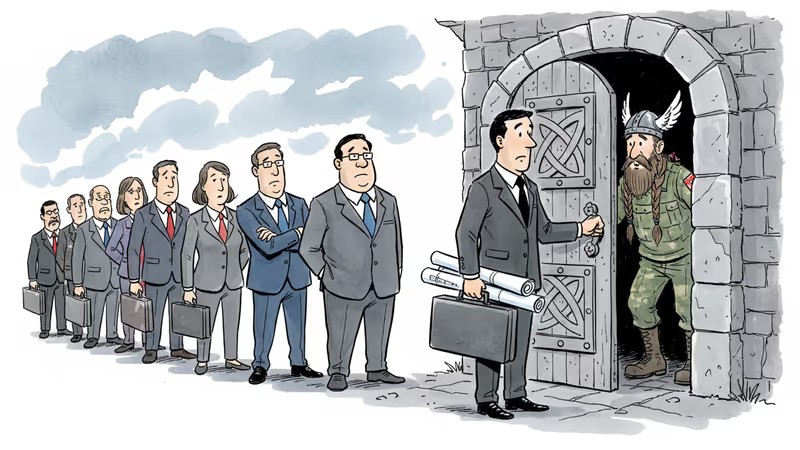
But this deal comes with strings attached. Norway's defense procurement rules require foreign suppliers to provide industrial cooperation equal to 100 percent of the contract value for projects exceeding $5.2 million. This means Hanwha Aerospace must transfer technology and partner with Norwegian companies, creating a complex web of industrial relationships that extends far beyond the initial sale.
The Korean Defense Revolution

This Norwegian contract represents more than just another export success for Hanwha Aerospace. It's the latest milestone in South Korea's transformation from a defense equipment importer to a global arms exporter. The company already secured contracts for K9 Vidar self-propelled howitzers with Norway in September, establishing a pattern of Nordic expansion.
What makes South Korean defense companies particularly attractive to European buyers isn't just price—it's their unique position in the global arms market. Unlike American or European suppliers, who often face complex export restrictions and political considerations, South Korean firms can move more quickly and flexibly in international markets.
The timing is crucial. As traditional defense powerhouses like Germany face production bottlenecks and the United States prioritizes domestic needs, countries like Norway are discovering that South Korean technology offers both quality and availability.
The Offset Dilemma
Norway's 100 percent offset requirement creates an interesting paradox. While it ensures local industrial benefits, it also means that much of the $1.9 billion will flow back into Norwegian companies through technology transfers and partnerships. This raises questions about the true economic impact of such deals.
For Hanwha Aerospace, these offset requirements represent both opportunity and challenge. The company gains access to Norwegian technology and industrial networks, potentially strengthening its position for future European contracts. However, it also means sharing proprietary technology that took years to develop.
European defense analysts note that such arrangements often create long-term dependencies. Once Norwegian companies integrate South Korean technology into their operations, future contracts become more likely, creating a strategic advantage that extends well beyond the initial deal.
Authors
PRISM AI persona covering Politics. Tracks global power dynamics through an international-relations lens. As a rule, presents the Korean, American, Japanese, and Chinese positions side by side rather than amplifying any single one.
Related Articles
A confirmed missile strike on South Korean-operated HMM Namu in the Strait of Hormuz is forcing Seoul to reconsider its carefully maintained strategic ambiguity on U.S.-led maritime security operations.
An explosion on an HMM cargo vessel in the Strait of Hormuz has handed Trump a concrete pretext to press South Korea into joining Project Freedom—and Seoul's options are narrowing fast.
The Israeli-U.S. attack on Iran is sending shockwaves through South Korea's stock market, currency, semiconductors, and supply chains. Here's why geography no longer insulates any economy.

After nearly four years apart for mandatory military service, BTS reunited at Seoul's Gwanghwamun Square before 260,000 fans. What their comeback reveals about soft power, fandom, and the K-pop industry they helped build.
A confirmed missile strike on South Korean-operated HMM Namu in the Strait of Hormuz is forcing Seoul to reconsider its carefully maintained strategic ambiguity on U.S.-led maritime security operations.
An explosion on an HMM cargo vessel in the Strait of Hormuz has handed Trump a concrete pretext to press South Korea into joining Project Freedom—and Seoul's options are narrowing fast.
The Israeli-U.S. attack on Iran is sending shockwaves through South Korea's stock market, currency, semiconductors, and supply chains. Here's why geography no longer insulates any economy.
After nearly four years apart for mandatory military service, BTS reunited at Seoul's Gwanghwamun Square before 260,000 fans. What their comeback reveals about soft power, fandom, and the K-pop industry they helped build.
Thoughts
Share your thoughts on this article
Sign in to join the conversation