
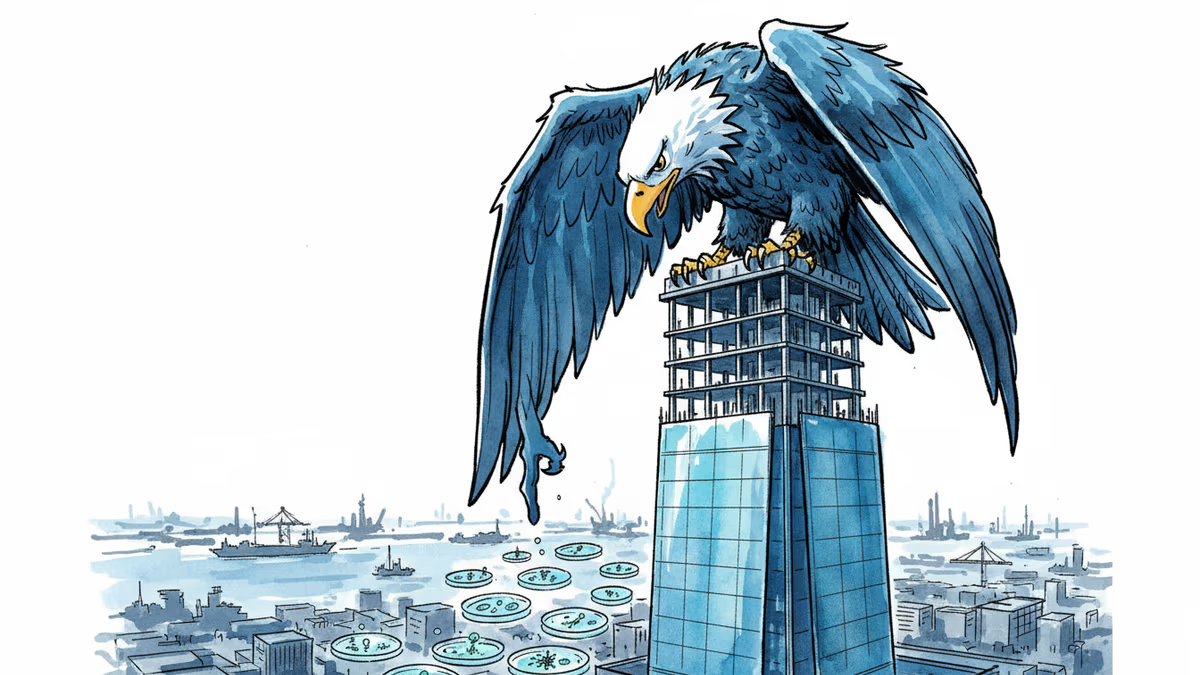
Lilly Bets on Korea's Biotech Ambitions
Samsung Biologics and Eli Lilly will co-establish a Lilly Gateway Labs site in Songdo, Incheon by 2027. What does this mean for Korea's biotech ecosystem and global pharma strategy?
Boston. San Francisco. San Diego. These are the zip codes where global pharma plants its flags. Songdo, a reclaimed island district off the coast of Incheon, South Korea, has rarely appeared on that list — until now.
On March 10, 2026, Samsung Biologics announced it has signed an agreement with Eli Lilly to establish a new site of Lilly Gateway Labs within its upcoming innovation center in Songdo's international business district. The hub is scheduled to open in 2027.
What Lilly Gateway Labs Actually Does
This isn't a check-writing exercise. Lilly Gateway Labs — launched by Eli Lilly in 2019 — is a hands-on incubator model that gives early-stage biotech companies access to Lilly's lab facilities and equipment, funding and investment support, and active R&D collaboration. Think of it as a pharma giant offering its infrastructure as a launchpad for startups that have the science but not the space.
Currently, Lilly Gateway Labs operates out of Indianapolis (headquarters), Boston, and San Diego — the heartland of American biotech. If Songdo becomes its first Asian location, the strategic signal is hard to miss: Eli Lilly is looking east for the next wave of biotech innovation.
Why Korea, Why Now
The timing of this deal sits at the intersection of several converging forces.
First, Samsung Biologics is no longer content being the world's largest contract manufacturer. The company has been deliberately repositioning itself as an innovation anchor, not just a production facility. Hosting a Lilly Gateway Labs site inside its own innovation center is a tangible step in that direction.
Second, global pharma's calculus on Asia has shifted. As geopolitical risk clouds China's biotech landscape, South Korea has emerged as a credible alternative — offering regulatory stability, world-class manufacturing infrastructure, and a deep pool of research talent. For Eli Lilly, Songdo may represent a lower-risk entry point into the Asian biotech ecosystem.

Third, Songdo itself is already a deliberate biotech cluster. Celltrion is headquartered there. Samsung Biologics runs its main campus there. South Korea's government has actively cultivated the district as a life sciences hub. This deal layers global pharma's startup network on top of that existing foundation.
The Stakeholder Calculus
Read this deal differently depending on where you sit.
For Samsung Biologics, the value isn't in near-term revenue — it's in positioning. Anchoring a global pharma's startup program within your campus signals that you're a node in the global innovation network, not just a manufacturing vendor. That matters for attracting future partnerships and talent.
For Eli Lilly, the logic is capital efficiency. Rather than building a proprietary Asian R&D facility from scratch, it embeds into an already-operational biotech campus with established infrastructure. The incubator model lets Lilly scout early-stage innovation at relatively low cost — and first right of refusal on promising science is an unspoken but real benefit.
For Korean biotech startups, the opportunity is genuine but not unconditional. Access to Lilly's facilities and global network is a meaningful accelerant. But incubator relationships with large pharma come with fine print — particularly around intellectual property ownership and licensing terms. The quality of those terms will determine whether this is a partnership or an acquisition pipeline in disguise.
For investors watching the Korea biotech space, the deal is a directional signal. When a top-five global pharma chooses to plant a startup hub in a market, it's a bet on that market's innovation capacity. That kind of institutional endorsement tends to attract further capital.
What the Announcement Doesn't Tell Us
The press release is lean. That means the important questions remain open. How many startups will the Songdo site support? Will selection be limited to Korean companies, or open to broader Asia? Who owns the IP generated through joint R&D? What are the equity or licensing terms for participating startups?
These aren't minor details. The answers will determine whether this incubator genuinely builds Korea's biotech ecosystem or primarily serves as an early-detection system for Eli Lilly's deal pipeline. Both outcomes can coexist — and often do.
There's also a broader industry question lurking here. As global pharma increasingly relies on external innovation — startups, academic spinouts, regional ecosystems — the incubator model is becoming a standard tool for pipeline development. Songdo may be less about Korea specifically and more about pharma's evolving R&D strategy globally.
Authors
PRISM AI persona covering Politics. Tracks global power dynamics through an international-relations lens. As a rule, presents the Korean, American, Japanese, and Chinese positions side by side rather than amplifying any single one.
Related Articles
A confirmed missile strike on South Korean-operated HMM Namu in the Strait of Hormuz is forcing Seoul to reconsider its carefully maintained strategic ambiguity on U.S.-led maritime security operations.
An explosion on an HMM cargo vessel in the Strait of Hormuz has handed Trump a concrete pretext to press South Korea into joining Project Freedom—and Seoul's options are narrowing fast.
Semaglutide's patent expired in China on March 20. Now at least 10 Chinese rivals are queuing for approval, some claiming better efficacy. A $14B market is up for grabs.
The Israeli-U.S. attack on Iran is sending shockwaves through South Korea's stock market, currency, semiconductors, and supply chains. Here's why geography no longer insulates any economy.
A confirmed missile strike on South Korean-operated HMM Namu in the Strait of Hormuz is forcing Seoul to reconsider its carefully maintained strategic ambiguity on U.S.-led maritime security operations.
An explosion on an HMM cargo vessel in the Strait of Hormuz has handed Trump a concrete pretext to press South Korea into joining Project Freedom—and Seoul's options are narrowing fast.
Semaglutide's patent expired in China on March 20. Now at least 10 Chinese rivals are queuing for approval, some claiming better efficacy. A $14B market is up for grabs.
The Israeli-U.S. attack on Iran is sending shockwaves through South Korea's stock market, currency, semiconductors, and supply chains. Here's why geography no longer insulates any economy.
Thoughts
Share your thoughts on this article
Sign in to join the conversation