
Your Face, Any Situation: Google's New AI Makes It Real
Google's Nano Banana 2 lets anyone create photorealistic fake images in seconds. As the line between real and artificial blurs, what can we still trust?
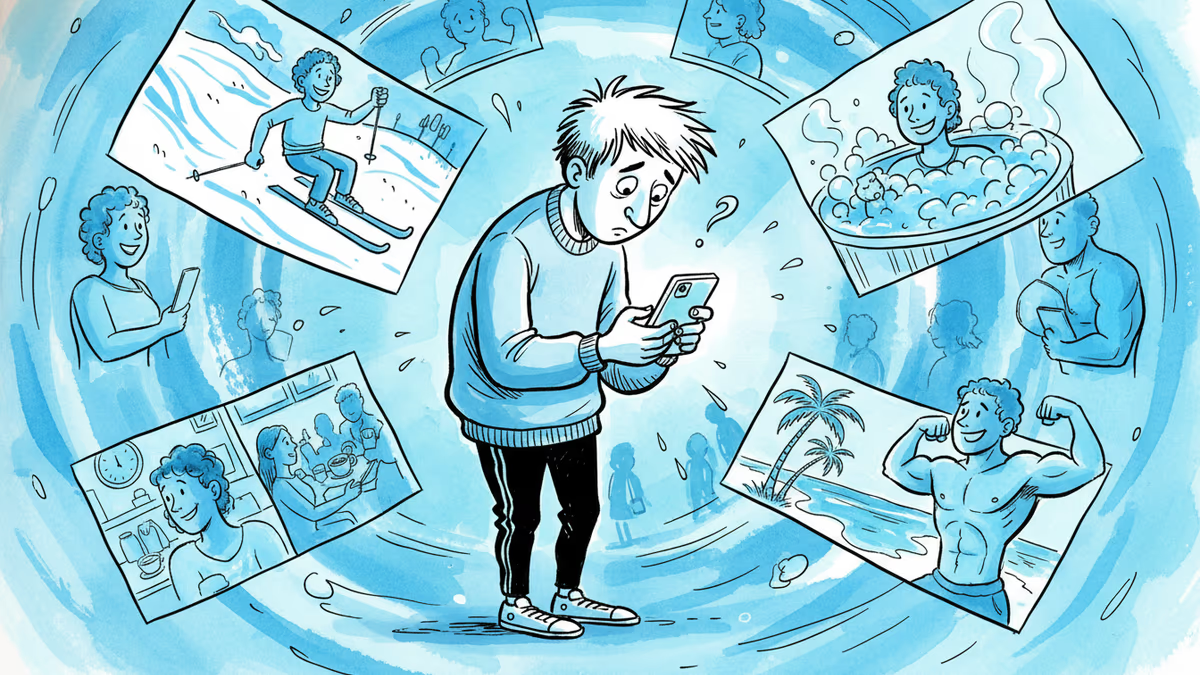
One million people tried it in the first 48 hours. Google's latest AI image generator, Nano Banana 2, has users uploading selfies and placing themselves in situations that never happened. Skiing down mountains they've never visited. Relaxing in hot tubs they've never owned. The catch? It's all 100% fake.
One Selfie Is All It Takes
Google's newest AI image generator is 3x faster than its predecessor and dead simple to use. Just click the banana emoji in the Gemini chatbot, upload a photo, and watch the magic happen. No technical skills required.
The results are unsettling in their realism. When a reporter uploaded a random bathroom selfie and asked to be placed in a snowy outdoor jacuzzi, the AI delivered. It perfectly recreated shirt details that weren't visible in the original photo. Even a chain necklace appeared correctly on the submerged hand in the generated image.
But perfection isn't guaranteed. When requesting a "ripped and shirtless skiing" scene, the result looked like a paper cutout head pasted onto a fitness model's body. Laughably bad, yet still convincing enough to fool casual scrollers.
The Real-Time Misinformation Problem
More concerning is the tool's ability to pull live web data. When asked to create a weather infographic for a ski trip, Nano Banana 2 generated a professional-looking chart complete with temperatures and snow conditions. The problem? It used week-old data, delivering completely wrong forecasts while looking authoritative.

Google watermarks its AI outputs, but these identifiers are easy to miss during rapid social media scrolling. As quality improves, distinguishing real from artificial becomes increasingly difficult.
Tech ethicist Dr. Sarah Chen warns: "We're entering an era where the burden of proof shifts from 'this looks fake' to 'this must be real.' That's a dangerous precedent."
The Regulatory Response
European regulators are already taking notice. The EU's AI Act requires clear labeling of synthetic content, but enforcement remains patchy. In the US, several states are drafting legislation targeting non-consensual AI-generated imagery, though progress is slow.
Meta and TikTok have implemented detection systems for AI content, but they're playing catch-up as generation tools improve faster than detection methods. The cat-and-mouse game favors the creators, not the detectors.
Meanwhile, educators scramble to update policies. How do you grade a history project that includes AI-generated "historical" photos? Some universities now require students to declare AI usage, but verification remains nearly impossible.
The Creator Economy Shift
For content creators, Nano Banana 2 represents both opportunity and threat. Stock photo companies report declining sales as users generate custom images instead. But authenticity-focused influencers worry about audience trust eroding when anyone can fake their lifestyle content.
"I spend thousands traveling for content," says lifestyle blogger Amanda Torres. "Now someone can fake the same shots from their bedroom. How do I prove my experiences are real?"
Authors
Related Articles

Samsung and SK unveiled a chip and AI investment package worth thousands of trillions of won on June 29. The headline number swings wildly by outlet, but the real contest isn't capital — it's water and power.
In a post-Google I/O interview, Sundar Pichai acknowledged flawed search results, real AI anxiety, and an AGI timeline that makes the label irrelevant. Here's what he said — and what it means.
Google is building AI agents that search the web proactively, without user prompting. That's not just a product update — it's a fundamental shift in who controls the information you receive.
Viral videos show 2026 graduates jeering executives who praise AI at commencement ceremonies. It's not just rudeness — it's a signal about who pays for technological optimism.
Samsung and SK unveiled a chip and AI investment package worth thousands of trillions of won on June 29. The headline number swings wildly by outlet, but the real contest isn't capital — it's water and power.
In a post-Google I/O interview, Sundar Pichai acknowledged flawed search results, real AI anxiety, and an AGI timeline that makes the label irrelevant. Here's what he said — and what it means.
Google is building AI agents that search the web proactively, without user prompting. That's not just a product update — it's a fundamental shift in who controls the information you receive.
Viral videos show 2026 graduates jeering executives who praise AI at commencement ceremonies. It's not just rudeness — it's a signal about who pays for technological optimism.
Thoughts
Share your thoughts on this article
Sign in to join the conversation