
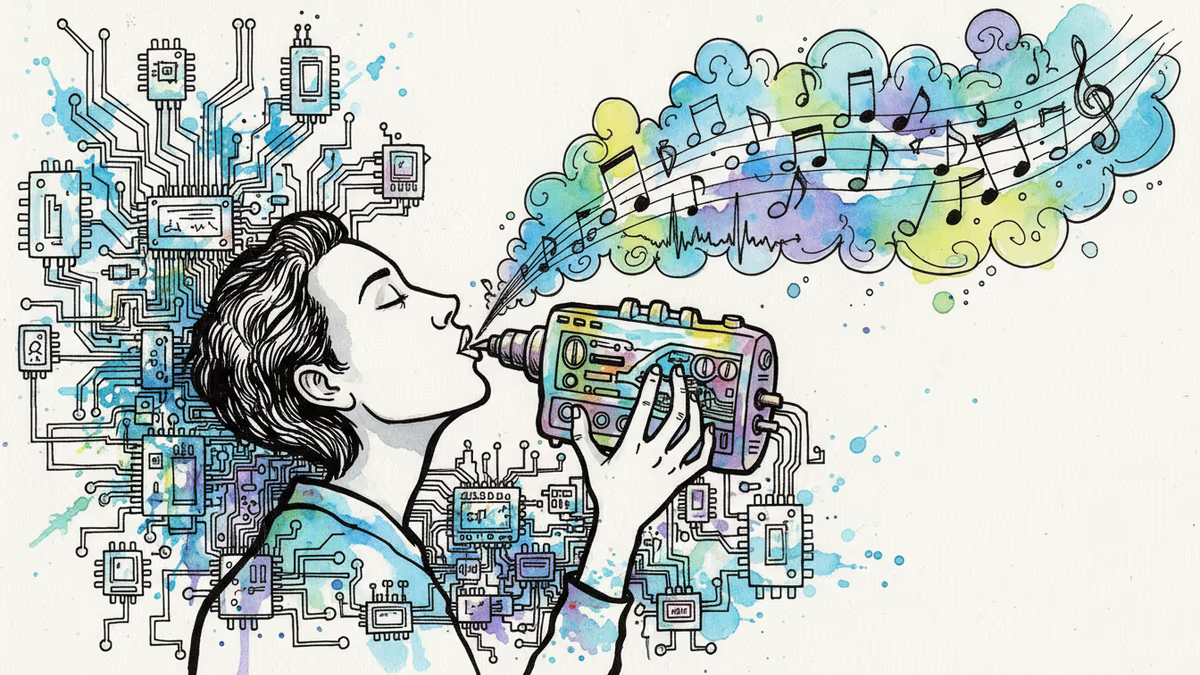
From Trash to Beats: When Vapes Become Musical Instruments
NYC makers transform discarded disposable vapes into digital synthesizers, turning e-waste into experimental music and highlighting creative approaches to electronic waste.
23 Million Disposable Vapes Hit US Landfills Every Year
In a Brooklyn hackerspace, an unusual sound echoes through the workshop—part dying rabbit, part bug zapper symphony. The source? A bright pink device that looks exactly like a disposable vape but produces digital music when you suck air through it.
Meet the Vape Synth, created by three NYC makers who call themselves Paper Bag Team. They're turning the $28 billion global vaping industry's waste problem into experimental musical instruments, one Elf Bar at a time.
Kari Love, David Rios, and Shuang Cai don't vape nicotine themselves. They're professors and PhD students who see opportunity in what others call trash. "The juice goes out, but then you have this charging circuit, the battery," Cai explains. "Everything in there is still perfectly fine."
The Disposable Explosion Nobody Talks About
When the FDA ordered Juul off US shelves, it cleared the runway for an invasion of entirely disposable devices. Chinese manufacturers flooded the market with colorful cartridges bearing names like Pillow Talk, Hyppe Bar, and PolkaDot—each designed to be thrown away after a few thousand puffs.
The environmental math is staggering. Each device contains a lithium-ion battery, charging circuitry, pressure sensors, and LEDs. In the US, vape recycling is essentially nonexistent. "They're this huge e-waste product," Love notes. "You see them everywhere."
The irony? While the nicotine juice runs dry, the electronics inside remain perfectly functional. A $15 vape contains components that could power other devices for years.
Making Serious Problems Silly

The team's approach draws from hacker Andrew Quitmeyer's "Bubble Punk" philosophy: make serious issues like waste reduction a little funny, and more people will engage. "We started from a very silly place," Love admits. "We have to use the low pressure sensor. Which means to play it, you must suck."
The resulting instrument sounds deliberately chaotic—think digital ocarina meets malfunctioning robot. That's intentional. The team has presented at events like the Open Hardware Summit and runs workshops at maker spaces, recently releasing detailed Instructables guides for DIY builders.
Rios, who teaches about musical interfaces at NYU, sees broader implications: "People feel just completely unempowered to do anything. Even the most basic thing of just popping the lid open to see what's in there."
Beyond the Gimmick: A Movement Emerges
The Vape Synth joins a growing ecosystem of e-waste artists. Sebastian Bidegain built vape cameras, Becky Stern repurposes vape batteries, and the Disengineering collective transforms them into microphones. Each project chips away at our throwaway mentality.
"This process is upstream salvage," Cai explains. "The idea is not that we want to use this as a solution to the existing status quo, but to use this to call for attention and encourage more creative action."
The workshops draw diverse crowds—from electronic musicians seeking new sounds to environmental activists looking for hands-on solutions. Participants learn to safely handle nicotine residue (gloves required), relocate pressure sensors, and wire basic audio circuits.
The Bigger Circuit Board
The team is already working on Version 2.0 with expanded musical range and MIDI controller capabilities. But the real innovation isn't technical—it's philosophical. They're reframing e-waste from "problem to solve" to "resource to reimagine."
Consider the scale: if just 1% of discarded vapes were diverted to creative reuse, that's hundreds of thousands of devices annually. Each contains components that took energy and rare earth minerals to manufacture. Why not extend their useful life?
The regulatory landscape remains murky. While the EPA classifies vapes as e-waste requiring special handling, there's little infrastructure for processing them. Meanwhile, manufacturers face no responsibility for end-of-life disposal.
Authors
Related Articles
Every new gadget carries hidden costs — in carbon, labor, and waste. Here's a practical, honest guide to buying tech more ethically in 2026.

Five stories from late September, traced to where the paper trail stops: Korea's export record, Nvidia's Hugging Face 8-K, a US-China AI channel, the UN on AI, and rising births.

Huawei's CANN is open source under a license barring software for non-Ascend chips. Inside China's second CUDA, and the two links still outside it: pre-training compute and 5nm capacity.
Samsung Electronics' union branch revealed that 84% of survey respondents oppose the government's roughly $290 billion (₩400 trillion) semiconductor megaproject in Gwangju. Government, management, the union and shareholders are all reading the same national project in sharply different ways.
Every new gadget carries hidden costs — in carbon, labor, and waste. Here's a practical, honest guide to buying tech more ethically in 2026.
Five stories from late September, traced to where the paper trail stops: Korea's export record, Nvidia's Hugging Face 8-K, a US-China AI channel, the UN on AI, and rising births.
Huawei's CANN is open source under a license barring software for non-Ascend chips. Inside China's second CUDA, and the two links still outside it: pre-training compute and 5nm capacity.
Samsung Electronics' union branch revealed that 84% of survey respondents oppose the government's roughly $290 billion (₩400 trillion) semiconductor megaproject in Gwangju. Government, management, the union and shareholders are all reading the same national project in sharply different ways.
Thoughts
Share your thoughts on this article
Sign in to join the conversation