
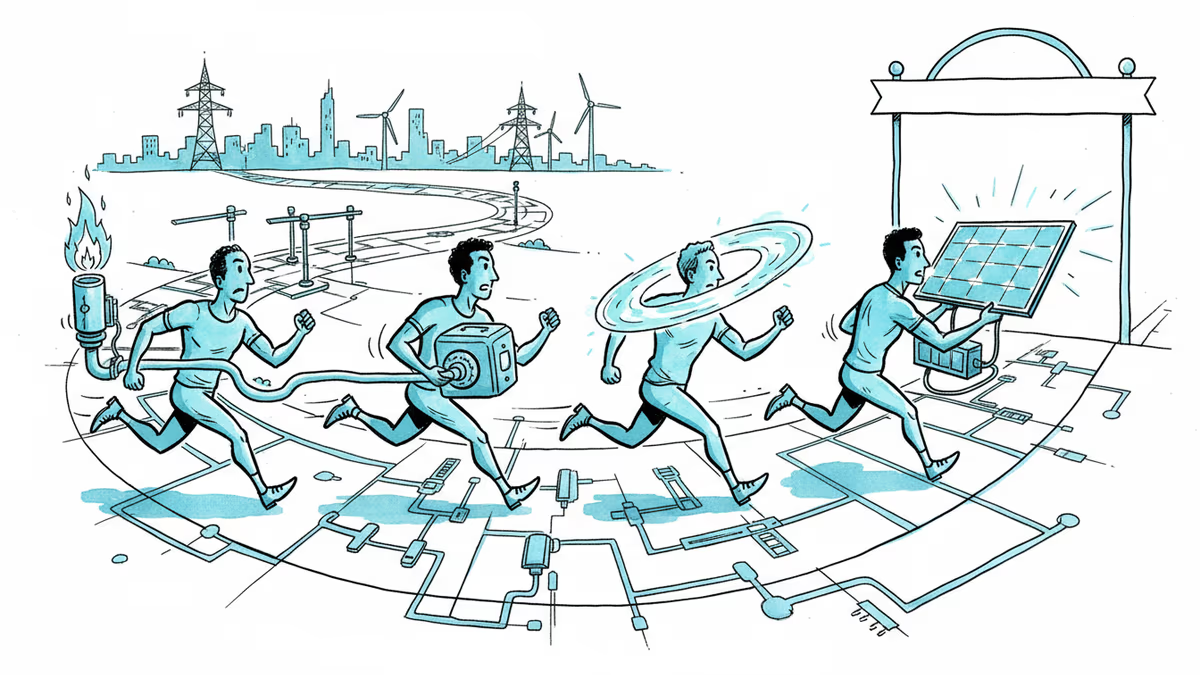
The 2035 Grid: A Four-Way Race Nobody Has Won Yet
AI's power hunger is forcing a reckoning. Natural gas, SMRs, fusion, and batteries are all racing to power the grid — but only one can win on cost. Here's where the race stands.
You Can Order a Gas Turbine Today. You'll Get It in 2032.
Order a natural gas turbine right now and you'll be waiting until the early 2030s for delivery. The backlog is that long. Here's the uncomfortable irony: by the time those turbines arrive, the competitors they were supposed to beat may already be plugged into the grid.
That's the energy paradox of 2026. AI data centers are consuming electricity at a pace that has caught even the most optimistic forecasters off guard. Tech companies need 24/7 baseload power — the kind that doesn't flicker when clouds roll in or wind dies down. Natural gas was the obvious answer: proven, relatively cheap, widely available. But two cracks appeared in that logic almost simultaneously.
First, the Middle East war exposed the supply chain. Iranian drone strikes knocked out a significant portion of Qatar's natural gas infrastructure — and Qatar is one of the world's largest LNG exporters. Geopolitical risk stopped being theoretical. Second, the turbine shortage hit. In the U.S., 40% of all natural gas consumed goes toward generating electricity, and demand for new plants is outstripping the industry's ability to build them.
That gap — measured in years, not months — has become the most valuable real estate in energy.
The Challengers Lining Up
Three technologies are sprinting to fill it, each with a different pitch.
Small Modular Reactors (SMRs) have the most credible near-term story. They're built on decades of proven nuclear physics, just shrunk and standardized. Kairos Power, with Google as a future customer, received approval for its Hermes 2 demonstration reactor in 2024 and is already under construction. Oklo — which merged with a Sam Altman-backed SPAC — is targeting 2028 for first commercial operations. TerraPower, founded by Bill Gates and partnered with Meta, plans to begin commercial operations in 2030. X-energy, backed by Amazon, is aiming for the early 2030s.
The pitch is straightforward: mass-manufacture reactors like products, drive costs down through scale, and offer tech companies the clean baseload power they're desperate for. Whether that manufacturing hypothesis holds up under real-world conditions is the central unanswered question.
Fusion is the longer shot with the bigger upside. Commonwealth Fusion Systems plans to flip the switch on its demonstration reactor next year, with a 400-megawatt commercial plant in Virginia targeted for the early 2030s. But Helion — also backed by Sam Altman — is making the most aggressive bet of anyone in energy. It has committed to supplying Microsoft with electricity by 2028, and is reportedly in talks with OpenAI for up to 5 gigawatts by 2030 and 50 gigawatts by 2035.

To hit 50 gigawatts, Helion would need to build 800 reactors by 2030 and another 7,200 in the five years after that. For context: the entire United States added 63 gigawatts of new generating capacity across all sources last year. If Helion delivered at that scale, it wouldn't just compete with natural gas — it would rewrite the energy market entirely.
Renewables paired with batteries are the quiet frontrunner that neither the nuclear nor gas camps want to talk about. Solar costs keep falling. Battery installations hit 58 gigawatt-hours last year. And a new generation of batteries — Form Energy's iron-air chemistry, XL Batteries' organic fluid stored in repurposed oil tanks — deliberately avoids lithium, cobalt, and nickel. No critical minerals means dramatically lower costs for long-duration storage. Even without subsidies, solar-plus-storage already ranges from $50 to $130 per megawatt-hour.
The Only Metric That Actually Matters
All of this comes down to one number: cost per megawatt-hour.
According to Lazard, new nuclear power currently runs around $170/MWh — the most expensive option on the table. Fusion is projected to start around $150/MWh. New natural gas plants sit at $107/MWh, though that figure has been trending up. Solar-plus-batteries? $50–$130/MWh, and falling.
SMR developers are betting that factory-scale manufacturing will slash their costs. Fusion startups are betting on physics breakthroughs translating to commercial efficiency. Natural gas is betting on the inertia of existing infrastructure and regulatory familiarity. And renewables are just... getting cheaper, almost regardless of what anyone bets.
The uncomfortable truth for SMR and fusion advocates is that they're racing against a moving target. Every year they spend proving their technology, batteries get cheaper. The window where nuclear — fission or fusion — can claim a decisive cost advantage may be narrower than their timelines suggest.
What the Stakeholders Aren't Saying Out Loud
Tech companies like Google, Microsoft, Amazon, and Meta are hedging across all four options simultaneously — signing power purchase agreements with SMR startups, funding fusion research, and still buying renewable energy credits. That's not a strategy; that's an admission that nobody knows which technology wins.
For investors, the risk profiles are radically different. Renewables-plus-batteries offer lower upside but proven execution. SMRs offer moderate upside with regulatory risk. Fusion offers transformative upside with existential execution risk — Helion's 7,200 reactors in five years target is either visionary or a number that will age very badly.
For policymakers, the stakes are geopolitical as much as economic. Countries that get baseload clean energy right in the next decade will have structural advantages in manufacturing, AI development, and industrial competitiveness. Countries that don't will be buying power — and the technology that generates it — from someone else.
For consumers and households, the near-term impact is less visible but real. If grid-scale batteries built from cheap, abundant materials become the dominant storage solution, electricity prices could fall significantly. If nuclear delays push utilities back toward natural gas, expect prices to stay elevated — or rise.
Authors
Related Articles

Snowflake's new $6 billion AWS contract is about more than cloud spending. It signals a shift in AI infrastructure—away from Nvidia GPUs and toward cheaper, homegrown chips for the agent era.
AI sustainability researcher Sasha Luccioni is launching a new venture to push for energy transparency in AI. Here's why Big Tech keeps the numbers hidden—and what's starting to change.
At Milken 2026, five AI insiders—from the CEO of ASML to a quantum physicist challenging LLMs—laid out the physical, energy, and geopolitical limits the AI boom is running into.
Palantir co-founder Peter Thiel and other Silicon Valley investors have poured $140 million into Panthalassa, a startup building wave-powered floating AI data centers in the open ocean. Here's what that actually means.
Snowflake's new $6 billion AWS contract is about more than cloud spending. It signals a shift in AI infrastructure—away from Nvidia GPUs and toward cheaper, homegrown chips for the agent era.
AI sustainability researcher Sasha Luccioni is launching a new venture to push for energy transparency in AI. Here's why Big Tech keeps the numbers hidden—and what's starting to change.
At Milken 2026, five AI insiders—from the CEO of ASML to a quantum physicist challenging LLMs—laid out the physical, energy, and geopolitical limits the AI boom is running into.
Palantir co-founder Peter Thiel and other Silicon Valley investors have poured $140 million into Panthalassa, a startup building wave-powered floating AI data centers in the open ocean. Here's what that actually means.
Thoughts
Share your thoughts on this article
Sign in to join the conversation