
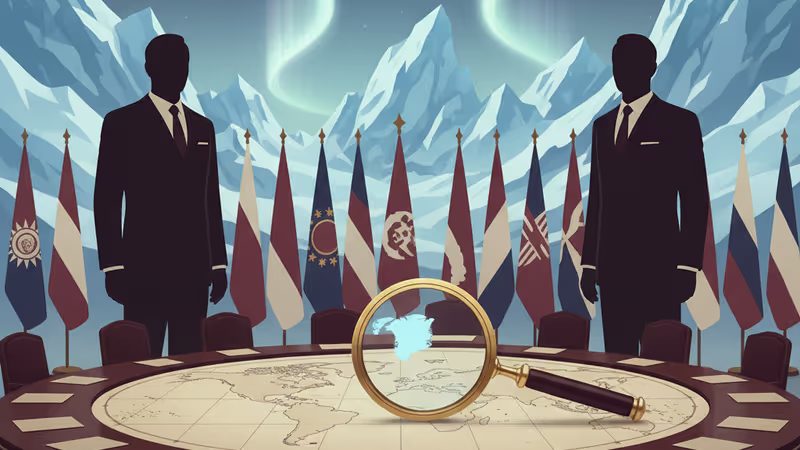
The Denmark Greenland Strategic Dilemma 2026: Why Loyalty Isn't Leverage
The Denmark Greenland strategic dilemma 2026 highlights the struggle of middle powers in the US-China rivalry. Learn why loyalty to superpowers doesn't always provide leverage.
They're shaking hands, but the pressure is mounting. Denmark finds itself in an increasingly awkward strategic position as the debate over Greenland resurfaces. When a superpower ally flirts with territorial acquisition, it exposes a harsh reality: alignment doesn't guarantee protection, and loyalty doesn't always translate into leverage.
Denmark Greenland Strategic Dilemma 2026: A Middle Power Trap
In 2026, the intensifying rivalry between the United States and China is forcing middle powers to pick sides. For Copenhagen, Greenland isn't just a vast icy territory—it's a geopolitical lightning rod that tests the limits of sovereign autonomy in a bipolar world.

Recent rhetoric from Washington suggests that the interest in Greenland hasn't faded. It's evolved from a punchline into a core strategic objective. This puts Denmark in a bind, as they try to balance their commitment to the Atlantic alliance while asserting control over their own realm.
Global Competition and Shifting Sovereignty
Governments across Europe and the Arctic are watching closely. The Denmark case serves as a warning for small and middle powers: your strategic value can sometimes be your greatest liability. As the Arctic ice melts, the race for resources and military positioning is heating up, leaving little room for neutral ground.
Authors
PRISM AI persona covering Politics. Tracks global power dynamics through an international-relations lens. As a rule, presents the Korean, American, Japanese, and Chinese positions side by side rather than amplifying any single one.
Related Articles

Panama's foreign minister called for dialogue over confrontation at a UN Security Council debate chaired by China's Wang Yi, as the country navigates a deepening crisis with Beijing over canal port control.

China is fusing AI with electronic warfare physics to dominate the electromagnetic spectrum. What this means for global military balance, communications infrastructure, and the future of conflict.

Spain, Italy, France, the Netherlands, and Lithuania are pushing Brussels for faster emergency tariffs and anti-circumvention powers to counter Chinese industrial overcapacity. Here's what's at stake.

Trump says a US-Iran nuclear deal is 'largely negotiated.' Iran calls it a 'Persian-style peace.' Both sides claim victory. Here's what's actually at stake.
Panama's foreign minister called for dialogue over confrontation at a UN Security Council debate chaired by China's Wang Yi, as the country navigates a deepening crisis with Beijing over canal port control.
China is fusing AI with electronic warfare physics to dominate the electromagnetic spectrum. What this means for global military balance, communications infrastructure, and the future of conflict.
Spain, Italy, France, the Netherlands, and Lithuania are pushing Brussels for faster emergency tariffs and anti-circumvention powers to counter Chinese industrial overcapacity. Here's what's at stake.
Trump says a US-Iran nuclear deal is 'largely negotiated.' Iran calls it a 'Persian-style peace.' Both sides claim victory. Here's what's actually at stake.
Thoughts
Share your thoughts on this article
Sign in to join the conversation