

GPT-5.2's Math Breakthrough Isn't About Better Homework—It's About a New Scientific Revolution
OpenAI's GPT-5.2 isn't just an update. Its breakthrough in math and science signals a shift from generative to cognitive AI, reshaping the future of enterprise R&D.
The Lede: AI Graduates from Content Creator to Scientific Collaborator
OpenAI's latest model, GPT-5.2, isn't just incrementally better; it represents a fundamental shift in the purpose of artificial intelligence. While the world has been mesmerized by AI's ability to generate text and images, its mastery of advanced mathematics and science—demonstrated by solving an open theoretical problem—signals a new era. This is the moment AI transitions from a highly-skilled intern, good at summarizing and creating drafts, to a senior research partner capable of generating novel, verifiable scientific insight. For enterprise leaders and investors, this is the real revolution.
Why It Matters: The End of AI's "Trust Deficit"
For years, the Achilles' heel of large language models has been their unreliability in domains requiring strict logical consistency, like math and science. Their tendency to "hallucinate" made them unusable for high-stakes applications. GPT-5.2's ability to generate reliable mathematical proofs and set new benchmarks on tests like GPQA Diamond begins to solve this critical trust problem.
The second-order effects are profound:
- Accelerated R&D: Industries like pharmaceuticals, materials science, and aerospace can now use AI to model complex systems and test hypotheses at a speed previously unimaginable, dramatically shortening discovery cycles.
- The New Competitive Moat: The AI arms race is no longer just about chatbot fluency. Supremacy will be defined by the ability to solve tangible, billion-dollar problems in the physical world. Companies that integrate this level of cognitive AI into their core research will create an insurmountable competitive advantage.
- Democratization of Discovery: Smaller labs and research institutions may gain access to a level of analytical power previously reserved for state-level supercomputers, potentially leveling the playing field for innovation.
The Analysis: Moving from Mimicry to True Reasoning
From Hallucination to Hard Science

The historical context here is crucial. Early LLMs were effectively sophisticated pattern-matching engines. They were excellent at predicting the next word in a sentence but lacked any underlying model of reality or logic. This is why they would confidently produce incorrect answers to math problems. GPT-5.2's performance suggests a move towards a more robust internal reasoning capability. By generating reliable proofs, it's not just guessing the answer; it's showing its work in the most rigorous language possible—mathematics. This is the trust leap enterprises have been waiting for before deploying AI in mission-critical R&D and engineering functions.
The Real AI Arms Race is in Verifiable Truth
While public attention focuses on a model's personality or creative abilities, the real battle between OpenAI, Google DeepMind, and Anthropic is shifting to the domain of objective, verifiable problem-solving. Benchmarks like FrontierMath are not subjective; a model is either right or wrong. This push into hard sciences forces a new level of discipline and capability. Expect rivals to rapidly pivot their messaging and R&D to showcase their own models' prowess in STEM, moving the industry's focus from generative flair to cognitive power. The company that proves its model can be trusted with a formula for a new drug or an aerospace schematic will win the enterprise market.
Investment and Market Impact
The investment thesis for AI is evolving in real-time. The initial hype was around consumer-facing apps and content generation tools. The next, far larger, wave of value creation will come from what can be termed "Cognitive-AI-as-a-Service" (CAaaS). Smart capital will flow towards platforms that can integrate these powerful reasoning models into specific industry verticals.
Consider the implications: A pharmaceutical company could license a specialized version of GPT-5.2 to identify novel protein-folding combinations, or a materials firm could use it to design a new superconductor. This isn't about replacing analysts; it's about augmenting PhD-level scientists, making them exponentially more productive. The valuation of companies that successfully bridge this gap between raw model capability and industrial application will dwarf today's AI leaders.
Industry and Business Implications
For business leaders, the strategic directive is clear: it's time to stop thinking about AI as a back-office efficiency tool. You must now view it as a front-office innovation engine. The key challenge is no longer technological access but talent and integration. Companies will need to cultivate a new role: the 'AI Research Translator'—domain experts (chemists, physicists, engineers) who are also skilled at directing these powerful AI models to solve specific, high-value problems. The most successful organizations will be those that embed this AI-human collaboration directly into their R&D and product development pipelines.
PRISM's Take: The Discovery Engine is Here
GPT-5.2's scientific achievements are a categorical leap forward. OpenAI hasn't just built a better chatbot; it has lit the fuse on an intelligence explosion in the scientific and industrial worlds. We are moving from an era where AI helps us find and process what we already know to one where it helps us discover what we don't. For businesses, the paradigm has shifted from automation to discovery. The question is no longer how to use AI to do things cheaper, but how to use it to achieve the impossible. The companies that grasp this distinction today will own the industries of tomorrow.
This content is AI-generated based on source articles. While we strive for accuracy, errors may occur. We recommend verifying with the original source.
Related Articles
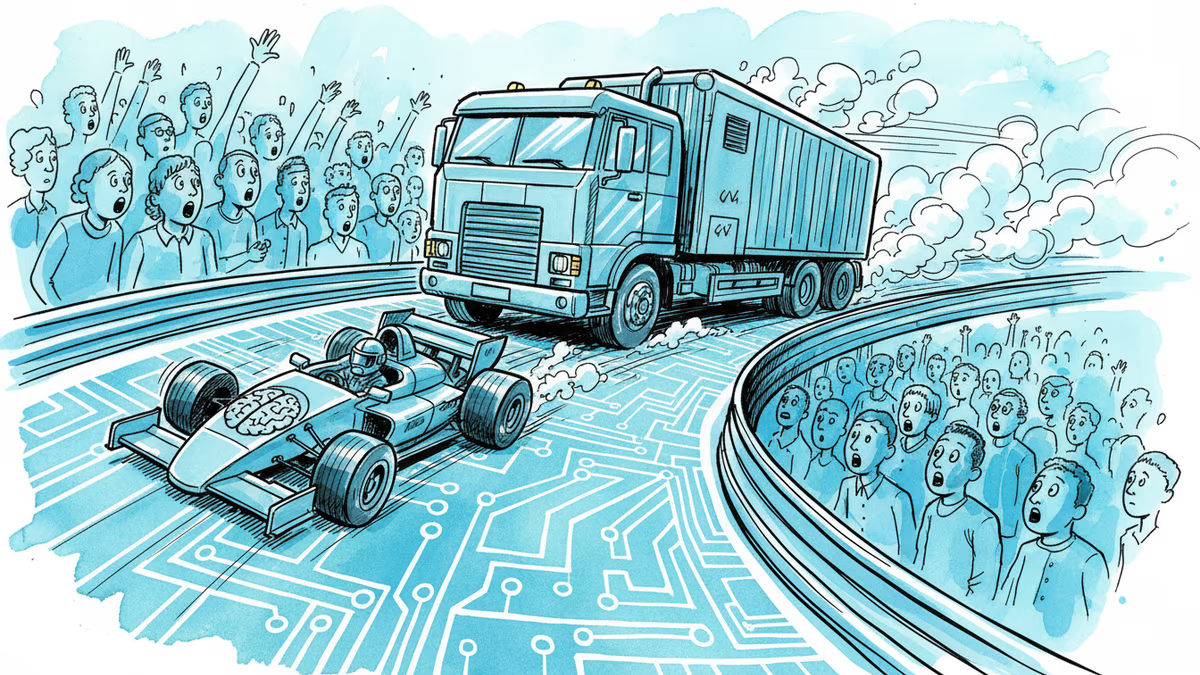
Cerebras Systems has refiled for an IPO targeting mid-May, backed by a $23B valuation, a reported $10B OpenAI deal, and an AWS partnership. What does this mean for Nvidia's dominance and the AI chip landscape?
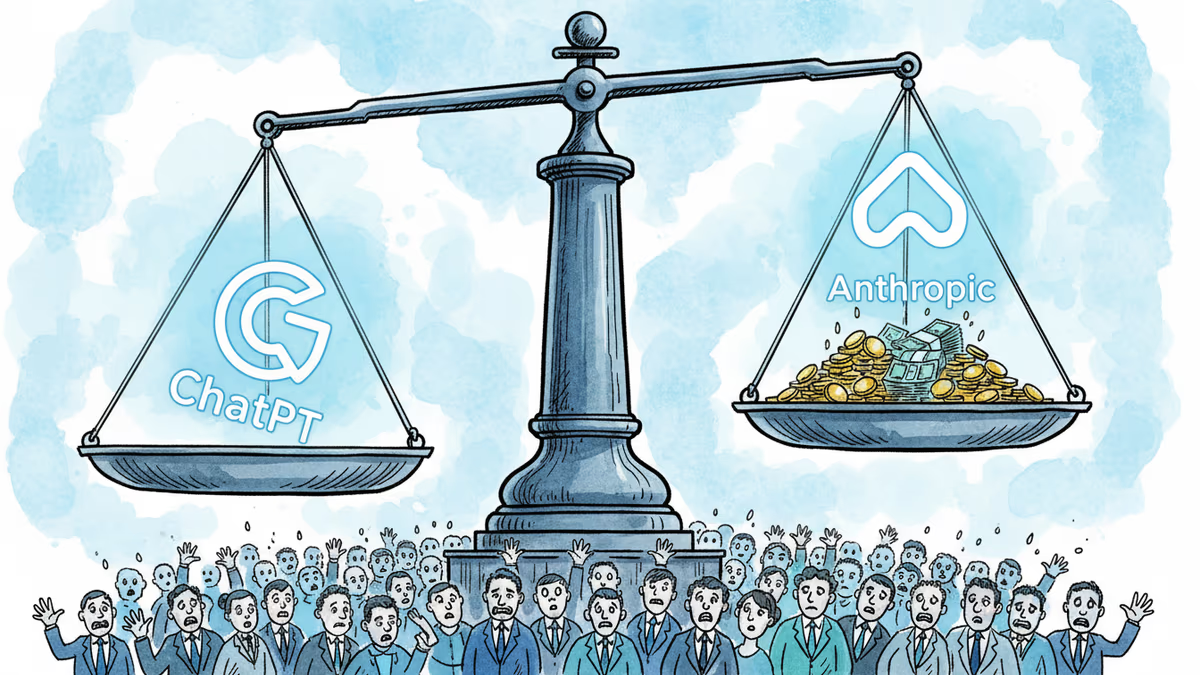
OpenAI's $852B valuation is drawing skepticism from its own backers as Anthropic's ARR tripled in three months. The secondary market is already voting with its feet.
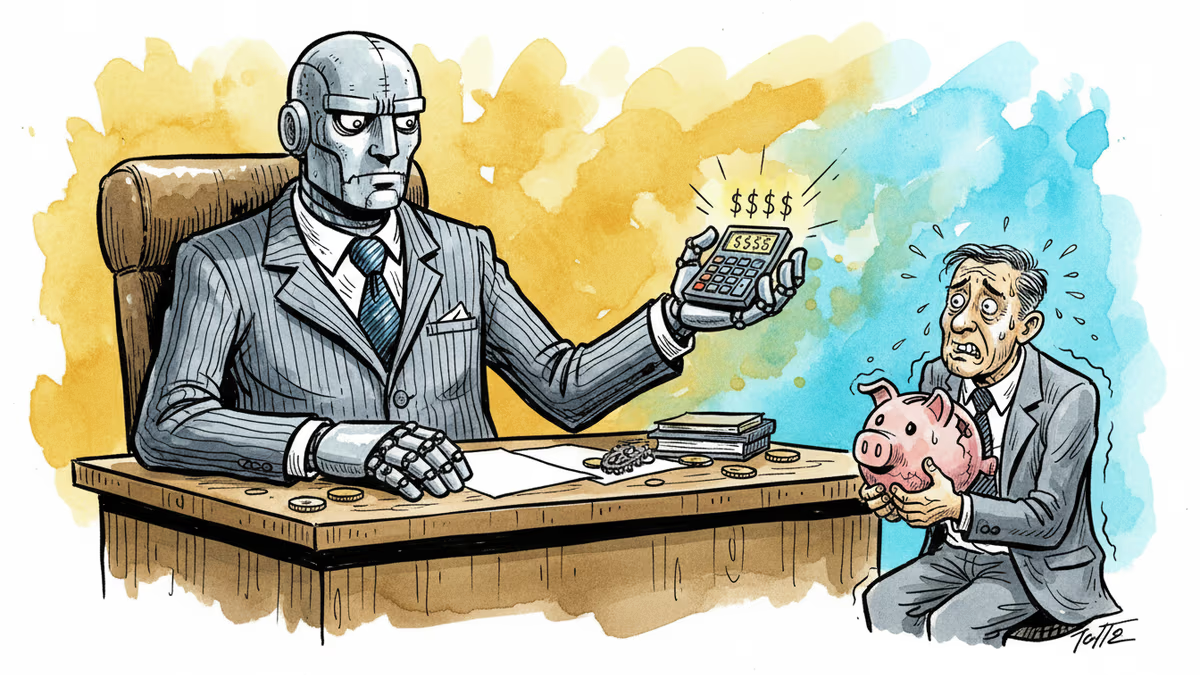
OpenAI acquired Hiro Finance, an AI-powered personal finance startup. Is this just a talent grab, or is the ChatGPT maker quietly building a financial services empire?

OpenAI CEO Sam Altman's San Francisco residence was attacked twice in three days — first a Molotov cocktail, then a shooting. What does this say about tech power, public anger, and the real-world risks facing AI leaders?
Cerebras Systems has refiled for an IPO targeting mid-May, backed by a $23B valuation, a reported $10B OpenAI deal, and an AWS partnership. What does this mean for Nvidia's dominance and the AI chip landscape?
OpenAI's $852B valuation is drawing skepticism from its own backers as Anthropic's ARR tripled in three months. The secondary market is already voting with its feet.
OpenAI acquired Hiro Finance, an AI-powered personal finance startup. Is this just a talent grab, or is the ChatGPT maker quietly building a financial services empire?
OpenAI CEO Sam Altman's San Francisco residence was attacked twice in three days — first a Molotov cocktail, then a shooting. What does this say about tech power, public anger, and the real-world risks facing AI leaders?
Thoughts
Share your thoughts on this article
Sign in to join the conversation