
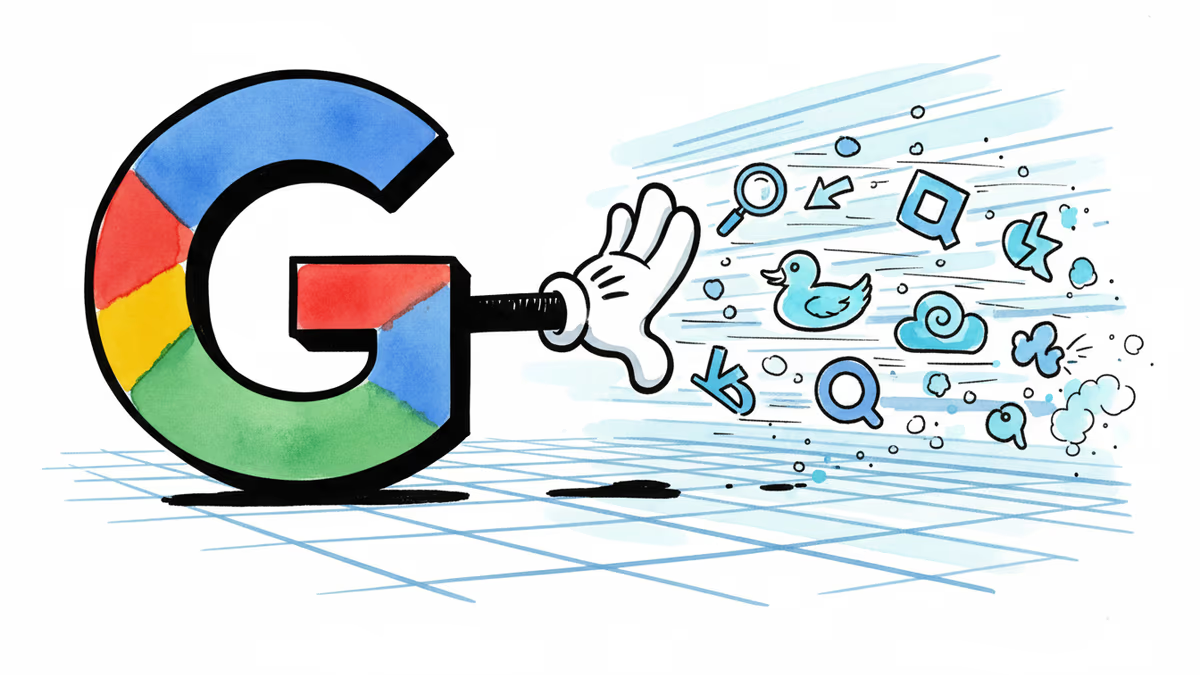
Google's Search Shake-Up: EU Forces the Tech Giant's Hand
Google will test showing rival services higher in European search results, potentially ending two decades of self-preferencing. What does this mean for competition?
The $150 Billion Question: Will Google Really Change?
Google just announced it's testing a fundamental shift in how it displays search results across Europe. Instead of prioritizing its own services like Google Flights and Google Hotels, the tech giant will show rival services higher up for hotels, flights, restaurants, and transportation.
This comes nearly a year after the European Commission ruled Google violated antitrust laws. But here's what's really at stake: Google's travel-related revenue alone is estimated at $15 billion annually. That's not pocket change, even for Alphabet.
Two Decades of 'Google First' Under Threat
Since the mid-2000s, Google has built an empire on a simple principle: when users search, they see Google's services first. Search "Paris hotels" and Google Hotels appeared above Booking.com or Expedia. This wasn't just about search—it was about creating an ecosystem where Google captured value at every step.
The strategy worked brilliantly. Google didn't just dominate search with 92% market share globally; it used that dominance to enter travel, shopping, maps, and dozens of other verticals. Each search became a potential revenue stream beyond just advertising.
But the EU saw this differently. In their view, Google was leveraging its search monopoly to unfairly advantage its other businesses—classic antitrust territory.
Market Reaction: Winners and Losers Emerge
The announcement sent ripples through public markets immediately.

Travel booking stocks surged: Booking Holdings jumped 2.3%, Expedia rose 1.8%, and smaller European competitors saw even bigger gains. "This could finally level the playing field," said one travel industry executive who requested anonymity.
Google investors weren't thrilled: Alphabet shares dipped slightly, with analysts questioning the long-term revenue impact. Morgan Stanley estimates Google's travel revenue could face "material headwinds" if the changes expand globally.
Smaller competitors celebrated: European price comparison sites and specialty travel services that have struggled for visibility suddenly see opportunity. "We've been waiting 15 years for this moment," said the CEO of a Berlin-based travel startup.
The Bigger Picture: Regulatory Dominos
This isn't just about Europe. Google faces similar pressures in the US, where the Department of Justice is pursuing its own antitrust case. The UK's Competition and Markets Authority is watching closely. If Google's European experiment works without devastating its business, expect similar changes worldwide.
But there's a strategic question: Is Google getting ahead of inevitable regulation, or is this a calculated move to appear compliant while minimizing actual impact?
The rollout is telling—starting with "lodgings" and expanding to "flights and other services" later. Google isn't ripping off the band-aid; it's testing how much revenue it can afford to lose.
What This Means for You
For consumers, the changes could mean more choice and potentially better deals. Instead of seeing Google's curated results first, you'll see what algorithms determine are the most relevant options—regardless of who owns them.
For businesses, it's a mixed bag. While travel companies celebrate, other industries wonder if they're next. Google Shopping, Google Maps business listings, YouTube in entertainment searches—the precedent could reshape how Google presents information across all verticals.
For investors, it raises fundamental questions about big tech's moats. If regulatory pressure can force Google to abandon profitable self-preferencing, what other "unfair advantages" might be next?
Authors
Related Articles
In a post-Google I/O interview, Sundar Pichai acknowledged flawed search results, real AI anxiety, and an AGI timeline that makes the label irrelevant. Here's what he said — and what it means.
Google is building AI agents that search the web proactively, without user prompting. That's not just a product update — it's a fundamental shift in who controls the information you receive.

Google unveiled the 'Googlebook' platform to replace Chromebook and ChromeOS—but revealed zero hardware specs. What's the strategy, and what does it mean for users, manufacturers, and the education market?

After 15 years of fragmented mobile messaging, Apple and Google are rolling out end-to-end encrypted RCS messaging between iPhones and Android devices. Here's what changed, why it took so long, and what it means for your privacy.
In a post-Google I/O interview, Sundar Pichai acknowledged flawed search results, real AI anxiety, and an AGI timeline that makes the label irrelevant. Here's what he said — and what it means.
Google is building AI agents that search the web proactively, without user prompting. That's not just a product update — it's a fundamental shift in who controls the information you receive.
Google unveiled the 'Googlebook' platform to replace Chromebook and ChromeOS—but revealed zero hardware specs. What's the strategy, and what does it mean for users, manufacturers, and the education market?
After 15 years of fragmented mobile messaging, Apple and Google are rolling out end-to-end encrypted RCS messaging between iPhones and Android devices. Here's what changed, why it took so long, and what it means for your privacy.
Thoughts
Share your thoughts on this article
Sign in to join the conversation