
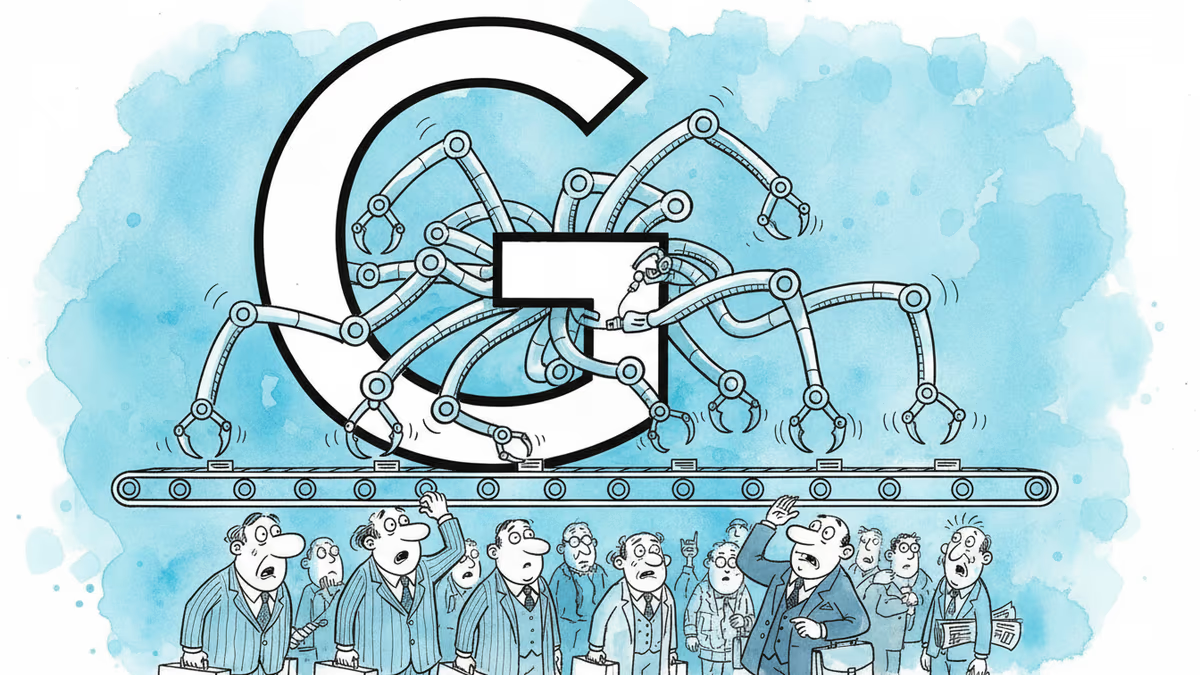
Google Promises More Prominent Links in AI Search Results
Google announces it will display links more prominently in AI Overviews and AI Mode. Is this genuine reform or damage control after publisher backlash?
70%. That's how much traffic some websites lost after Google rolled out AI Overviews. Now Google suddenly wants to make links "more prominent." Genuine reform or damage control?
The New Promise
Google's VP of Search Robby Stein made it sound simple on Tuesday: hover over sources in AI Overviews and AI Mode, get a pop-up with links, descriptions, and images. Desktop and mobile will both show "more descriptive and prominent link icons."
"Our testing shows this new UI is more engaging, making it easier to get to great content across the web," Stein wrote. The question isn't whether Google tested it—it's whether users will actually click.
Publishers: Cautiously Optimistic or Skeptically Resigned?
The publishing world's reaction splits down predictable lines. Smaller publishers who've watched their traffic crater since AI Overviews launched are cautiously hopeful. "Any visibility is better than invisibility," one digital media executive told us privately.
But skepticism runs deep. If Google's AI already summarizes the answer, why would users click through? The value proposition has fundamentally shifted. Publishers now compete not just with each other, but with AI-generated summaries of their own content.
SEO professionals are watching closely. Early tests suggest the changes might help, but the real test comes when users encounter these "prominent" links in practice. Will they click, or will the summary satisfy their curiosity?

Regulatory Pressure or Genuine Reform?
Timing tells a story. The EU is investigating Google's AI search practices for potentially harming news publishers. Major US outlets like The New York Times and The Washington Post have struck individual deals with Google, but smaller publishers remain vulnerable.
This announcement comes as Google faces mounting pressure from regulators, publishers, and even some advertisers who worry about the long-term health of the web ecosystem. When your business model depends on a thriving web, you can't let too many publishers go under.
The Bigger Battle for Web Traffic
Google's move reflects a deeper tension in the AI era. Tech companies want to provide instant answers, but they need the web to generate those answers. It's a delicate balance—extract too much value, and you kill the sources you depend on.
Other AI search engines like Perplexity and You.com face similar challenges. They're all trying to solve the same puzzle: how do you give users what they want while keeping content creators incentivized to create?
The answer might not be technical—it might be economic. Some industry observers predict we're heading toward a world where AI companies pay licensing fees to major content creators, similar to how streaming services pay for content.
What This Means for Your Business
If you run a website, this change matters—but probably not as much as you'd hope. The fundamental challenge remains: in an AI-first search world, you need to offer something the summary can't.
That might be real-time information, interactive tools, community discussion, or simply a better user experience. The websites thriving in the AI era aren't just information sources—they're destinations worth visiting.
Authors
Related Articles
In a post-Google I/O interview, Sundar Pichai acknowledged flawed search results, real AI anxiety, and an AGI timeline that makes the label irrelevant. Here's what he said — and what it means.
Google is building AI agents that search the web proactively, without user prompting. That's not just a product update — it's a fundamental shift in who controls the information you receive.
Google unveiled the 'Googlebook' platform to replace Chromebook and ChromeOS—but revealed zero hardware specs. What's the strategy, and what does it mean for users, manufacturers, and the education market?
After 15 years of fragmented mobile messaging, Apple and Google are rolling out end-to-end encrypted RCS messaging between iPhones and Android devices. Here's what changed, why it took so long, and what it means for your privacy.
In a post-Google I/O interview, Sundar Pichai acknowledged flawed search results, real AI anxiety, and an AGI timeline that makes the label irrelevant. Here's what he said — and what it means.
Google is building AI agents that search the web proactively, without user prompting. That's not just a product update — it's a fundamental shift in who controls the information you receive.
Google unveiled the 'Googlebook' platform to replace Chromebook and ChromeOS—but revealed zero hardware specs. What's the strategy, and what does it mean for users, manufacturers, and the education market?
After 15 years of fragmented mobile messaging, Apple and Google are rolling out end-to-end encrypted RCS messaging between iPhones and Android devices. Here's what changed, why it took so long, and what it means for your privacy.
Thoughts
Share your thoughts on this article
Sign in to join the conversation