
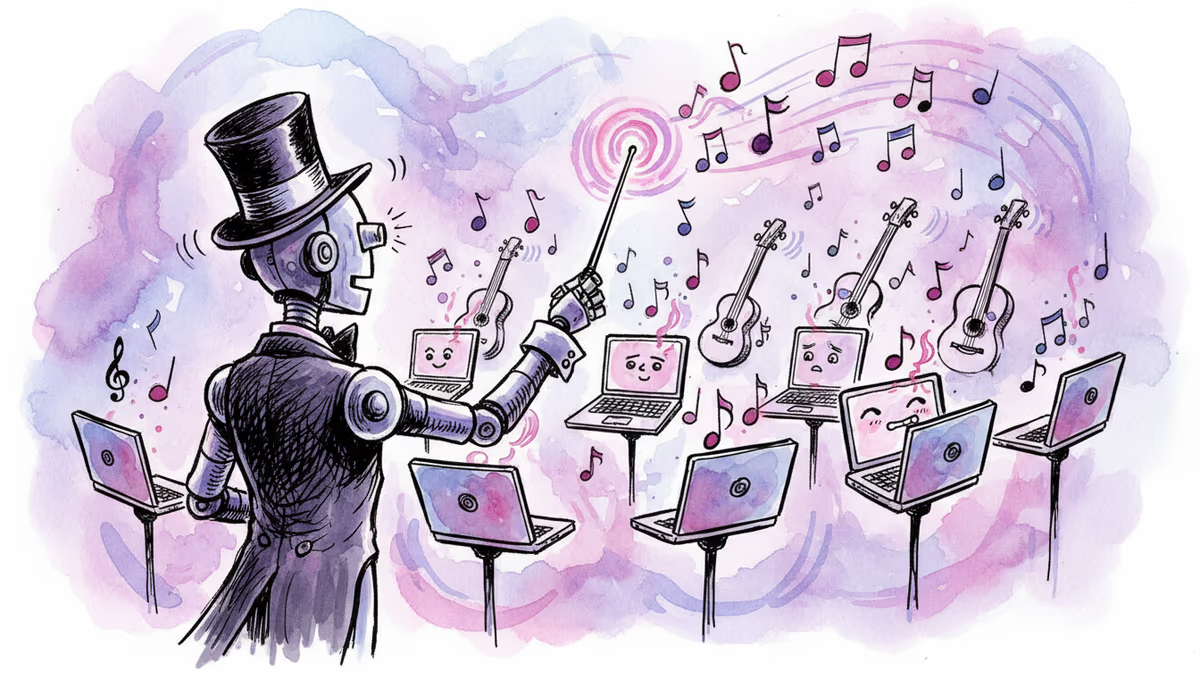
Google's AI Can Now Write Your Song in 30 Seconds
Google deploys Lyria 3 AI model in Gemini app, making AI music generation accessible to everyone. Exploring the implications for music industry and creativity.
From Text to Tune in 30 Seconds
Google just democratized music creation—or destroyed it, depending on who you ask. The tech giant has quietly rolled out its Lyria 3 AI model to the Gemini app, letting anyone generate a complete song with lyrics, melody, and vocals in under 30 seconds. No musical training required.
The process is almost absurdly simple. Open Gemini, select "Create music," type a vague description like "upbeat summer anthem," and wait. The AI handles everything—chord progressions, vocal style, even rhyme schemes. You can upload an image for inspiration or just let the algorithm surprise you.
This isn't Google's first rodeo with AI music. Lyria has been quietly evolving within DeepMind's labs, previously available only through developer-focused platforms like Vertex AI. But Lyria 3 represents a quantum leap in both capability and accessibility. The model is faster, more intuitive, and significantly more creative than its predecessors.
The Industry Divides
The music world's reaction splits along predictable lines. Independent producers are thriving. "I can prototype 10 ideas in the time it used to take me to set up my DAW," says Nashville-based songwriter Maria Rodriguez. For demo creation and rapid ideation, Lyria 3 is a game-changer.
Major labels are more cautious. The legal landscape remains murky—who owns the rights to AI-generated music? What happens when Lyria 3 accidentally recreates a copyrighted melody? These questions don't have clear answers yet, and that makes executives nervous.

Then there are the purists. "This isn't music, it's sophisticated karaoke," argues classical composer David Chen. He's not entirely wrong. The 30-second limit means we're talking about jingles, not symphonies. But that limitation might be temporary.
The Creator Economy Shift
The real disruption might come from unexpected places. TikTok creators are already using Lyria 3 to generate custom background tracks, bypassing expensive licensing fees. Small businesses are creating branded audio content. Podcast producers are generating intro music tailored to specific episodes.
This democratization has economic implications. The global music production software market, worth $11.9 billion in 2023, could face significant disruption. Why pay for expensive software when Google gives you a music factory for free?
But there's a flip side. As AI-generated music floods platforms, human-created content might become more valuable, not less. Authenticity could become the new premium.
The 30-Second Question
That time limit isn't arbitrary—it's strategic. Google is testing waters without completely capsizing the boat. 30 seconds is long enough to be useful but short enough to avoid major copyright battles and industry backlash.
Yet even this constraint reveals something profound about how we consume music today. In the TikTok era, 15-30 second clips often matter more than full songs. Lyria 3 isn't just adapting to current music consumption—it's optimizing for it.
Authors
Related Articles
In a post-Google I/O interview, Sundar Pichai acknowledged flawed search results, real AI anxiety, and an AGI timeline that makes the label irrelevant. Here's what he said — and what it means.
Google is building AI agents that search the web proactively, without user prompting. That's not just a product update — it's a fundamental shift in who controls the information you receive.
Google unveiled the 'Googlebook' platform to replace Chromebook and ChromeOS—but revealed zero hardware specs. What's the strategy, and what does it mean for users, manufacturers, and the education market?
After 15 years of fragmented mobile messaging, Apple and Google are rolling out end-to-end encrypted RCS messaging between iPhones and Android devices. Here's what changed, why it took so long, and what it means for your privacy.
In a post-Google I/O interview, Sundar Pichai acknowledged flawed search results, real AI anxiety, and an AGI timeline that makes the label irrelevant. Here's what he said — and what it means.
Google is building AI agents that search the web proactively, without user prompting. That's not just a product update — it's a fundamental shift in who controls the information you receive.
Google unveiled the 'Googlebook' platform to replace Chromebook and ChromeOS—but revealed zero hardware specs. What's the strategy, and what does it mean for users, manufacturers, and the education market?
After 15 years of fragmented mobile messaging, Apple and Google are rolling out end-to-end encrypted RCS messaging between iPhones and Android devices. Here's what changed, why it took so long, and what it means for your privacy.
Thoughts
Share your thoughts on this article
Sign in to join the conversation