
Why Google Just Paid $1B for a Battery That Breathes
Google's billion-dollar bet on Form Energy's 100-hour iron-air battery isn't just about powering data centers—it's reshaping how we think about energy storage in the AI era.
$1 billion. That's what Google just paid for a technology that most people have never heard of. Not for another AI model or quantum computer, but for batteries that can power a data center for 100 hours straight.
Google announced this week it's building a new Minnesota data center powered by wind, solar, and a very unusual battery from startup Form Energy. The price tag, according to The Information: roughly $1 billion. But this isn't just about keeping the lights on.
The Battery That Breathes
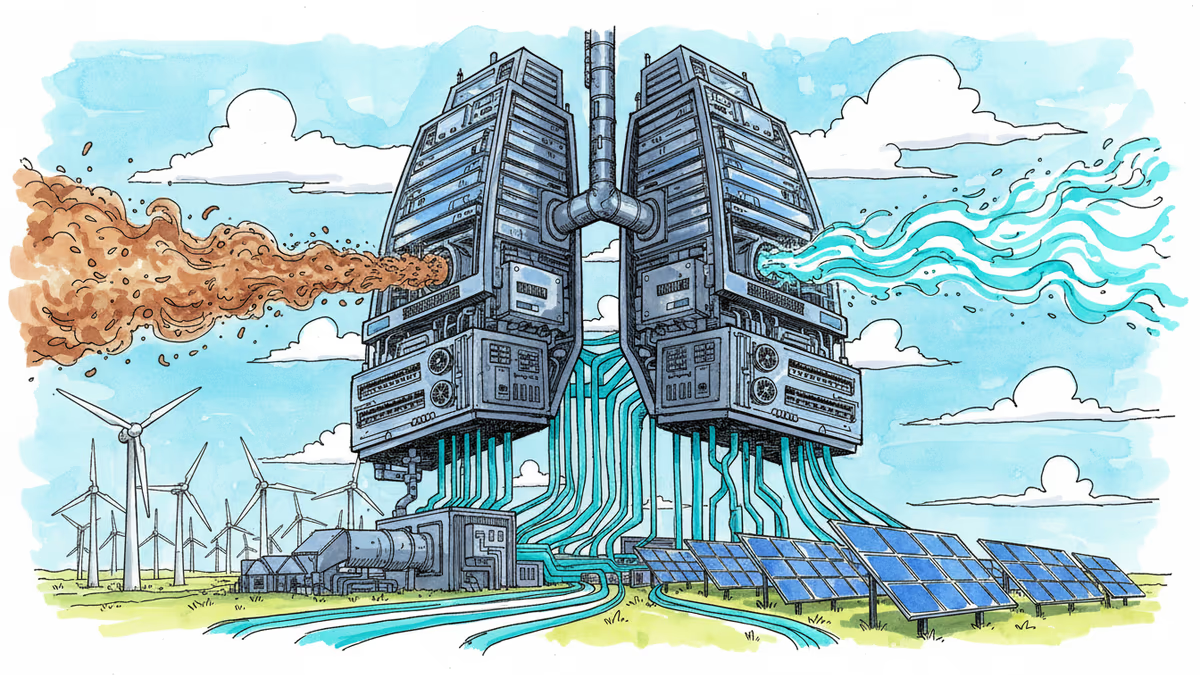
Form Energy's iron-air battery works like a slow-motion lung. Oxygen pumps into cells, rusts iron, and releases electrons. It's essentially controlled corrosion turned into a power source. The result? 300 megawatts of continuous electricity for 100 hours—far longer than any lithium-ion battery can manage.
This massive battery will smooth out the flow from 1.4 gigawatts of wind power and 200 megawatts of solar. When the wind stops blowing or the sun sets, the iron keeps breathing, and the data center keeps running.
The AI Power Crisis
Why would Google pay so much for what's essentially a giant rust machine? Because AI is eating electricity faster than anyone anticipated. A single ChatGPT query uses 10 times more power than a Google search. Multiply that by billions of queries across Gemini, Claude, and every other AI assistant, and you've got an energy crisis brewing.

Traditional lithium-ion batteries can't solve this. They're expensive, use scarce materials, and typically last only a few hours. Form Energy's approach is different: iron is abundant and cheap, and their batteries can discharge for days.
The Startup's Big Break
Form Energy has been developing this technology for years from their West Virginia factory, but they hadn't landed a major customer until now. CEO Mateo Jaramillo says the Google deal has unlocked a $500 million funding round, with plans to go public next year. The company has raised $1.4 billion to date.
It's a classic Silicon Valley story with a twist: instead of disrupting software, they're disrupting the physics of energy storage.
What This Means for Everyone Else
Google's billion-dollar bet sends a signal to the entire tech industry. As AI workloads explode, companies will need reliable, long-duration energy storage. Microsoft, Amazon, and Meta are all facing similar challenges with their data centers.
For the broader energy market, this could accelerate the shift toward renewable power. If you can store wind and solar energy for days instead of hours, you need fewer backup fossil fuel plants. That's a game-changer for climate goals.
But there's a competitive angle too. By securing Form Energy's entire initial production capacity, Google may have just locked competitors out of the most promising long-duration battery technology.
Authors
Related Articles
Snowflake's new $6 billion AWS contract is about more than cloud spending. It signals a shift in AI infrastructure—away from Nvidia GPUs and toward cheaper, homegrown chips for the agent era.
In a post-Google I/O interview, Sundar Pichai acknowledged flawed search results, real AI anxiety, and an AGI timeline that makes the label irrelevant. Here's what he said — and what it means.
Google is building AI agents that search the web proactively, without user prompting. That's not just a product update — it's a fundamental shift in who controls the information you receive.
Google unveiled the 'Googlebook' platform to replace Chromebook and ChromeOS—but revealed zero hardware specs. What's the strategy, and what does it mean for users, manufacturers, and the education market?
Snowflake's new $6 billion AWS contract is about more than cloud spending. It signals a shift in AI infrastructure—away from Nvidia GPUs and toward cheaper, homegrown chips for the agent era.
In a post-Google I/O interview, Sundar Pichai acknowledged flawed search results, real AI anxiety, and an AGI timeline that makes the label irrelevant. Here's what he said — and what it means.
Google is building AI agents that search the web proactively, without user prompting. That's not just a product update — it's a fundamental shift in who controls the information you receive.
Google unveiled the 'Googlebook' platform to replace Chromebook and ChromeOS—but revealed zero hardware specs. What's the strategy, and what does it mean for users, manufacturers, and the education market?
Thoughts
Share your thoughts on this article
Sign in to join the conversation