

Google's Chrome Now Shops For You - The Rise of AI Agents
Google launches Auto Browse in Chrome, letting AI handle online tasks from booking flights to shopping. But as browsers get smarter, what happens to human agency?
What if your browser could book your flights, reorder your favorite jacket, and hunt down discount codes—all while you grab coffee?
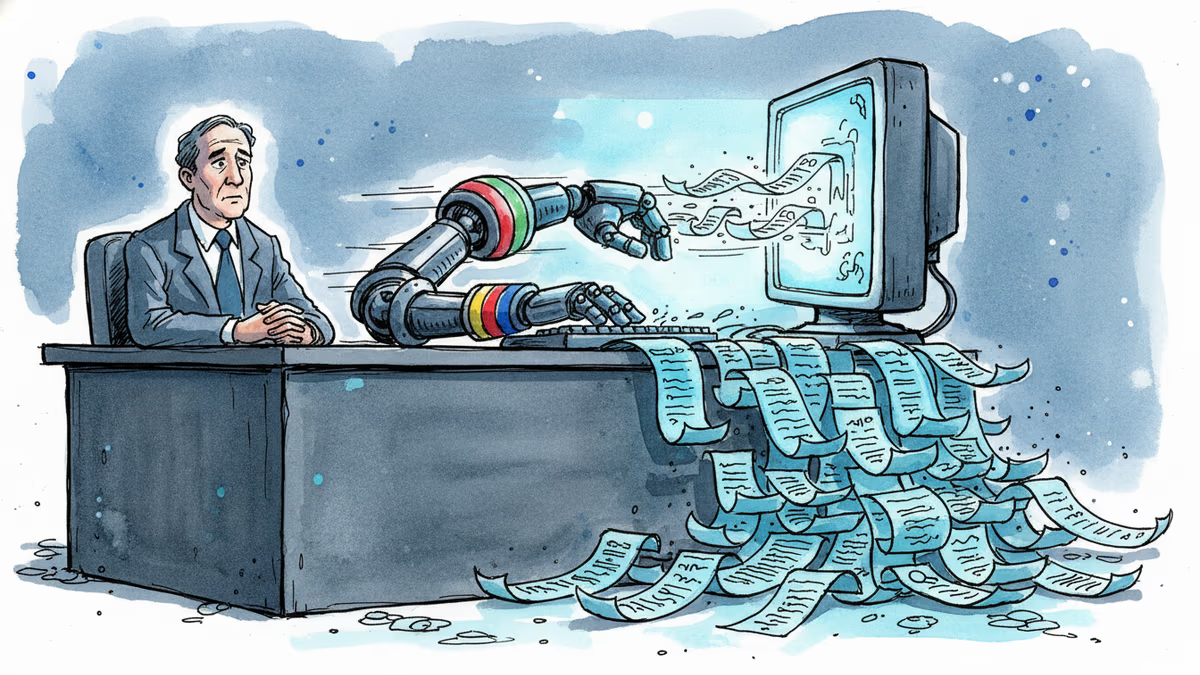
Google made this scenario reality Wednesday with the launch of Auto Browse for Chrome. Powered by the company's Gemini 3 AI model, this digital assistant takes control of your browser to handle online tasks that typically require multiple clicks, searches, and form fills.
The feature represents Google's latest push to embed AI deeper into everyday web browsing. Last year brought Gemini in Chrome for answering questions about web pages. Now, the AI doesn't just read—it acts.
Your Digital Shopping Assistant
Auto Browse lives in Chrome's Gemini sidebar and currently serves only US subscribers of Google's $20/monthAI Pro and $30/monthAI Ultra plans. Free users and international markets remain in limbo, with no timeline for broader access.
In Google's demo, product director Charmaine D'Silva showed the AI reordering a jacket from last year's purchase. "Instead of having to remember where I bought something and try to reorder," she explained, "I can now delegate to Auto Browse."
The process feels like watching a ghost operate your computer. Semi-transparent clicks appear as the AI navigates websites, fills forms, and hunts for coupon codes. Users can observe in real-time but aren't required to micromanage every step.
Yet Google draws clear boundaries. Sensitive actions like social media posts or credit card transactions still require human approval. A persistent disclaimer reminds users: "You are responsible for Gemini's actions during tasks."
The Security Elephant in the Room

That disclaimer isn't just legal boilerplate—it's a warning about real risks. Auto Browse and similar AI tools remain vulnerable to prompt injection attacks, where malicious websites trick the AI into unintended actions.
Imagine asking the AI to "find the best deal on headphones" only to have a compromised site redirect it to input your personal information elsewhere. The automation that makes these tools convenient also makes them potentially dangerous.
Google's gradual rollout suggests awareness of these risks. By limiting initial access to paying customers, the company can monitor performance and security issues before wider deployment.
The Bigger Browser Wars
Google's move aligns with Silicon Valley's vision for AI-first web browsing. OpenAI's Atlas browser is being built around generative AI from the ground up, while existing browsers retrofit AI capabilities into familiar interfaces.
This trend leaves users with an interesting choice: embrace AI-powered efficiency or seek alternatives. The Vivaldi browser notably markets itself to users who want to avoid AI-powered web browsing entirely.
The implications extend beyond individual preference. As AI agents become more capable, they could fundamentally alter how websites design user experiences. Why optimize for human visitors if most interactions happen through AI intermediaries?
What We Might Lose
Efficiency gains come with trade-offs. The serendipitous discovery of new products while browsing, the satisfaction of finding a great deal through personal research, the gradual learning that comes from navigating different websites—all could diminish as AI handles more tasks.
There's also the question of market concentration. If most users rely on Google's AI to make purchasing decisions, does that give Google unprecedented influence over commerce? The company already faces antitrust scrutiny for its search dominance.
Authors
Related Articles

In a post-Google I/O interview, Sundar Pichai acknowledged flawed search results, real AI anxiety, and an AGI timeline that makes the label irrelevant. Here's what he said — and what it means.
Google is building AI agents that search the web proactively, without user prompting. That's not just a product update — it's a fundamental shift in who controls the information you receive.

Google unveiled the 'Googlebook' platform to replace Chromebook and ChromeOS—but revealed zero hardware specs. What's the strategy, and what does it mean for users, manufacturers, and the education market?

After 15 years of fragmented mobile messaging, Apple and Google are rolling out end-to-end encrypted RCS messaging between iPhones and Android devices. Here's what changed, why it took so long, and what it means for your privacy.
In a post-Google I/O interview, Sundar Pichai acknowledged flawed search results, real AI anxiety, and an AGI timeline that makes the label irrelevant. Here's what he said — and what it means.
Google is building AI agents that search the web proactively, without user prompting. That's not just a product update — it's a fundamental shift in who controls the information you receive.
Google unveiled the 'Googlebook' platform to replace Chromebook and ChromeOS—but revealed zero hardware specs. What's the strategy, and what does it mean for users, manufacturers, and the education market?
After 15 years of fragmented mobile messaging, Apple and Google are rolling out end-to-end encrypted RCS messaging between iPhones and Android devices. Here's what changed, why it took so long, and what it means for your privacy.
Thoughts
Share your thoughts on this article
Sign in to join the conversation