
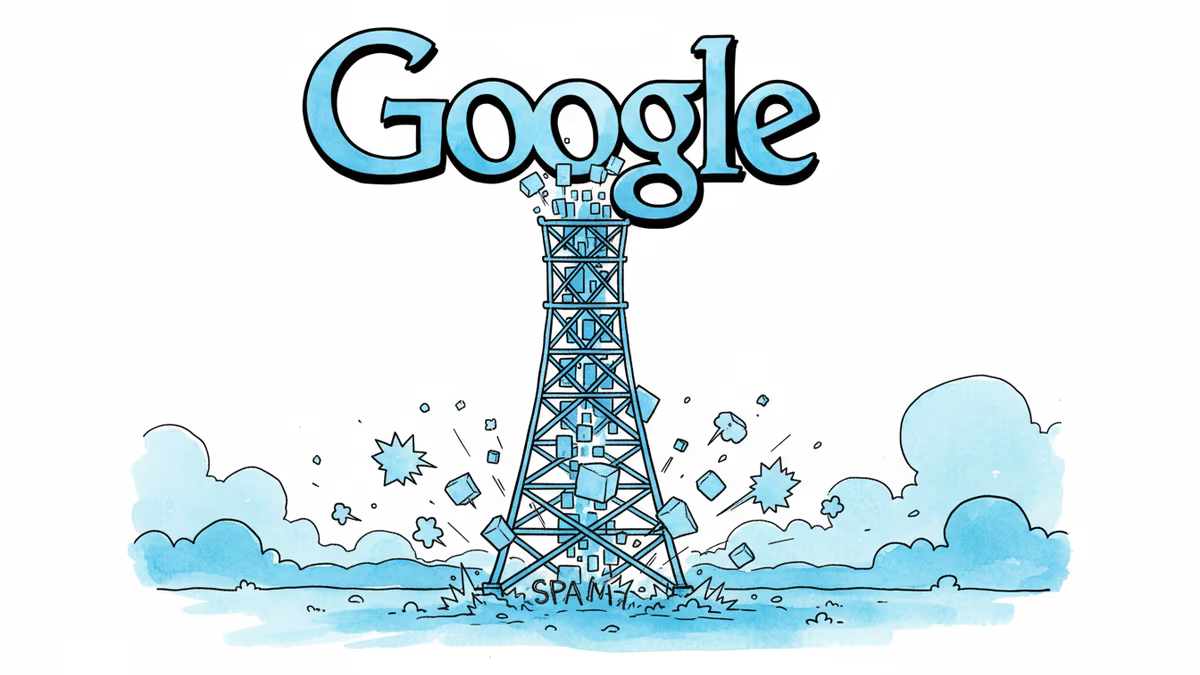
Why Google Just Handed Over Control to Indian Telecoms
Google's RCS spam problems in India forced a strategic retreat. Now the tech giant is partnering with Airtel to integrate carrier-level filtering - a move that could reshape messaging ecosystems globally.
463 Million Users Just Changed the Game
When India's second-largest telecom operator announced its partnership with Google on Sunday, it wasn't just another tech collaboration. Bharti Airtel, serving 463 million subscribers, agreed to integrate its network-level spam filtering directly into Google's Rich Communication Services (RCS) ecosystem. The catch? They'd been holding out until now.
"We had not onboarded Google because we first wanted RCS messages to be routed through the Airtel spam filter," an Airtel spokesperson revealed. That admission exposes just how cautious carriers have been about Google's messaging ambitions.
The 2022 Reality Check That Humbled Google
India taught Google a harsh lesson about messaging at scale. In 2022, spam complaints became so overwhelming that Google had to temporarily pause business promotions on RCS in the country. The culprit? Unwanted ads flooding users through the Google Messages app.
The numbers tell the story of India's messaging challenge: over 1 billion internet users, 700 million smartphone owners, and aggressive enterprise marketing practices. Add rapid digital payment adoption to the mix, and you've got a perfect storm for spam and fraud. Even WhatsApp, with its 853 million Indian users, struggles with similar issues.
When Carriers Fight Back
Airtel's AI-powered systems have blocked 71 billion spam calls and 2.9 billion spam messages over the past year, driving a 69% drop in fraud-related financial losses on its network. Those aren't just statistics—they're battle scars from the war against digital spam.

The partnership creates real-time verification systems combining Airtel's network intelligence with Google's RCS platform. Sender verification, spam detection, and do-not-disturb enforcement all happen at the carrier level now. Airtel calls it a "global first," though the companies didn't provide comparative details.
The Platform Power Struggle
Google's Android ecosystem president Sameer Samat hinted at broader ambitions: "We are committed to continuing to work with the broader ecosystem of carriers to create a consistent and trusted messaging experience for RCS users around the world." Translation: expect this model to spread beyond India.
But here's the strategic tension: Google wants RCS to replace SMS globally, claiming 1 billion daily messages in the US alone as of May 2025. Yet to achieve that scale, they're ceding control to local carriers with different standards, policies, and priorities.
The WhatsApp Problem
India's messaging landscape reveals the challenge Google faces. With 853 million WhatsApp users dominating the market, RCS needs more than just technical superiority—it needs trust. That's where carrier integration becomes crucial.
"The efficacy of this partnership should be reflected in metrics such as reductions in spam volume, user complaints, and fraud incidence, as well as improvements in engagement with legitimate messages," notes Prabhu Ram, vice president at CyberMedia Research.
Beyond India's Borders
The implications extend far beyond one market. If carriers in other regions demand similar control over spam filtering, Google's vision of a unified RCS ecosystem could fragment into carrier-specific implementations. European regulators, already skeptical of Big Tech platforms, might see India's model as a template for digital sovereignty.
For consumers, the trade-off is clear: better spam protection in exchange for carrier oversight of their messaging experience. The question is whether users will notice the difference—or care about who's filtering their messages as long as it works.
Authors
Related Articles
In a post-Google I/O interview, Sundar Pichai acknowledged flawed search results, real AI anxiety, and an AGI timeline that makes the label irrelevant. Here's what he said — and what it means.
SolarSquare is raising $55-60M at a $450-500M valuation, more than doubling its worth in 18 months. Here's what's driving investor conviction in India's residential solar market.
Google is building AI agents that search the web proactively, without user prompting. That's not just a product update — it's a fundamental shift in who controls the information you receive.
Indian venture capital has quietly displaced Silicon Valley in its own backyard. Only one American VC made India's top 10 investor list last year. Here's why that matters beyond India.
In a post-Google I/O interview, Sundar Pichai acknowledged flawed search results, real AI anxiety, and an AGI timeline that makes the label irrelevant. Here's what he said — and what it means.
SolarSquare is raising $55-60M at a $450-500M valuation, more than doubling its worth in 18 months. Here's what's driving investor conviction in India's residential solar market.
Google is building AI agents that search the web proactively, without user prompting. That's not just a product update — it's a fundamental shift in who controls the information you receive.
Indian venture capital has quietly displaced Silicon Valley in its own backyard. Only one American VC made India's top 10 investor list last year. Here's why that matters beyond India.
Thoughts
Share your thoughts on this article
Sign in to join the conversation