
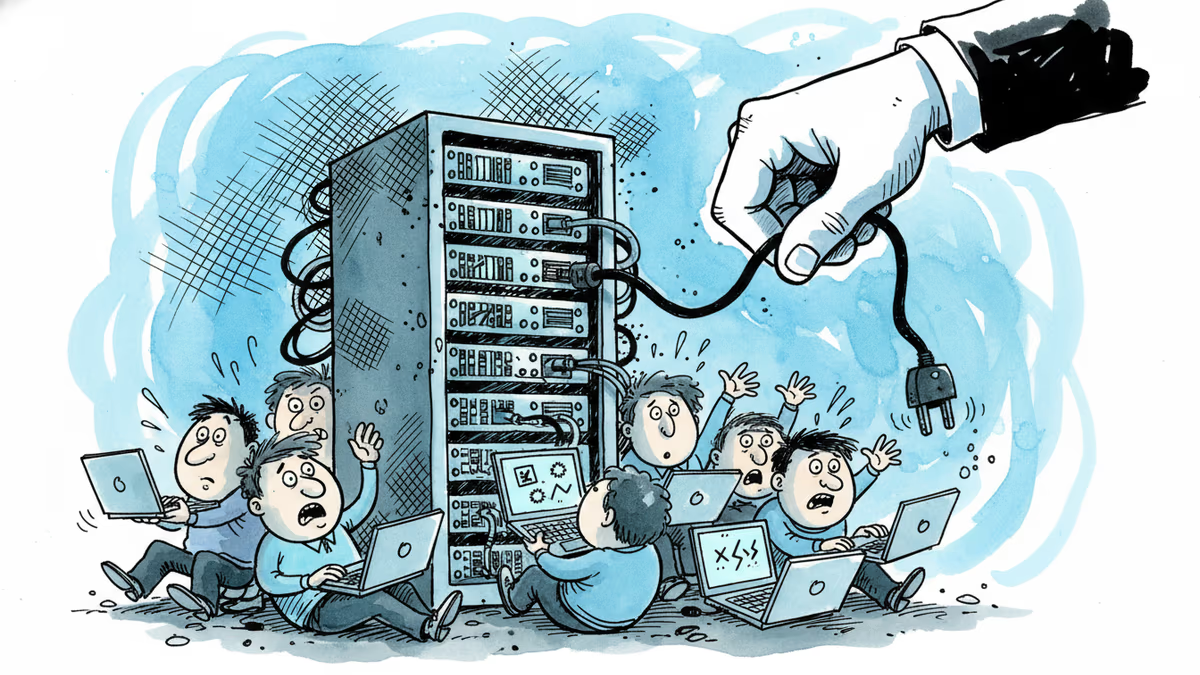
When Governments Block Developer Tools, Who Really Loses?
India's sudden blocking of Supabase reveals the growing tension between digital sovereignty and developer freedom. What this means for the future of tech innovation.
365,000 Monthly Users Just Lost Their Development Platform
India quietly blocked Supabase, a popular developer database platform, on February 24th under Section 69A of the Information Technology Act. No public reason was given. The San Francisco-based company, valued at $5 billion, suddenly found itself cut off from its fourth-largest market.
This isn't just about website access. Supabase powers live applications and services. One Indian startup founder, speaking anonymously, told TechCrunch they "stopped seeing new user sign-ups from India over the past two to three days." When your infrastructure disappears overnight, so does your business.
The blocking appears inconsistent—users in New Delhi can't access the service across JioFiber, Airtel, and ACT Fibernet networks, while some in Bengaluru still can. It's as if the government is testing the waters.
The Ripple Effect on Innovation
India represents 9% of Supabase's global traffic, with visits jumping 179% year-over-year to about 365,000 in January alone. That's a rapidly growing developer ecosystem suddenly cut off from a key tool.
Supabase suggested workarounds like DNS changes or VPNs, but as one technology consultant working with local startups noted, these aren't practical for end users. More importantly, they create reliability and security concerns for production systems.
The precedent is troubling. India previously blocked GitHub in 2014 during a security probe, and users reported issues accessing GitHub domains in 2023. Developer tools—the backbone of digital innovation—are increasingly becoming targets of government intervention.
Digital Sovereignty vs. Open Innovation

This incident highlights a growing global trend. Countries are asserting more control over their digital infrastructure, from China's Great Firewall to Russia's sovereign internet laws. India, with its 1.4 billion population and booming tech sector, is walking a similar path.
"You don't know where you can safely run projects without the danger that something might happen where it gets blocked," said Raman Jit Singh Chima, Asia Pacific policy director at Access Now. This uncertainty is perhaps more damaging than the blocking itself.
For developers, the calculation is changing. Technology stack decisions now must factor in "government policy risk" alongside performance and cost considerations. That's a fundamental shift in how innovation happens.
The Startup Dilemma
Supabase, founded in 2020 as an open-source alternative to Firebase, raised $380 million across three funding rounds since September 2024. It's exactly the kind of innovative platform that has democratized app development, allowing small teams to build sophisticated applications quickly.
But when governments can unilaterally cut access to such platforms, it creates a chilling effect. Startups must now consider: Will this service be available tomorrow? Should we build on platforms that governments might block?
The irony is stark. India has positioned itself as a global tech hub, yet its own developers are being cut off from the tools driving global innovation. The country's "Digital India" initiative aims to transform the nation into a digitally empowered society, but selective blocking of developer platforms seems to work against that goal.
The Broader Pattern
This isn't an isolated incident. Governments worldwide are grappling with how much control to exert over digital infrastructure. The challenge is that modern software development is inherently global—developers rely on services, libraries, and platforms from around the world.
When any link in this chain gets severed for political or security reasons, innovation suffers. The question isn't whether governments have the right to regulate digital services—they clearly do. It's about how they exercise that power and what the long-term consequences are for their own tech ecosystems.
Authors
Related Articles
SolarSquare is raising $55-60M at a $450-500M valuation, more than doubling its worth in 18 months. Here's what's driving investor conviction in India's residential solar market.
Indian venture capital has quietly displaced Silicon Valley in its own backyard. Only one American VC made India's top 10 investor list last year. Here's why that matters beyond India.
India's biggest digital payments platform PhonePe has shelved its IPO amid geopolitical tensions and a 9% market drop—but a quietly revised valuation tells a more complicated story.
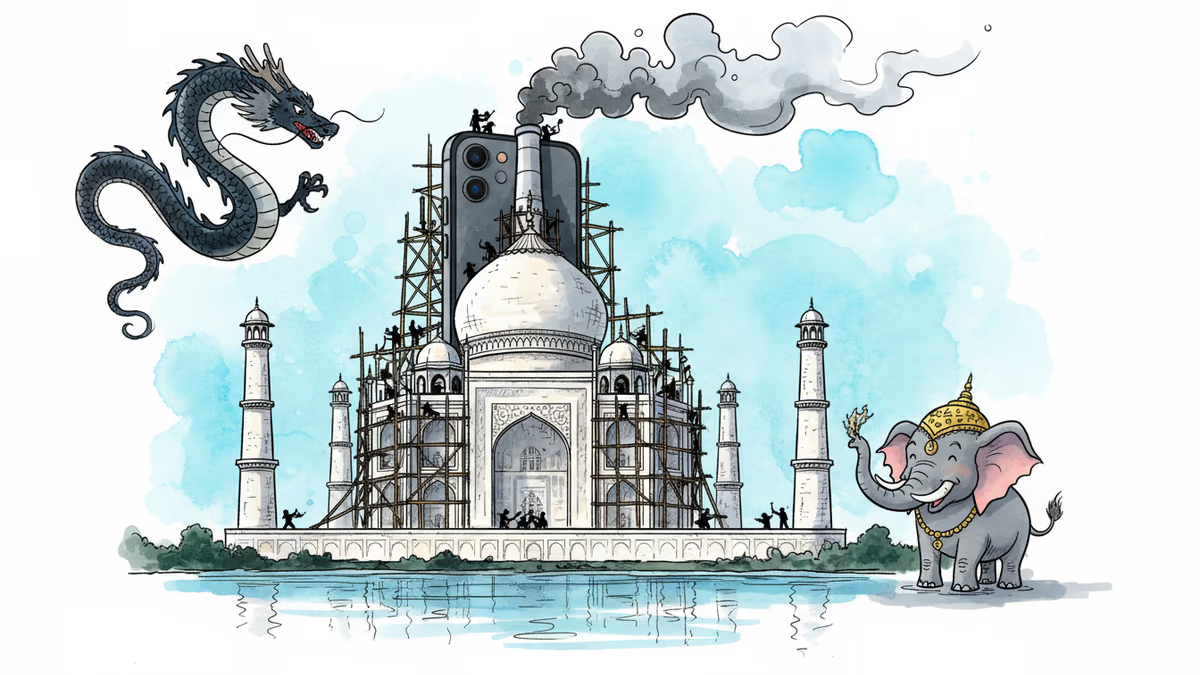
Apple has hit 25% iPhone production in India, a milestone years in the making. What it means for supply chains, consumers, and the geopolitics of where things get made.
SolarSquare is raising $55-60M at a $450-500M valuation, more than doubling its worth in 18 months. Here's what's driving investor conviction in India's residential solar market.
Indian venture capital has quietly displaced Silicon Valley in its own backyard. Only one American VC made India's top 10 investor list last year. Here's why that matters beyond India.
India's biggest digital payments platform PhonePe has shelved its IPO amid geopolitical tensions and a 9% market drop—but a quietly revised valuation tells a more complicated story.
Apple has hit 25% iPhone production in India, a milestone years in the making. What it means for supply chains, consumers, and the geopolitics of where things get made.
Thoughts
Share your thoughts on this article
Sign in to join the conversation